Summarize this article with AI
Yoga for runners is an add-on. It works best alongside the training you already do. Two or three short sessions a week can loosen tight hips as well as hamstrings and calves. They can also train your balance and help you unwind. It won't replace strength training, though. No trial has shown that it prevents running injuries or makes you meaningfully faster on its own.
This guide explains what the research supports and where it falls short. There's a 5-minute pre-run flow. You'll also get a 15-minute routine for after runs and rest days. The guide also explains why moving poses fit the minutes before running while longer holds fit afterward. The sources go beyond yoga trials. They include stretching trials and research reviews along with current US exercise guidelines.
Yoga for runners: what it can and can't do
Yoga gives you a regular, structured way to work on range of motion, balance and relaxation. Few studies have looked at yoga in runners. There are only a handful of trials. They're small and mostly look at what happens over the short term. Most support comes from studies of active people in general. Stretching research adds guidance on when yoga fits around a run.
Here's how the common claims hold up.
| Claim | What the research shows | What it means for you |
|---|---|---|
| Yoga makes you more flexible | Supported. In a 16-week trial of 40 college students, twice-weekly yoga improved sit-and-reach by 3.5 cm (about 1.4 inches) while the control group didn't change. A review of 77 stretching studies found a moderate gain in range of motion. | Expect to move more freely after several weeks of regular practice. |
| Yoga improves balance | Supported, with low-certainty evidence. Single-leg balance improved in college athletes and in the 16-week student trial. Reviews note uneven study quality. | Standing poses are an easy way to train balance. |
| Yoga lowers stress | Supported in healthy adults, according to the NIH's yoga summary. | A good fit for rest days and busy weeks. |
| Yoga prevents running injuries | Not shown. We found no trial that tested it. Stretching programs haven't lowered injury rates in a meta-analysis of 25 trials, including a trial in recreational runners. | Keep your strength work. Yoga doesn't replace it. |
| Yoga makes you faster | Not meaningfully. In the largest yoga trial in runners (90 high schoolers), one 20-minute routine before a timed mile changed times by about a second. Stretching doesn't change running economy (how much energy you use at a given pace), according to a 2025 meta-analysis. | Do yoga for how it helps you move and recover, not for a race-time boost. |
| Yoga prevents next-day soreness | Barely. Stretching lowered soreness by about 1 point on a 100-point scale in a Cochrane review. | Stretch because it feels good, not to avoid soreness. |
Flexibility: real, but more isn't always better
Part of the gain from regular stretching comes from your nervous system tolerating the stretch better, not from longer muscles. In stretching programs of 3 to 8 weeks, muscle and tendon stiffness barely changed, and the authors concluded the adaptation was mostly sensory. That still matters: a position that used to feel like a strain starts to feel normal.
Runners also don't need yoga-teacher flexibility. Among sub-elite and international-level male runners, the least flexible used the least oxygen at a given pace. A 2025 study of 71 recreational runners found no overall link. These are correlations, not proof that stiffness helps. Aim for comfortable, pain-free mobility in your hips, hamstrings and calves, not extreme splits.
Strength: yoga is not a lifting session
Most yoga is light exercise. The 2024 Adult Compendium of Physical Activities rates Hatha yoga at 2.3 METs and vinyasa at 2.7, with power yoga estimated at 4.0. (One MET is the energy you use sitting quietly, so 2.3 METs is 2.3 times that.) US guidelines say yoga "may also be considered both aerobic and muscle strengthening, depending on the type and the postures practiced" (Physical Activity Guidelines for Americans). A gentle post-run routine won't load your legs the way squats or step-ups do, though.
That matters because strength training has better injury evidence than stretching. In the 25-trial meta-analysis above, stretching made no difference, but strength training cut sports-injury risk to about a third (risk ratio 0.315). That isn't a guarantee for runners: those trials covered many sports, and a short self-directed routine for first-time marathoners didn't reduce injuries. Still, two strength sessions a week plus yoga is a better plan than yoga alone. Our guide to runner's butt covers glute strength work that fits around running.
Breathing and focus
Yoga breathing practice hasn't been shown to make running more economical. In a 3-week trial of 21 runners, 30 minutes of pranayama (yogic breathing exercises) six days a week left running economy unchanged. A later report from the same research team found the breathing group chose faster paces at the same perceived effort afterward. That's a change in how hard running felt, not proof of better fitness. For breathing during your runs, see how to breathe while running.
Is yoga better before or after a run?
Either time can work. Choose a yoga style that fits when you're doing it. Before running, move through the poses. Save the longer holds for after you run or for a rest day.
Before a run: keep it moving
Long static holds right before a hard effort can blunt your performance. A review of stretching studies found performance dropped about 1.1% on average when static stretches lasted under 60 seconds per muscle group, and about 4.6% at 60 seconds or more. When people did dynamic activity after stretching, no clear effect remained. Most of those tests measured strength and power, not distance running.
For running itself, a 2025 meta-analysis of 15 studies found stretching didn't change running economy, and the authors called it "unreasonable to avoid pre-running stretching" for that reason. Volume still matters. In a small trial of 10 trained runners, 16 minutes of static stretching before a 30-minute run cut the distance covered from 6.0 to 5.8 km (about 3.7 to 3.6 miles).
So before a run, use a short flow that keeps you moving, with no hold longer than a few breaths, then start with easy running. Warm-ups that included activity beyond stretching improved performance in 79% of the measures examined in one review.
After a run or on a rest day: hold longer
After a run you're warmed up and not about to race, so this is the time for longer holds. ACSM guidance for most adults is to stretch to the point of mild tightness and hold for 10 to 30 seconds. The ACSM's general target is about 60 seconds per stretch in total, so repeat each one two to four times. The routine below uses two 30-second holds per side for the main stretches.
Don't count on it to prevent soreness. The Cochrane review above found almost no effect. One large trial of 2,377 active adults who stretched before and after activity for 12 weeks did report bothersome soreness less often (24.6% vs 32.3%), but overall injury risk didn't change.
The recovery evidence for yoga itself is small. A 2025 crossover study included 20 male university athletes. Breathing rate fell more with 15 minutes of yoga after interval training than with 15 minutes of static stretching. The study didn't measure soreness or what happened in the next workout.
Around hard workouts, long runs and races
Treat these as practical suggestions rather than rules that studies have tested.
- Before intervals, tempo runs or a race: stick to the short moving flow. Save deep holds for later.
- After a long run or hard workout: a gentle 10-minute routine is enough. Skip power or hot yoga that day. Both add their own load, and power yoga had a higher injury rate than other styles in a survey of 1,702 practitioners.
- The day before a race: choose gentle yoga you already know. Save new deep poses for later. Trying one isn't worth the risk of waking up sore.
How often should runners do yoga?
Start with short sessions. Two or three a week is a reasonable number while you're getting started. ACSM's recommendation is flexibility exercise at least two to three days a week. It says daily stretching works best. Flexibility and balance improved in the yoga trials mentioned above. Most involved two sessions a week for 10 to 16 weeks.
Ten to 20 minutes per session is enough to begin. Research hasn't settled a minimum dose. One review suggested stretching at least 5 days a week, while the larger 2024 analysis of 77 studies found that range-of-motion gains didn't depend on total stretching time or weekly frequency. Practicing regularly for several weeks matters more than any single long class.
Add yoga to your strength work, not in place of it. US guidelines call for muscle-strengthening activity on 2 or more days a week, and flexibility work by itself doesn't count toward that goal (Physical Activity Guidelines for Americans).
An example week
The sample week is built around running four days. Make it fit your own schedule.
| Day | Running or training | Yoga |
|---|---|---|
| Monday | Rest | 15-minute routine below |
| Tuesday | Easy run | 5-minute flow before |
| Wednesday | Strength session | None, or 5 minutes of holds after lifting |
| Thursday | Intervals or tempo run | 5-minute flow before, nothing deep after |
| Friday | Strength session | Optional gentle class |
| Saturday | Long run | 10 minutes of gentle holds afterward |
| Sunday | Easy run | 15-minute routine after |
The longer sessions fall on Monday, Saturday and Sunday. Those cover the suggested two or three sessions a week. Use the 5-minute flows as warm-ups too.
A 5-minute yoga flow before you run
Let your breathing guide each movement. Move from pose to pose without spending too long in any position. You can use a mat, carpet or grass.
- Cat-cow, 6 breaths. On hands and knees, let your belly drop and lift your chest as you breathe in. As you breathe out, let your back round.
- Downward dog with heel pedal, 30 seconds. Start with both hands and knees on the ground. Tuck your toes and lift your hips to form an upside-down V. Bend one knee as the opposite heel presses toward the floor. Alternate about 8 times per side.
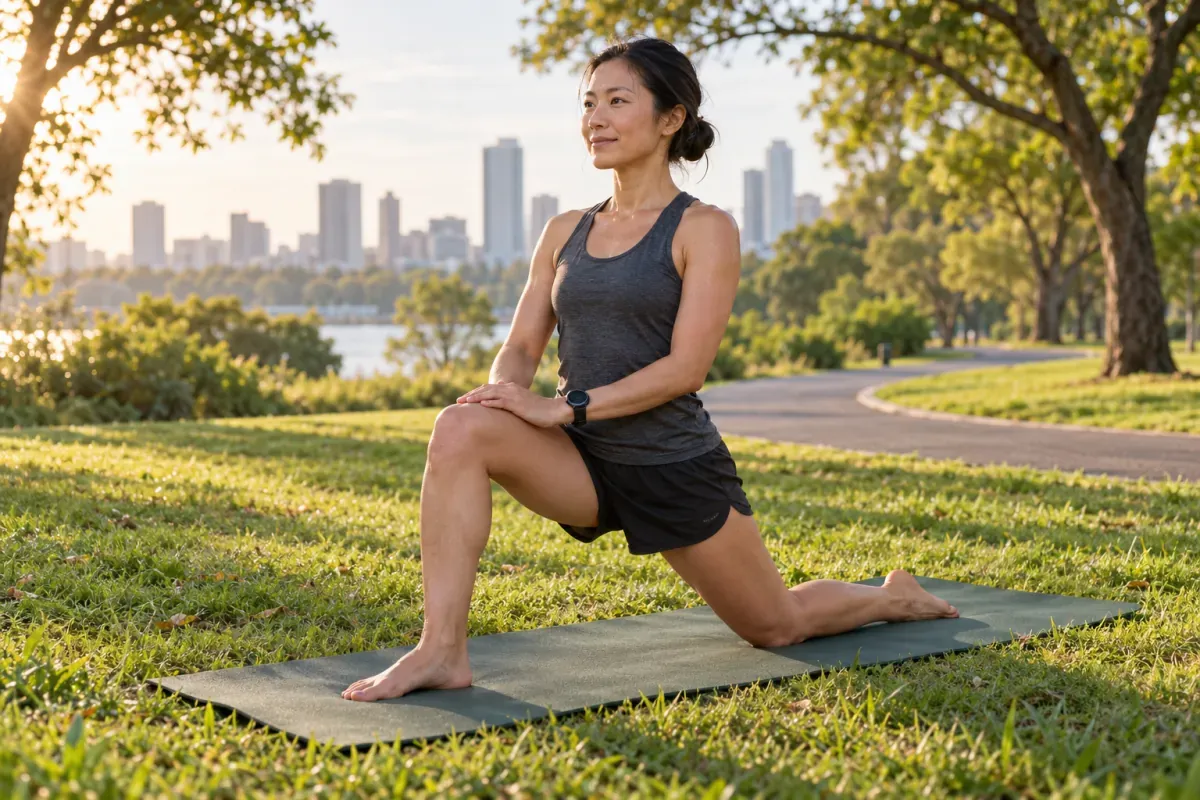
- Low lunge rock, 5 per side. Set your back knee on the ground to begin. Shift forward in the lunge. Move your hips until the front of your back hip feels a stretch. Straighten your front leg as your hips move back over the back knee. Take one breath each way.
- Lunge twist, 3 breaths per side. Start in a low lunge. Place the hand opposite your front leg down on the floor. Reach toward the ceiling with your other arm.
- Chair pose to calf raise, 8 reps. Raise your arms overhead. Keep them there while you sit back into a half squat. Then stand up and rise onto your toes.
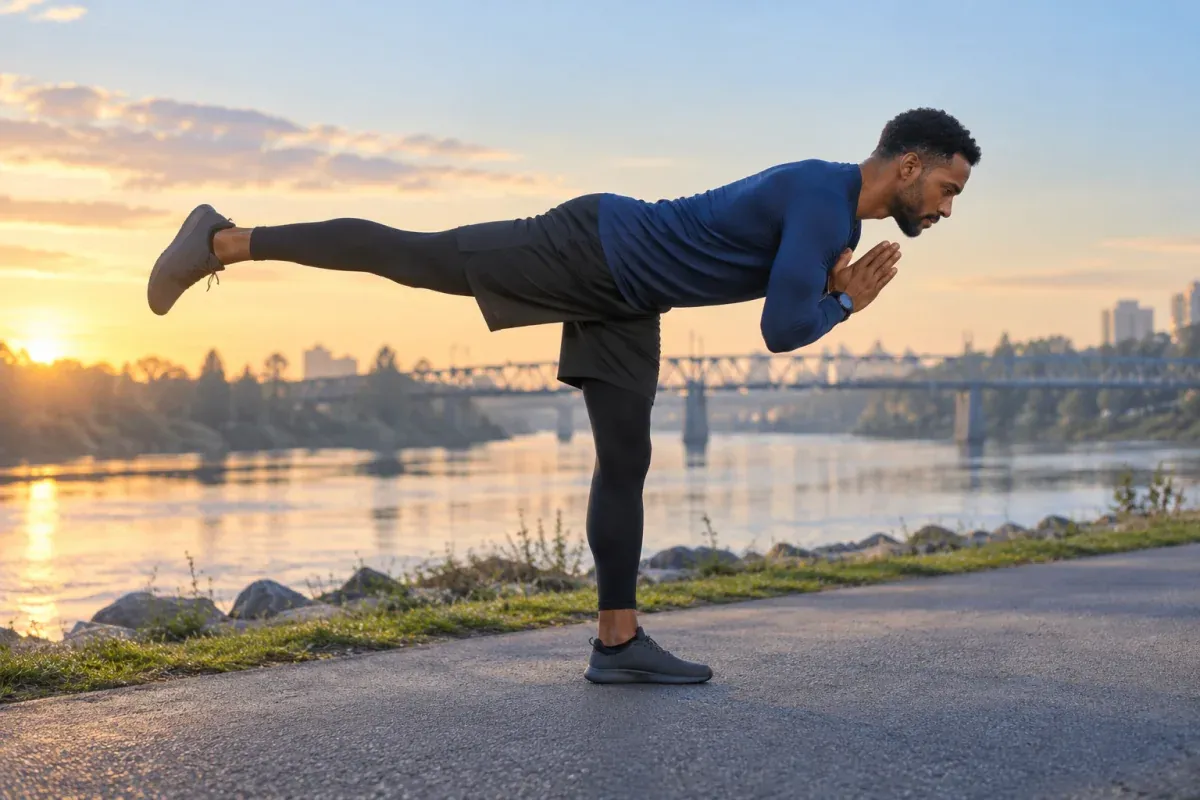
- Warrior 3, 3 breaths per side. Hinge forward on one leg and reach the other leg back, hands at your chest or on your hips. A wall can help with wobbles. Rest your fingertips against it to steady yourself while you hold the pose.
Then walk or jog easily for the first 5 to 10 minutes of your run.
A 15-minute yoga routine after your run
This routine fits after an easy run. You can also do it when you're taking a rest day. After a long run or hard workout, choose just a few of the stretches and keep it to a gentle 10 minutes. Breathe slowly and hold each stretch at mild tightness, never pain. The total for each main stretch is about 60 seconds per side.
1. Downward dog for calves and hamstrings
Take 5 to 8 slow breaths, which gives you about 45 seconds in the pose. You should feel the stretch along the backs of your calves and thighs. Bend your knees as needed to make the position feel comfortable. Your heels don't have to reach the floor. There's an easier version of this pose. For that version, put your hands on a chair seat or against a wall.
2. Low lunge for hip flexors
Step one foot forward. Let your back knee come down onto a folded towel. Tuck your tailbone just a little and ease your hips forward until you feel a stretch at the front of your back hip and thigh. That's where your hip flexors and quads are. Hold 30 seconds before switching sides. Then repeat once more on each side. Reach the arm on your back-leg side overhead to deepen the stretch.
3. Half splits for hamstrings
Start from your low lunge. Move your hips back until they're over your back knee. Point your toes upward as you straighten the leg in front. Give your hands support with blocks or a stack of books. Keep your back long as you bend from the hips. Repeat a 30-second hold twice on each side.
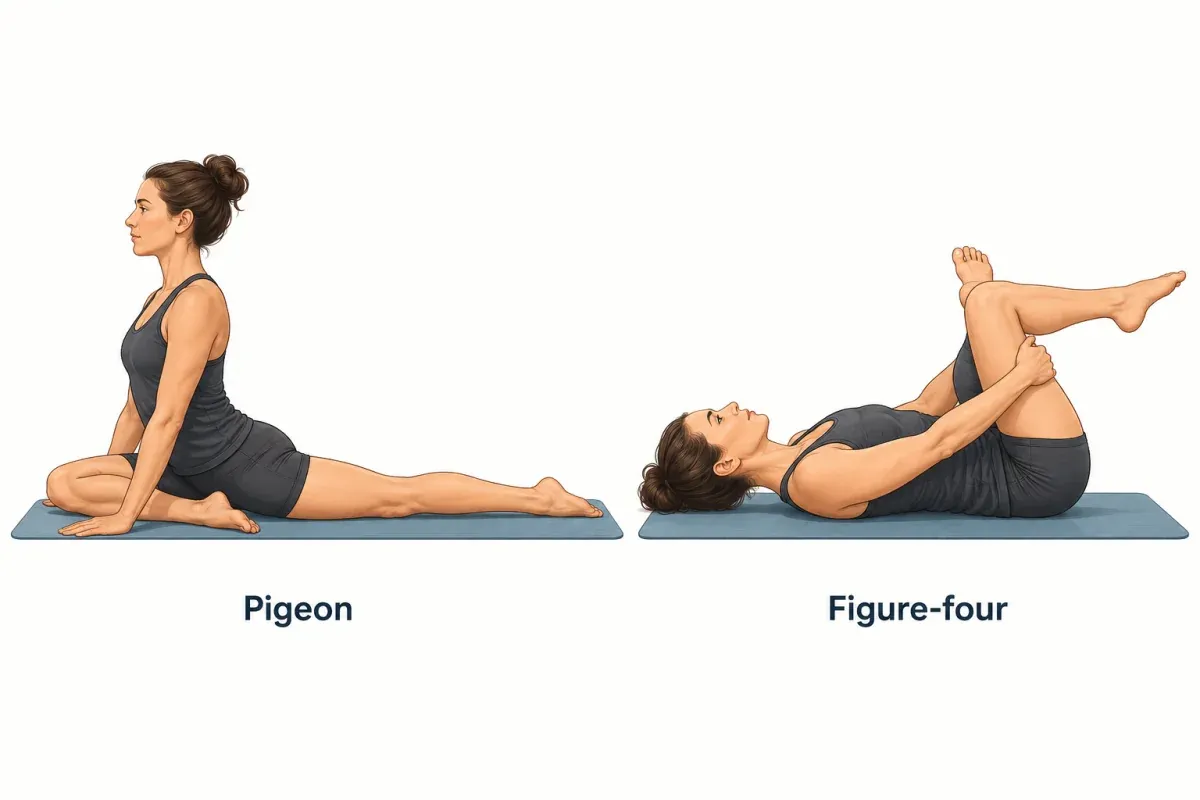
4. Pigeon or figure-four for glutes and outer hips
For pigeon, bring one shin forward under your chest at whatever angle your knee allows and slide the other leg back. Stay upright with your hands supporting your weight. You can fold forward instead and let your forearms take your weight. Lie on your back for figure-four instead if you feel it in your knee rather than your hip. Cross one ankle over the opposite knee, then draw that thigh toward you. Hold each side for 45 to 60 seconds.
5. Reclining strap stretch for hamstrings and inner thighs
Lie on your back first. Put a strap around one foot or use a belt or towel in its place. Raise that leg until you feel a stretch along the back of your thigh. Hold it in that position for 30 seconds. Then let the leg open out to the side for 30 seconds to stretch your inner thigh, the adductors covered in our adductor vs abductor guide. Switch legs.
6. Toe squat and kneeling stretch for your feet and shins
Kneel with your toes tucked under. From there sit back with your weight moving toward your heels. Stay there for 20 to 30 seconds. Let your hands take some weight if the stretch feels intense. Then untuck your toes, rest the tops of your feet on the floor and sit back again for another 20 to 30 seconds. Put a folded blanket under your knees. If kneeling hurts, skip this one.
7. Supine twist for the lower back and glutes
Lie on your back. Stretch your arms out wide as you bring one knee across your body. Spend 30 seconds on each side. Let gravity lower your knee rather than trying to force it toward the floor.
8. Legs up the wall to finish
Lie near a wall with your hips close enough to rest your legs up on it. You can lie flat instead. Breathe slowly while staying in the position for 1 to 3 minutes.
How to choose a yoga class or video
Look up the style before booking. Classes vary a lot. Know what you're signing up for when you're deciding which class to take.
- Hatha or slow flow: you'll move at a gentle pace. There's time to settle in. You can get comfortable in each pose as you move through the class. Either is a good starting point.
- Yin or restorative: long holds in supported positions. They suit rest days.
- Vinyasa or flow: you keep moving throughout. You move through the poses at a pace set by your breathing. The effort may be higher than you'd planned.
- Power yoga: count this class as a workout of its own. Include it among your hard days.
- Hot yoga: a heated room raises core temperature and heart rate, according to a 2025 review of 43 studies. The NIH warns of overheating and dehydration. Keep it away from key workouts and hot-weather long runs.
Props make most poses easier. Gather a strap (or belt). Add two blocks (or thick books) and a folded blanket to use for support. A class gives beginners a chance to get help. An in-person teacher can correct your positions during a class meant for newcomers. The survey included 1,702 practitioners. It linked practicing only on your own without supervision to a higher risk of adverse effects.
How to do yoga safely
Yoga is about as safe as other exercise. A meta-analysis of 94 trials found adverse events were no more common with yoga than with usual care or other exercise. A few habits keep it that way:
- Stretch to mild tightness, not pain. If sensations are sharp or pinching or burning or tingling, back off.
- Skip the extreme poses as a beginner. The NIH advises new practitioners to avoid headstands, shoulder stands, the lotus position and forceful breathing.
- Check with your doctor if a condition applies. The NIH notes that pre-existing knee or hip injuries, lumbar spine disease, severe high blood pressure, balance problems and glaucoma may need modified poses. People with glaucoma should avoid upside-down poses, which in these routines include downward dog and legs up the wall. In a small study of people with and without glaucoma, both poses raised eye pressure within a minute. During pregnancy, avoid hot yoga and long periods lying on your back.
- If you're very flexible, work in the middle of your range. Use strength to hold the pose rather than sinking into its end position.
Yoga isn't a substitute for getting an injury checked. See a doctor or physical therapist if pain lingers after a session, comes with swelling, numbness or weakness, or changes the way you run. Our guides on lower back pain when running and knee pain after running cover common running complaints.
Start this week
Try the 5-minute flow before heading out for your next easy run. Try the 15-minute routine when your next rest day comes around. Keep at it for a month. During that month aim to fit in two or three sessions each week. Then choose where to practice. Keep practicing at home or add a class to your schedule.
Frequently asked questions
What type of yoga is best for runners?
Hatha or slow flow is a good starting point. The pace of these classes is gentle. There's time to settle in. As the class moves along you can get comfortable in each pose before moving on. Rest days work well for yin and restorative yoga. The support during their long holds makes them a good fit then. Count both power yoga and hot yoga toward your hard sessions. Keep both away from the workouts that matter most in your schedule.
Is it better to do yoga before or after running?
Both times work if you choose a style that fits. Keep it moving before a run. Choose a short flow and spend only a brief time in any static holds. Longer holds had a bigger performance drop. That was the finding in stretching studies comparing 60 seconds or more per muscle group with shorter holds. Leave the longer holds for after a run or a rest day.
How many days a week should a runner do yoga?
Two or three sessions of 10 to 20 minutes is a sensible start. The ACSM recommends flexibility exercise at least two to three days a week and says daily stretching works best. Regular practice over several weeks matters more than any single long class.
Will yoga make me a faster runner?
Yoga probably won't do that alone. One 20-minute routine before a timed mile changed times by about a second in the largest yoga trial in runners. Stretching doesn't change running economy. Yoga can help with relaxation. It can also improve both your balance and your range of motion. Most performance gains come from running itself and from doing strength training.
Can yoga replace strength training for runners?
No. Yoga is light exercise in most forms. Squats and step-ups challenge your legs more than a gentle yoga routine does. Strength training has much better evidence than stretching for reducing sports injuries. Keep doing strength work. Practice yoga alongside your two strength sessions each week as an addition.
Is it OK to do yoga on rest days?
Yes. Rest days are one of the best times to fit in your yoga practice. Choose slow flow or yin or restorative yoga for a gentle session. You could also do a 15-minute routine at home. Leave power or hot yoga for later if tomorrow's plan includes a hard workout.
Can yoga help with tight hips and hamstrings?
Yes. Your range of motion improves when you stretch on a regular basis. Yoga trials measured flexibility gains after 10 to 16 weeks of twice-weekly practice. Most of the early improvement comes from being able to tolerate the stretch better. Choose poses aimed at your hips and hamstrings. Use low lunges and half splits along with pigeon or figure-four and a strap hamstring stretch.
I completed my first 10K on a dare. In a year, I ran a half-marathon. Another year later, I finished a marathon race. Today I run 4 marathons a year and a half-marathon every week. I learned everything about running the hard way. So, I help runners achieve better results easier.