
Summarize this article with AI
Knee pain after running is usually an overuse problem: your knee took on more running, hills or speed than it was ready for. It's also common. In one review of running injury studies, the knee accounted for 28% of lower-limb running injuries, more than any other area.
Where it hurts gives you the best first clue. With many gradual aches you can keep running in a reduced and pain-guided way while you fix the cause. Check the warning signs below first. If none apply, the location guide will help you narrow things down. Then work through the pain limits and training checks and strength routine.
Signs that mean you should get your knee checked first
Over several runs most knee pain after running builds up gradually. A few signs suggest a problem that a professional should look at. Get that done before you run again. Get same-day care or call your doctor if:
- You can't put weight on the leg or the pain is severe.
- The knee looks a different shape or swelled up quickly.
- It locks, catches, gives way or clicks painfully. Painless clicking is normal.
- You can't fully straighten or bend it.
- You have a fever. The knee is also red and hot and swollen.
- The pain started with a twist, a fall or a pop.
These signs draw on a family physicians' guide to evaluating knee pain and the NHS advice on when to get urgent help. The rest of this guide covers the gradual kind of pain: an ache that builds across runs and changes with how much you run.
What knee pain location says about the likely cause
Where the pain sits is one of the first things a clinician asks about. Use this table as a starting map, not a diagnosis: two problems can overlap, and some feel alike. The locations follow the same American Family Physician guide.
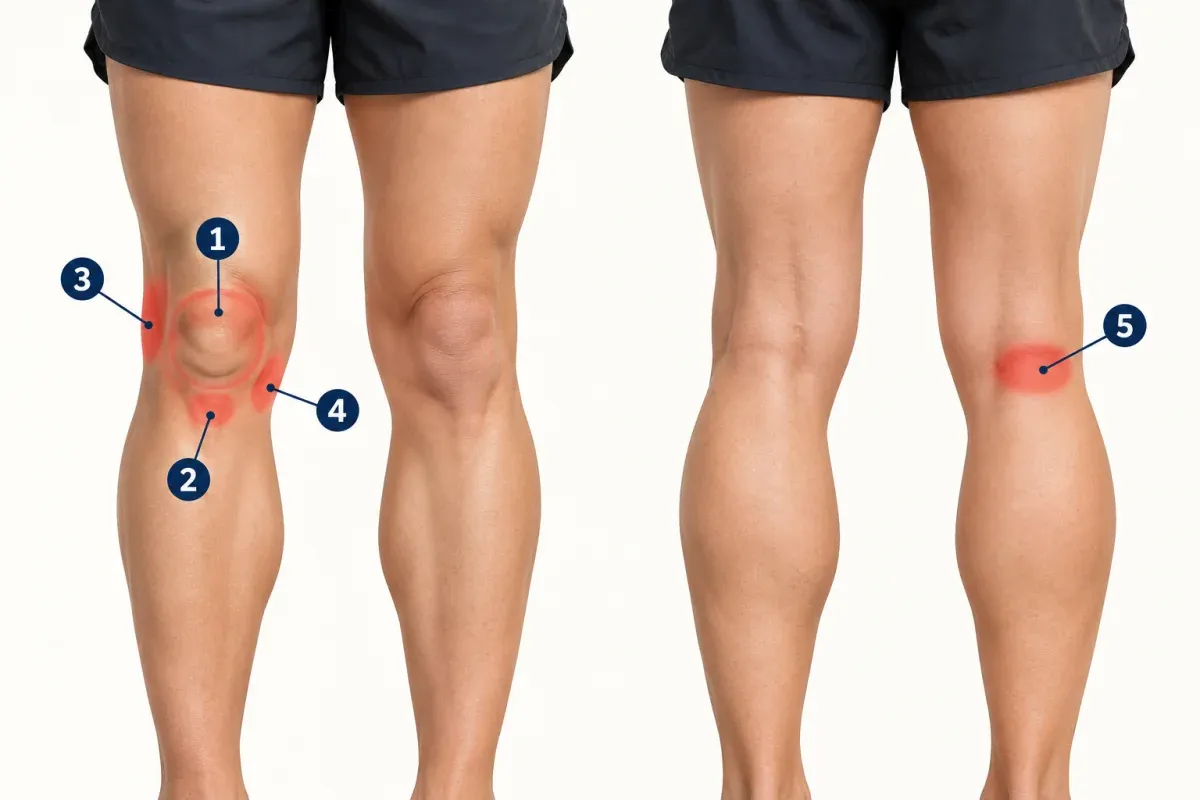
| Where it hurts | Often linked to | Typical pattern | First move |
|---|---|---|---|
| Around or behind the kneecap | Patellofemoral pain ("runner's knee") | Dull ache; worse on stairs, squats, downhills or after sitting with bent knees | Shorter, flatter runs; hip and knee strength work |
| Just below the kneecap | Patellar tendon pain | Sore at the bottom tip of the kneecap; worse with springy moves like jumping | Ease off hills and speed; build strength gradually |
| Outside, a little above the joint | Iliotibial (IT) band syndrome | Starts partway into a run, then earlier as it gets worse | Cut distance; hip strength work |
| Inside, just below the joint | Pes anserine bursitis; a meniscus tear if you twisted it | Tender spot on the inner shin; catching or swelling after a twist suggests the meniscus | See a clinician if it catches, locks or swells |
| Back of the knee | Baker's cyst; hamstring tendon | Pain behind the knee rather than in front | See a clinician if it lasts or swells |
| Whole knee, swollen or stiff | Arthritis flare, gout, infection or injury | Swelling, warmth or stiffness, sometimes with no clear trigger | See a clinician; go sooner with fever or redness |
Pain behind or around the kneecap (runner's knee)
Patellofemoral pain, also called patellofemoral pain syndrome, is the medical name for what most runners call runner's knee. It's a dull ache around or behind the kneecap (patella) that gets worse when you load a bent knee, as you do in squats, on stairs and hills, and in running itself. Many people also notice it when they stand up after sitting for a while (2016 international consensus).
It's common: the same review of running injury studies found it made up about 17% of the specific injuries recorded (Francis et al.). It can also linger. The US physical therapy guideline for patellofemoral pain notes that symptoms can come back and last for years, which is a good reason to act early instead of waiting for it to fade.
Patellar tendon pain just below the kneecap
The patellar tendon connects the bottom of your kneecap to your shin. When it's irritated, the pain sits right at the bottom tip of the kneecap. It gets worse the more you ask of your thigh muscles, especially with springy, explosive moves like jumping and bounding (Malliaras et al.).
Treatment centers on how much load the tendon can handle. You build that up gradually. Most people expect progress to come sooner than it often does. A few weeks may pass without a big change. That doesn't mean you're failing.
IT band syndrome outside of the knee
The iliotibial (IT) band is a thick strip of tissue that runs down the outside of your thigh. IT band syndrome causes pain on the outside of the knee, about 2 cm (3/4 inch) above the joint line. The classic pattern: it shows up late in a run at first, then earlier and earlier, and sometimes even at rest (American Family Physician).
You'll often read that the band "rubs" over the bone. Anatomy research suggests it can't really slide back and forth like that. The pain more likely comes from the band pressing on a sensitive layer of fat and tissue underneath it (Fairclough et al.). That changes what's worth doing about it, as you'll see below.
Inside or back of the knee
Pain on the inner side just below the joint often comes from pes anserine bursitis. That's an irritated, fluid-filled cushion on the inner shin. Clinicians look about 3 cm (just over an inch) below the joint line for a tender spot.
A meniscus tear is a different story. It's more likely if the pain followed a twist, the knee swelled within hours to a few days, or it catches or locks (American Family Physician). Pain behind the knee is less common and can come from a Baker's cyst or a hamstring tendon. These patterns fit simple overuse less well, so get them checked rather than managing them on your own.
With knee pain, can you keep running?
Some advice says to stop running until the pain is completely gone. One trial in runners with kneecap pain tested a middle path. In the study by Esculier and colleagues, 69 runners who'd had patellofemoral pain for at least three months got eight weeks of education on adjusting their running to their symptoms. One group also did a strength program, and another did gait retraining. All three groups improved by a similar amount, and the add-ons didn't improve symptoms any further over 20 weeks.
The runners kept training within these pain limits:
- During the run: the knee pain stays at 2 out of 10 or lower.
- After the run: within an hour pain settles back to where it started.
- Next morning: the knee feels no worse than before the run.
If a run breaks any of those, take an extra day off or make the next one shorter or slower or flatter. The trial runners made these changes to their training.
- Run more often while you keep each run shorter and slower.
- For now skip downhills and stairs.
- If they help, use run-walk intervals.
- Rebuild distance first and then add speed and then hills.
There are three caveats to remember. Each runner's plan was designed and adjusted by physical therapists. Some may have improved on their own because the trial had no untreated group. And the limits come from kneecap pain. There's less direct evidence for pain elsewhere around the knee, so treat them as a cautious guide there and get checked sooner if things aren't settling. Any warning sign from the top of this page overrides all of this.
If today's run hurt
Give the knee a day or two of easier activity. Skip your next long or hard run and stick to activities that don't aggravate it, such as walking if it feels comfortable. Wrapped ice for up to 20 minutes every 2 to 3 hours can take the edge off (NHS). If you want a pain reliever, ask a pharmacist which one suits you.
Find what changed in your training
Knee pain rarely comes out of nowhere. A review of knee injuries in endurance runners found that a previous injury and higher training load or volume were among the most consistent risk factors (Senthil et al.). So before you change shoes or overhaul your form, look back at your last few weeks of training.
Start by checking for a single run that jumped past your recent longest. A 2025 study followed 5,205 runners through their Garmin data for 18 months. Overuse injuries were more likely after a run that was more than 10% longer than the longest run in the previous 30 days. Week-to-week changes in total distance didn't show the same link. The study covered all overuse injuries, not just knee injuries, and it shows an association rather than proof of cause.
Say your longest run in the past month was 6 miles. Adding 10% brings it to 6.6 miles. Stay at 6.5 miles or less for your next long run and you'll be under that line.
Other changes worth checking:
- A new route with more hills or long descents
- Hill or stair repeats, or faster workouts you just added
- A race or several runs on back-to-back days
- Picking up where you left off when you return after time off
- More running days per week than usual
Strength exercises that help knee pain from running
Exercise is the mainstay of treatment for runner's knee, according to the American Family Physician review of running injuries. An international expert consensus recommends combining hip-focused and knee-focused exercises.
The routine could be simple. The exercises below give an example of what it could look like. This example isn't a prescription.
- Side-lying hip abduction: lie on your side. Position yourself so that your hips are stacked. From there, raise your top leg toward the ceiling. Our guide to hip adductors and abductors covers the form.
- Glute bridge: first lie on your back. Keep your knees bent and lift your hips while you're lying there.
- Wall sit or partial squat: only bend as far as feels comfortable.
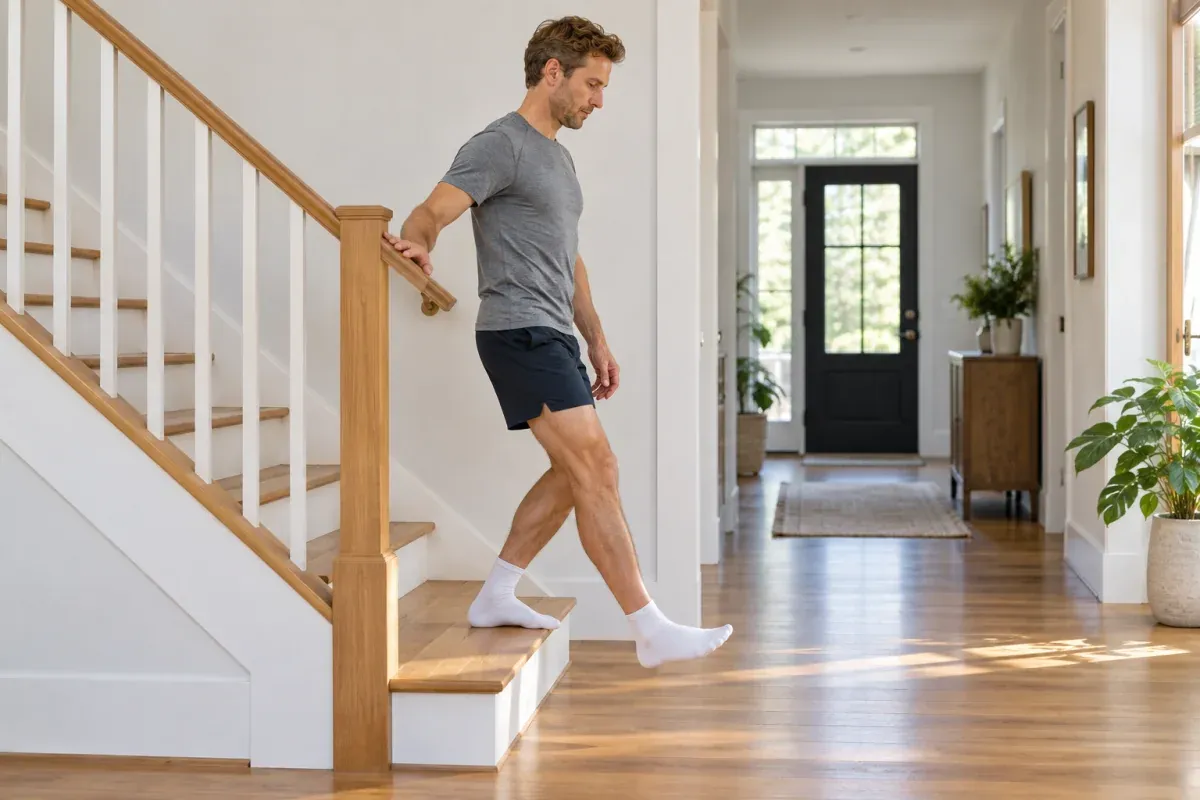
- Step-down: begin by standing on a low step. Slowly lower the other foot. Once you've lowered it toward the floor, you can straighten back up.
- Straight-leg raise: begin by lying on your back. Tighten your thigh first. As you lift one leg, make sure that the leg stays straight.
Pick three or four exercises. Do these three times a week. The strength group in the Esculier trial trained three times a week for up to 20 minutes. That's roughly the same schedule. Use the same pain limits as for running. As the moves get easy, add reps or resistance.
Keep your expectations realistic. A review of 18 prospective studies found that hip weakness didn't predict who later developed kneecap pain (Neal et al.). Strengthening still helps people who already have it; it just doesn't mean weak hips caused your pain.
For IT band pain, strengthening the muscles on the outside of the hip is the most common thread in treatment studies, though the evidence is limited (Sanchez-Alvarado et al.).
Cadence, shoes, braces and foam rolling for knee pain
Cadence. Slightly shorter, quicker steps can lower the load on your knee. In lab studies of healthy runners, a 5% to 10% higher step rate reduced the energy the knee absorbed (Heiderscheit et al.), and a 10% increase cut the modeled peak force behind the kneecap by 14% (Lenhart et al.). In the knee-pain trial, though, runners who raised their step rate didn't improve more than those who only adjusted their training. Treat it as an optional tool. Our cadence guide explains how to change it gradually.
Shoe inserts. The international expert consensus on kneecap pain supports foot orthoses, usually called orthotics, to improve pain or function. A physical therapist can tell you whether they're worth trying for you.
Braces and tape. The evidence is uncertain. That's the verdict of the same consensus on kneecap taping and bracing. A sleeve is worth wearing if it makes your runs feel more comfortable. Just don't rely on it to fix the cause.
Foam rolling and stretching the IT band. Rolling or stretching the band can feel good. But a 2022 review concluded that stretching is unlikely to change its length or stiffness. Use these for comfort, and put your real effort into training changes and hip strength.
Shoes. Check how running shoes should fit. It's worth checking if your shoes are new or feel off. Change one thing at a time. You can then tell which change helped.
Is running bad for your knees over the long term?
For recreational runners, the evidence is reassuring. A meta-analysis of 25 studies found hip or knee arthritis in 3.5% of recreational runners, compared with 10.2% of non-runners and 13.3% of competitive runners. These studies show an association, so they can't prove running protects your joints, and other factors, such as past injuries, may play a part.
If you already have knee arthritis, exercise is one of the treatments the American College of Rheumatology guideline strongly recommends. A clinician or physical therapist can help you work out how much running fits your situation.
When to see a doctor about knee pain after running
If any warning sign from the top of this page shows up, get same-day care or call your doctor. Otherwise book an appointment if:
- The pain hasn't improved within a few weeks of easing your training (NHS).
- The knee hurts at rest or at night or swells after runs.
- To avoid pain you're changing your stride or limping.
- Pain behind the knee lingers.
- That same pain keeps coming back.
A physical therapist or sports medicine doctor can pin down the cause, set a return-to-running plan and progress your strength work.
If none of these apply, keep your next run short and flat. Rate the pain from 0 to 10 while you run. Make a note of how the knee feels the next morning. Set aside time this week for your first strength session. Take that short log along if you do end up seeing someone. It records your knee's response to running.
Frequently asked questions
After a run, how do I get rid of knee pain?
Get the knee checked first if it swelled up quickly or locks or can't take your weight. Otherwise ease the load. Make the runs you do next shorter and slower and flatter. For now skip downhills and stairs. Wrapped ice can ease the ache. Apply it for up to 20 minutes every 2 to 3 hours. Then check which training change triggered it. Start hip and knee strength work three times a week.
With runner's knee, is it okay to keep running?
Often, within limits. The participants in a trial were runners with kneecap pain. During runs they kept pain at 2 out of 10 or lower. Within an hour they let it settle back to its starting level. They also checked the knee the next morning to see that it felt no worse. Stop and get checked if you notice swelling, locking, giving way or pain that changes how you walk.
Does runner's knee ever go away?
Usually it improves with training changes and exercise. It can come back or linger, sometimes for years. Runners in one trial had improved by the four-week check and were still improved at 20 weeks. See a clinician if it hasn't improved within a few weeks of easing off.
After running, should I ice my knee?
You can if it helps. The NHS suggests a wrapped ice pack or bag of frozen peas. It suggests up to 20 minutes every 2 to 3 hours. Ice can ease pain for a while. But it doesn't fix the training load that's behind the problem.
For knee pain from running, what exercises help?
For kneecap pain, combine hip and knee exercises as an international expert consensus recommends. Side-lying hip abduction is a good option. Glute bridges are another good option. Wall sits or partial squats are options too. The list also includes step-downs and straight-leg raises. Choose three or four exercises. Do them three times a week. Use the same limits as for running and keep pain within them.
With knee pain from running, do knee braces help?
The evidence is uncertain, according to an international expert consensus on kneecap pain. A sleeve may make runs feel more comfortable. Load changes and strength work do more to address the cause.
Can running cause arthritis in the knees?
For recreational runners the evidence is reassuring. A meta-analysis of 25 studies found hip or knee arthritis in 3.5% of recreational runners. The figure was 10.2% for non-runners. That association doesn't prove that running protects your knees.
I completed my first 10K on a dare. In a year, I ran a half-marathon. Another year later, I finished a marathon race. Today I run 4 marathons a year and a half-marathon every week. I learned everything about running the hard way. So, I help runners achieve better results easier.