Summarize this article with AI
Running uphill feels tough no matter who you are. Every step lifts your body. The pace needs to come down. That's how you keep the same effort as you make your way uphill. Let the hill set the terms for how you run. Back off the pace enough to hold a steady effort. Stay tall, let your steps get shorter and keep running over the top. Walk the steepest parts if running would get you up them only a little faster.
How far should your pace drop on a climb? This guide answers that. It also covers useful technique cues, pacing for hilly races and when walking saves energy. Hill training has benefits and limits. You'll find both here along with a four-step way to begin and advice for the downhill afterward. The advice comes from lab studies of hill running alongside training trials and pacing research. It also points out where popular hill tips reach beyond the evidence.
How to run uphill at a glance
Try these cues the next time you're climbing:
- Run by effort, not pace. A slower pace is normal. Keeping your flat pace uphill uses energy you'll need for the rest of the run.
- Let your steps get shorter. Your steps naturally get shorter when the road starts climbing. Let that happen rather than reaching out in front.
- Stay tall. Let the slope tilt your body forward a little, keep your chest open and look up the hill, not at your shoes.
- Keep your arms relaxed and in rhythm with your legs.
- Use your breathing as your gauge. Ease off or walk for a bit if you're gasping halfway up.
- Keep running over the top. Hold your effort steady through the crest. Let a few more steps carry you past it before returning to your pace.
- Walk the steep bits when running is barely faster than walking. A brisk power hike is a legitimate tool, not a failure.
Why running uphill feels so much harder
You're lifting your body with every step
On the flat, most of your energy goes into moving forward. Going uphill means lifting your whole body weight against gravity with every stride as well, so the energy cost rises fast.
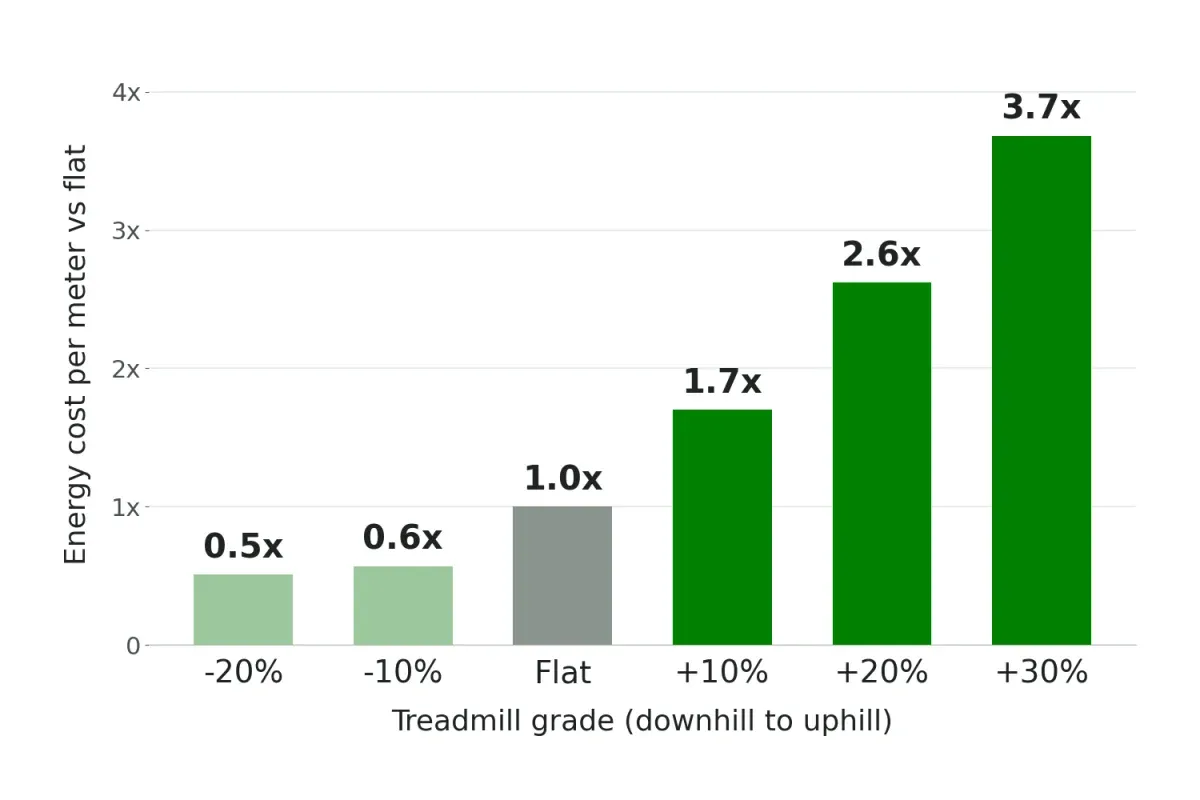
In lab tests on elite mountain runners, running up a 10% grade cost about 70% more energy per meter than running on the flat. A 20% grade cost about 2.6 times as much, and a 30% grade about 3.7 times as much. Those runners were far fitter than most of us, so treat the numbers as a guide rather than an exact cost for you.
Gentle road hills add up too. A standard exercise prediction equation estimates that running 6 mph up a 5% grade takes about 20% more oxygen than running 6 mph on the flat. Treat that as a ballpark figure, since the equation tends to overestimate.
How much to slow down to keep effort steady
Keeping effort steady means slowing down. A hill takes more energy per mile than running on the flat does. Two models give a useful range. Here's what the prediction equation above suggests. Add about 4.5% to your flat pace for each 1% of grade. The mountain-runner lab average is about 7% per 1% of grade. That covers the stretch between flat ground and a 10% grade.
| Your flat pace | Extra time per mile for each 1% of grade (same effort) |
|---|---|
| 8:00 per mile | About 22 to 34 seconds |
| 10:00 per mile | About 27 to 42 seconds |
| 12:00 per mile | About 32 to 50 seconds |
Treat these figures as estimates rather than goals. The assumptions matter here. Both estimates assume a steady climb at a steady effort and lose accuracy on steep or very short hills.
You may have seen a rule that each 1% of incline costs 12 to 15 seconds per mile. Coach Jack Daniels often gets the credit. We couldn't find an original source from him for the rule. That rule fits a narrow pace range. Even with the gentler 4.5% estimate above, it matches only runners going about 4:30 to 5:30 per mile. The table shows a bigger slowdown for runners moving at recreational paces.
A 10% grade costs about 70% more than flat running in the mountain-runner data. At the same effort, a 10:00-per-mile runner would be going about 17:00 per mile. That's close to brisk walking pace, which is why walking comes up later in this guide.
Your heart rate lags behind the hill
Heart rate doesn't jump the moment the road tilts up. In a treadmill study of 24 men, heart rate took about a minute to cover most of a change in effort. Thirty seconds in, it had made only about 40% of its eventual rise. After 2 minutes, it was close to 90%.
Your heart rate may reach its peak near the top or just afterward on a 30- to 60-second hill. Chasing a heart rate number on short hills will have you pushing too hard at the start. Breathing and perceived effort are better guides here. Keep heart rate for climbs that are long and steady rather than short hills. Hilly terrain is also one of the common reasons your heart rate runs high on easy days.
Your muscles share the work differently
On steeper climbs, almost all the extra work comes from your hips, and MRI scans show more of your quads and calves switching on. Your hamstrings, often named in hill advice, don't reliably work harder. The landing jolt shrinks, but push-off force rose about 75% on a steep treadmill incline.
Uphill running technique worth using and tips to skip
Hill tips can sound oddly exact. They tell you precisely how to lean and how much to raise your cadence, or they urge you to pump your arms harder. Most of it hasn't been tested on hills. The advice below has mixed sources. Some comes from research while some is simply a coaching cue you may find useful.
Let shorter steps bring a slightly quicker cadence
Runners naturally shorten their stride on hills. In a study of high-level marathoners running the same speed on a 7% treadmill grade, step length dropped about 4% and step rate rose about 4%. Outdoors on an undulating course, experienced runners' strides were about 20% shorter uphill while their step rate stayed fairly steady.
Your body chooses that pattern naturally. Your steps get shorter. The rhythm of your steps stays steady or quickens a little on the climb. A cadence target isn't necessary here. Don't reach forward into a long stride. Each step becomes a steeper climb when you stretch out in front like that. Step rate has its own guide. For general work on it, start with how to increase your running cadence.
Keep tall as the hill tilts you forward
On steeper grades, your trunk naturally tilts forward. In one study, the change was clear at 10% and 15% grades but not at 5%. "Lean from the ankles, not the waist" is a common coaching cue for this. It's sensible, but it's a cue, not a tested rule.
Don't stare down at your feet or bend at the waist. That posture often means you're putting in more effort than you can keep up. Keep your chest open, your hips under you and your eyes a few steps up the hill. Hills still call for the basics of good running form. The hill simply puts that posture on a slope.
Let your arms swing loosely in rhythm
Arm swing matters. On flat ground, running with the arms held still (behind the back, across the chest or on top of the head) cost 3% to 13% more energy than running with a normal swing. We found no study testing whether swinging harder helps you climb, though. Keep your elbows bent, your hands loose and your arms moving in time with your legs. There's no need to flail or punch the air for extra lift.
Let your foot strike change on its own
Many runners change where their foot lands. They shift toward a midfoot or forefoot landing as the hill gets steeper. You can let that shift happen naturally rather than force it. Your calves and Achilles already carry extra load uphill. You don't have to stay on your toes for a long climb.
Use smaller targets on a long climb
Aim for a mailbox or bend nearby. Treat it as the place you're trying to reach on that long climb. Then choose the next one. This is a mental tactic, not a physiology finding. It helps hold your effort steady without facing the whole hill at once.
Pacing a hilly run or race
The usual advice is to hold your effort steady as your pace changes. Let your pace drop on the climb while keeping your breathing under control. Bring the pace up again when you reach level road.
We found no running trial that directly compares even effort with even pace, but the evidence points the same way. In treadmill races on hilly courses, runners' blood lactate rose on the uphill stages even as they slowed, which suggests climbs are where runners overspend. A little extra effort on a climb is fine. Surging into the red at the bottom isn't.
Even experienced runners slow down a lot. On an outdoor undulating course, they ran about 23% slower uphill and about 14% faster downhill than on the flat, and they worked hardest on the climbs. The study's authors concluded that the level stretch right after a hill offers the biggest chance to save time. That's why running through the crest pays off.
Don't count on the downhill to give it all back. In those treadmill races, courses with 5% climbs and descents were 2.4% to 2.8% slower than a flat course, even though they started and finished at the same height. Strava's 2017 pace model, built from millions of runs with heart rate data, found that downhills help much less than climbs cost: at best about 12% faster at a 9% downhill grade, and no benefit at all by 18%.
Here's how that plays out in a hilly race. Suppose your flat pace is 10:00 per mile and the course has a half-mile climb at a grade of about 4%. Using the range above, at the same effort you'd be running about 11:48 to 12:48 per mile on that climb. You'd lose roughly 55 to 85 seconds against your time for a flat half-mile. Budget for that lost time on race day. Make up a little on the flat past the top rather than fighting the climb.
Check grade-adjusted pace on your watch or app after the run, when you want to compare a hilly route against a flat one. Short hills make that number jump around too much to guide your pace.
When walking uphill is the smarter move
You haven't given up on a run just because you walk a hill. Hiking saves energy on steep climbs. That's why good trail runners choose to walk those parts of the route.
The science backs that up on very steep ground. In a study of runners on steep treadmill inclines, walking at about 2.9 mph up a 28% grade used about 8% less energy than running at the same speed. On a 17% grade at a faster speed, there was no difference.
On ordinary road hills, walking pays off only at slow speeds. On a 5% grade, walking used less energy than running below about 4.7 mph, a pace of roughly 12:45 per mile. As a rough guide, on road hills of about 5% to 12%, walking makes sense once your running pace would be slower than about 12 to 15 minutes per mile. There's no single grade where everyone should switch.
To walk well:
- Keep it brisk. Take quick steps that stay short and keep your arms swinging actively.
- Stay tall. Hold the same posture as when running: chest open, eyes ahead.
- On very steep trail climbs, try pushing on your thighs. Place your hands just above your knees as you do it. Many trail runners use this to share the work with their upper body.
- Mix it up on long climbs. Start by running for 20 steps. Follow with 20 steps of walking and keep switching between running and walking up the climb. Counting also keeps your mind busy.
If you're newer to running, walking the hills on a rolling route is a perfectly good way to build up to running them.
What hill training does for your running
Hills are more than an obstacle. When you run them hard on purpose, they become a form of interval training. Here's what the research shows, including a few common claims it doesn't support.
Hill intervals can make you faster, modestly. In a study of 20 well-trained runners, adding two uphill interval sessions a week for six weeks was followed by about a 2% faster 5K. That's roughly 20 seconds off a 17-minute 5K. Every hill program they tested worked about equally well for 5K time. The study had no flat-interval group, though, so it can't show that hills beat other hard running.
Flat intervals did as well or better in a head-to-head test. In a trial with 32 well-trained runners, both uphill and flat intervals improved how long runners could last at a hard pace. The flat group improved more: about 139 seconds versus 70 seconds. Neither group's VO2 max, the most oxygen your body can use, changed significantly. So hills are a good kind of interval training, not a superior one. If you want structured interval sessions on flat ground, see these interval running workouts.
Short, hard hill reps can be efficient. In a six-week trial of 24 moderately trained runners, 30-second reps on a 10% incline improved threshold speed more than slower 3-minute reps, even though the short-rep group ran less than half as much in each session.
Hills don't replace strength training. You'll often read that hills build leg strength like squats. A 2026 analysis of 13 trials found no significant effect of uphill running on knee strength or jumping. Hills ask more of your glutes, quads and calves while you're climbing, but if you want stronger legs, add strength training.
There's no good evidence that hills prevent injuries. No trial we found shows that hill training cuts injury risk. In a study that followed 1,680 adult road racers for a year, hill running wasn't clearly tied to more injuries either.
One caution applies to all of this. Nearly every hill training study used trained or well-trained runners, often on treadmills. How much a beginner gains is unknown.
So what are the real benefits? Hills prepare you for hilly race courses. They let you work hard without the landing jolt of fast running on the flat. And they make a familiar route feel new.
How to start running hills in four steps
Wait until the current step feels routine. That usually takes two to three weeks, and only then should you move to the next step. A hard hill workout uses up one of your hard days for the week. Don't add it as an extra session.
Step 1: Easy running on a rolling route
Run a route with a few gentle hills while keeping to your normal easy effort. Allow your pace to drop on climbs and walk if you need to. Keep the work easy. The aim is to let your legs adjust to both climbing and descending.
Step 2: Add hill strides
After an easy run, find a moderate hill. Run up it for 10 to 15 seconds at a strong but relaxed effort, then walk back down. Start with 4 to 6 reps, focusing on quick, light steps and a tall posture. In the study of well-trained runners, very short, very steep sprints gave the largest gain in running economy, but only three runners did that version, so treat it as a hint, not proof.
Step 3: Short hill repeats
Wait until strides feel easy. Next come 6 to 10 repeats of 30 to 45 seconds. Choose a hill with a grade of about 5% to 10% for them. Work hard while staying in control. Recover by walking or jogging back down. Studies of trained runners commonly used 10 to 14 reps of 30 seconds on about a 10% grade. The schedule was twice a week for six weeks. One weekly session works well for most recreational runners. A full warm-up and cool-down are included in the interval guide's hill repeats session.
Step 4: Train with longer climbs and hilly long runs
Training for a hilly race calls for longer efforts. Pick a moderate grade. Run 3 to 5 repeats of 2 to 4 minutes at a comfortably hard effort. Jog down between repeats. Another option is to take part of your long run onto a hilly route. That same study involved well-trained runners. They ran 2- to 5-minute reps on grades of 7% to 10%. The best aerobic fitness gains came from those reps and included improvements in VO2 max.
| Session | Example | Effort | Recovery | Good for |
|---|---|---|---|---|
| Rolling easy run | Your usual easy run on a hilly route | Easy; walk if needed | Not needed | Getting used to hills |
| Hill strides | 4 to 6 × 10 to 15 seconds | Strong, relaxed | Walk down | Form, leg turnover |
| Short hill repeats | 6 to 10 × 30 to 45 seconds | Hard, controlled | Walk or jog down | Speed and fitness |
| Longer hill repeats | 3 to 5 × 2 to 4 minutes | Comfortably hard | Jog down | Hilly race prep, aerobic fitness |
| Hilly long run | Part of your long run on hills | Easy to steady | Not needed | Hilly half marathons and marathons |
You can estimate a hill's grade this way. Start by dividing the rise by the distance. Then multiply the answer by 100. Take a rise of 5 feet over 100 feet of road. That works out to a 5% grade. You can often skip that calculation. Many route-planning apps and watch maps show grade on a chart of the route's climbs and descents.
Running back down: the downhill after the climb
The climb is hard on your heart and lungs. The descent is hard on your legs.
Downhill running hits harder with each step. On a steep treadmill decline of about 16%, impact forces rose 54% and braking forces 73% compared with level running at the same speed. Stress on the kneecap joint was higher on a moderate decline than on the flat, while a moderate incline was no worse than flat.
Your quads also take the brunt. They lengthen under load to brake each step, which is the kind of work that causes soreness. People who aren't used to downhill running usually get the most muscle damage, often with sore, weaker quads for several days.
The good news is that your legs adapt quickly. In a classic study, one downhill run reduced soreness and muscle damage markers from a repeat run 3 or 6 weeks later, though the protection was gone by 9 weeks. In lab tests of downhill walking, even 5 minutes of downhill work reduced the damage from a 40-minute descent a week later. That study used walking, not running, but it supports the same approach: add downhills a little at a time.
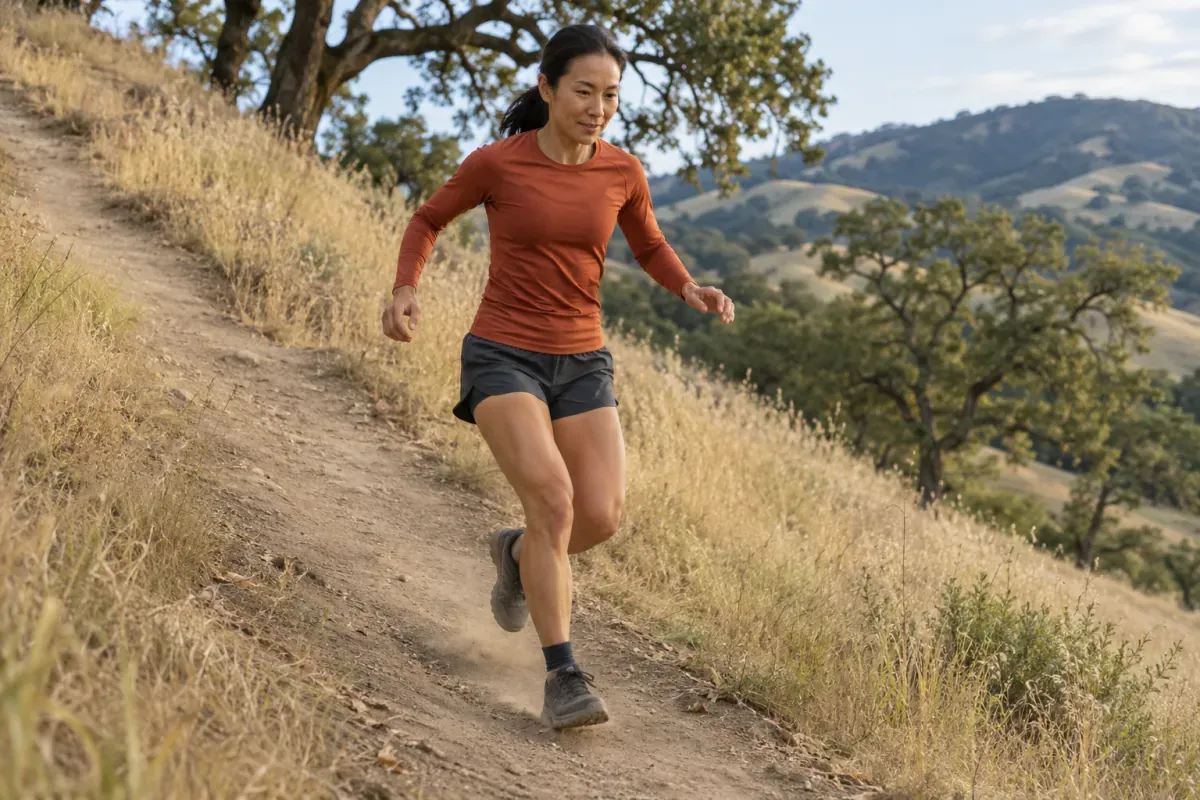
To run downhill well:
- Take short, quick steps. Don't stretch your stride out so far that you slam into the ground.
- Stay over your feet. In the kneecap study above, leaning back more on the decline went with the higher knee load. Keep your body roughly upright relative to the slope instead of sitting back.
- Look ahead, especially on trails. That way you can choose where each foot will land before you get there.
- Let speed build gradually. You don't need to bomb down to gain time.
- Walk or jog down between hill repeats. Use the downhill recovery to go easy.
Race courses with big descents call for some downhill practice in the weeks beforehand. Start with only short stretches. Read about what may be behind knee pain after running if downhills bother your knees.
No hills nearby?
A treadmill is the easiest substitute. For everyday runs, a 1% incline matched outdoor energy cost at paces faster than about 9 minutes per mile. If you run slower than that, 0% and 1% are both fine. For hill sessions, raise the incline to around 5% to 10% and lower the speed to keep the effort right. The treadmill pace chart shows speed and incline pairs for the same effort.
A bridge can give you a short hill to run outdoors. You can also use an overpass that has a sidewalk. A quiet parking garage ramp is another option. Stick to places where people on foot are expected and watch for traffic. Stair repeats are another way to get a hard climb. Stairs are a supplement. Use them alongside hill running, not in place of it, because the movement is different.
Who should take hills carefully
Hills change where the load lands. That helps some runners and bothers others.
- Achilles, calf or shin trouble. At the same speed, climbs of 10% or steeper load the shin bone more than flat running, and lab models suggest the Achilles works harder too. Slowing down on the climb offsets some of this. No study we found ties hill running itself to Achilles injuries, but if those areas are sore, stick to gentle grades and walk the steep parts.
- Kneecap pain. In lab testing, a moderate uphill didn't load the kneecap joint more than flat running, but a downhill did. Running up and walking down is a reasonable option.
- New or returning runners. Build a base of easy running before adding hard hill efforts. For people who haven't been exercising, ACSM's screening guidance advises against unaccustomed vigorous effort.
- Pain that changes your stride. Stop the session. Muscle soreness that eases over a few days is normal, especially after your first downhills. Pain that gets worse as you run isn't. Get pain checked by a doctor or physical therapist if it lingers or keeps coming back.
A hill is a hard effort, and some signs matter more than finishing the climb. Stop and get medical advice before running again if you have chest pain or pressure, unusual shortness of breath, dizziness or fainting, or a racing or irregular heartbeat. Call 911 right away if you think you might be having a heart attack, or if symptoms are severe or don't ease quickly once you stop.
Your first hill this week
Pick a route that has one or two hills. Use that route for this week's run and keep the effort easy throughout. Let the pace slow as you keep your body tall and your steps short. Walk anywhere running would only get you along a little faster than walking. Look for where the climb ends and keep running for a few steps beyond it. Once rolling routes feel routine, add four hill strides after an easy run.
Frequently asked questions
Is running uphill good for you?
Yes, for most healthy runners. Hard uphill efforts work as interval training, and in a study of well-trained runners, two hill sessions a week for six weeks were followed by about a 2% faster 5K. Climbs also cut the landing jolt of fast running and prepare you for hilly races. They don't replace strength training, and there's no good evidence that they prevent injuries.
Why is running uphill so much harder than running on flat ground?
You lift your body weight with every step. In lab tests on elite mountain runners, a 10% grade cost about 70% more energy per meter than flat running. Your heart rate also takes a minute or two to catch up, so a short hill can feel hardest near the top or just after it.
How much slower should I run uphill?
Keep the effort unchanged and expect to add roughly 4.5% to 7% to your flat pace for each 1% of grade you climb. Take someone running at a 10:00-per-mile pace. They'd add about 27 to 42 seconds per mile for each 1%. Let breathing and effort guide you instead of a pace number, and allow your pace to ease back on the climb.
How many times should you run up a hill in a workout?
Keep your first hill sessions small. Begin with 4 to 6 hill strides of 10 to 15 seconds each. Later, work up to 6 to 10 repeats of 30 to 45 seconds, which make a solid session. Studies of trained runners commonly used 10 to 14 reps of 30 seconds up a grade of about 10%. Build up gradually and stop while your form still holds.
Is it okay to walk up hills during a run?
Yes. Walking takes less energy on very steep climbs. You use more if you run those climbs at the same hiking speed. On typical road hills of about 5% to 12%, walking makes sense once your running pace would be slower than about 12 to 15 minutes per mile. Walk briskly and stay tall while keeping your steps short.
Does running hills make you faster on flat ground?
It can, modestly. In trained runners, 5K times improved after six weeks of hill intervals, but in a head-to-head trial, flat intervals improved endurance at a hard pace more than hill intervals did. Think of hills as one good form of hard running, not a shortcut.
Is running uphill bad for your knees?
Probably not, at least for the kneecap joint on moderate grades. In lab testing, a moderate uphill put no more stress on that joint than flat running, while downhill running raised it. Steep climbs do load the shin bone more at the same speed, and lab models suggest the Achilles works harder too. Ease into steep hills, slow down on them and walk down if descents bother your knees.
Does running uphill burn more calories?
Yes, per mile. Tests on a 10% grade found an energy cost per meter about 70% higher than on the flat. A standard prediction equation estimates about 20% more oxygen at 6 mph on a 5% grade compared with flat running. Because you also run slower uphill, how many calories you burn per minute depends on how hard you work.
I completed my first 10K on a dare. In a year, I ran a half-marathon. Another year later, I finished a marathon race. Today I run 4 marathons a year and a half-marathon every week. I learned everything about running the hard way. So, I help runners achieve better results easier.