Summarize this article with AI
"Runner's butt" usually means one of two things: the worry that running has made your butt flatter or smaller, or "dead butt syndrome," the idea that your glutes stop doing their job. On the first, running is unlikely to shrink your glute muscles, but easy miles don't build much there either. When a runner's butt gets smaller, lost body fat is the likely reason, sometimes along with not eating enough.
This guide looks at what's actually changing. Sprinters' glutes look very different from marathoners'. This guide explains why they differ so much. It also shows how to keep or build your glutes with two short strength sessions a week plus a little fast running. It also covers what research says about dead butt syndrome and which kinds of butt or hip pain need a doctor or physical therapist. MRI and muscle-activity studies are among the sources it draws on. So are strength-training trials and the current US exercise guidelines.
What "runner's butt" means
People use "runner's butt" for two different things.
The first is about shape. It's the idea that lots of running, especially long and steady mileage, leaves your butt flatter or smaller than it used to be. Running forums return to it often. It's half a joke when people bring it up. The other half is real worry.
The second is about function. "Dead butt syndrome," sometimes called gluteal amnesia, is a popular name for glutes that supposedly stop doing their share of the work. Cleveland Clinic calls it a "colorful nickname" and names long periods of sitting as the most common trigger.
Neither of these is a standard medical diagnosis. The shape question comes down mostly to how you train, how much body fat you carry and how much you eat. Function gets its own section below. The label often takes the blame for aches that it may not explain.
Does running make your butt smaller?
Probably not, at least not the muscle. Steady, easy running, the kind that fills most training weeks, is unlikely to shrink your glutes, but it doesn't build much size either. If your butt looks smaller, lost body fat is the likely cause, sometimes combined with not eating enough.
Your glutes do work when you run. In a small lab study of nine regular runners, the gluteus maximus, the big muscle that gives your butt its shape, was mostly quiet during walking but far more active during running. Its activity roughly doubled as running speed rose from 2.0 to 4.0 meters per second, or from about 13:25 to 6:42 per mile. On each step, it mainly keeps your upper body from tipping forward and appears to help slow the swinging leg. It may also help extend your hip while your foot is on the ground. At sprint speeds, the hip muscles, including the gluteus maximus, take on a bigger share of the work of moving the legs faster.
Working a muscle isn't the same as growing it, though. A 2025 meta-analysis of randomized trials found that steady, moderate aerobic training did not consistently increase muscle size. An older meta-analysis put the effect of endurance training alone on muscle growth at 0.27, against 1.23 for strength training, on a scale where bigger numbers mean bigger effects. In plain terms, lifting did far more for muscle size.
We couldn't find a study comparing the glutes of distance runners alone with those of people who don't exercise, so it's hard to say exactly what years of running do to them. The runner data that do exist don't point to muscle loss. In first-time marathoners, MRI scans before and after 16 weeks of training showed no new wasting in the glute muscles. In another MRI study, people who exercised more than 8 hours a week, including marathoners, had a somewhat larger gluteus maximus than less active people, though their exercise also included other sports.
Why sprinters' glutes look different
Elite sprinters often have noticeably bigger glutes, and MRI data back that up. In a study of male sprinters, the gluteus maximus was about 35% larger in sub-elite sprinters and almost twice as large in elite sprinters as in untrained men. Glute size alone explained 34% to 44% of the differences in the sprinters' 100-meter times, while the two smaller glute muscles, the gluteus medius and minimus, didn't differ between the groups.
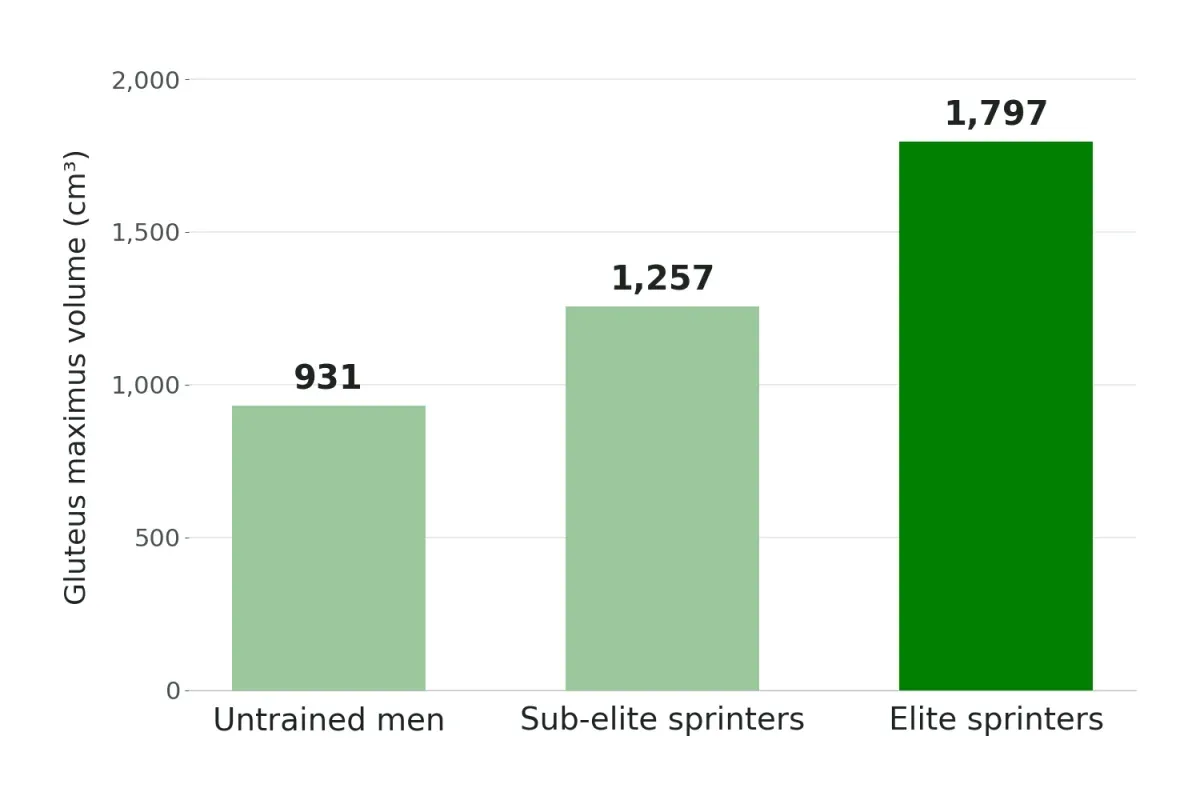
Two caveats apply. The study captured a single moment. The sprinters also lifted weights at least once a week as part of their training. So the study can't separate what sprinting built from what lifting built or from the body type that drew these athletes to the sport.
The comparison still has value. Sprinting calls for short bursts of high force from the glutes. So does lifting. Those same muscles face much less demand during the easy running that makes up most distance training.
Fat loss and where your body stores fat
Running burns calories, and many runners lose some body fat over time. You don't get to choose where it comes off. In one small 12-week trial, people trained only one leg on a leg press. Their body fat dropped, but mostly from the arms and trunk, not from the trained leg.
Where fat sits differs between people, too. Women tend to carry relatively more fat around the hips and thighs than men, so when overall body fat drops, the butt can be one of the places it shows. The same review notes that after menopause, fat tends to shift toward the middle of the body. Your sex and age shape your butt in ways running can't change.
So when your butt looks smaller after months of running, the most likely explanation is fat loss plus a week with little muscle-building work in it. That fits the evidence above even though researchers haven't tested the explanation directly. It may be a trade you're happy with if you're losing weight on purpose. If you're not, check whether you're eating enough for your training. Our guide to running and fat loss explains how the calorie side works.
When too little food costs you muscle
High mileage on too little food is a separate problem. Not eating enough to cover your training can lead to relative energy deficiency in sport, or REDs, which harms health and performance in both women and men. A calorie deficit also makes muscle harder to hold on to, which is why the International Society of Sports Nutrition (ISSN) suggests higher protein intakes for lifters who are cutting calories.
Warning signs of under-fueling include fatigue, weight loss you didn't plan, and irregular or missed periods. If those sound familiar, talk to a doctor or a sports dietitian before you add more running.
How running, lifting and eating affect your glutes
| Training | What it does for your glutes | What the evidence is based on |
|---|---|---|
| Easy distance running | Works them, but adds little or no size | Lab studies of muscle activity; trials of steady aerobic training |
| Strides and other fast running | Works them harder than easy running does | Muscle-activity and running-mechanics studies; no glute growth trials |
| Strength training with real load | The most reliable way to make them bigger | Training trials that measured glute size on MRI |
| Losing body fat | Can make your butt look smaller; you can't pick where fat comes off | Fat-distribution research and a spot-reduction trial |
| Eating too little for your training | Raises the risk of losing muscle, plus other health problems | Sports nutrition and sports medicine consensus statements |
How to keep or build your glutes while you run
You don't need to cut your mileage. Most runners can keep running the way they do now and add two things: strength work with real load and a small dose of fast running. Eating enough holds it all together.
Lift with enough load twice a week
US guidelines call for muscle-strengthening activity at least 2 days a week. For muscle size, the American College of Sports Medicine's 2026 position stand suggests about 10 sets per muscle group per week. Two sessions with five or six hard sets of glute-focused exercises each will get you there. And a 2022 meta-analysis found that pairing aerobic exercise, such as running, with lifting didn't reduce muscle growth, so you don't have to choose.
"Hard" means the last few reps of each set feel tough while your form still holds. Going all the way to failure isn't required. If you're new to lifting, learn each movement with light weights first. When a set starts to feel easy, add a little weight or a couple of reps.
Pick exercises that put a load on your hips and take them through a big range of motion:
- Squats. In a 10-week study of untrained men, full-depth squats grew the gluteus maximus by 6.7%, against 2.2% for half squats.
- Hip thrusts. In a 9-week trial, hip thrusts and back squats grew the glutes by similar amounts, even though hip thrusts showed more glute activity on muscle sensors (EMG).
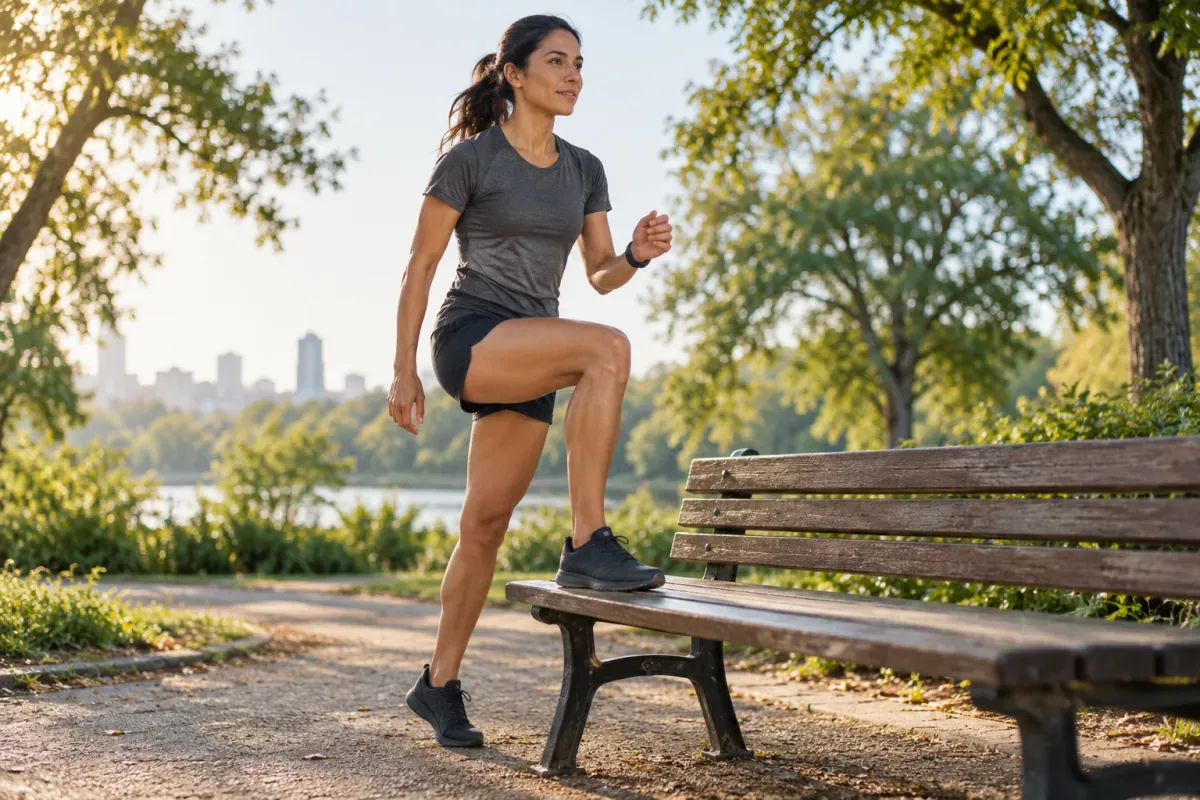
- Step-ups, split squats and deadlifts. These rank among the exercises with the highest gluteus maximus activity, and the single-leg versions train one side at a time, as running does.
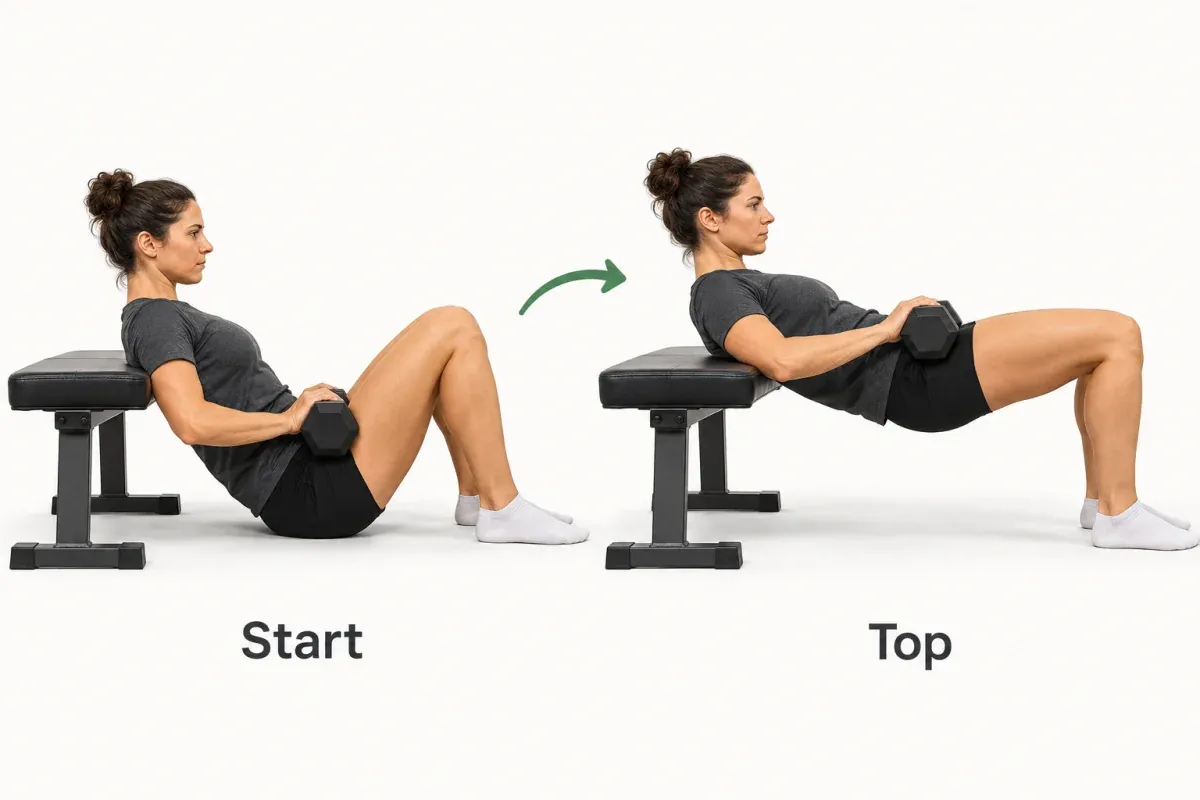
Clamshells, glute bridges and side-lying leg raises have a place, too. They make good warm-ups, and side-lying hip abduction produced the highest gluteus medius activity of 12 exercises in one study. The gluteus medius sits on the side of your hip and, with the other hip abductors, helps keep your pelvis steady when you stand on one leg. Once these moves feel easy, though, they stop challenging the muscle much, so treat them as extras rather than your main lifts. Our adductor vs. abductor guide shows how to do the side-lying work.
Make room for fast running each week
Speed asks more of your glutes. Add faster running once a week. That gives your glutes more work than you'd get from easy miles alone. Strides keep it simple. Use the end of an easy run for relaxed accelerations. Do 4 to 6 of them. Hold each acceleration for about 20 seconds before easing off. Walk or jog slowly between the accelerations. If fast running is new to you, start with fewer accelerations and build up from there.
Hills add work, too. In a small study of four men, nearly all the extra work of running up steeper slopes came from the hip, though studies disagree on how much of it the glutes themselves do. Neither strides nor hills will replace lifting, but they add a demand that easy miles don't.
Eat enough food and include protein
Muscle grows from training plus enough food. For people lifting weights, extra protein stops adding benefit at about 1.6 grams per kilogram of body weight per day. The ISSN suggests 1.4 to 2.0 g/kg a day, in servings of 20 to 40 grams spread through the day.
For a 150-pound (68 kg) runner, the daily range runs from about 95 to 136 grams. At 1.6 g/kg, that comes to roughly 109 grams. Carbohydrates still fuel your running, so add protein alongside the carbs already in your meals rather than cutting back on them to make room. Our guide to whether running builds muscle covers fueling for muscle in more detail.
An example week
Here's one way to fit everything together around running five days a week. Move the days to fit your schedule because this is an example rather than a prescription. The strength sessions go on a rest day and an easy day and never share a day with the long run or the workout. Friday's rest day gives your legs a break between Session B and the long run.
| Day | Running | Strength |
|---|---|---|
| Monday | Rest | Session A: squats 3 sets, hip thrusts 3 sets, side-lying hip abduction 2 sets per side |
| Tuesday | Easy run | None |
| Wednesday | Workout, such as intervals or a tempo run | None |
| Thursday | Easy run | Session B: split squats 3 sets per leg, Romanian deadlifts 3 sets, side plank 2 sets per side |
| Friday | Rest | None |
| Saturday | Long run | None |
| Sunday | Easy run plus strides | None |
The weekly total is 12 hard sets. These sets mainly target the gluteus maximus. On top of that, your trunk gets some extra work from them. The gluteus medius also gets more to do along the way. Two sessions can feel like too much at first. In that case, begin with just one of them. Add the second after a few weeks.
When to expect glute growth
The training studies above measured glute growth after 9 weeks and 10 weeks in people new to lifting. The 6.7% gain from full-depth squats is real but modest, so judge your progress by your lifts as well as the mirror.
Is dead butt syndrome real?
The idea behind dead butt syndrome is that long hours of sitting "switch off" your glutes, so other muscles, like your hamstrings or lower back, take over their work. It's a popular label rather than a diagnosis, and health sources don't agree on what it means.
The core claim is largely untested. We found no study that measured glute activity before and after a long stretch of sitting, and PubMed, a major database of medical research, returns no records for "gluteal amnesia". That doesn't prove the idea wrong. It means we couldn't find evidence that it's right.
Some of the usual advice holds up for other reasons. US guidelines tell adults to move more and sit less, because more sitting is linked to heart disease, high blood pressure and earlier death. Getting up regularly costs nothing, and strengthening your glutes is worth doing for the reasons above.
What the research doesn't back is blaming most running aches on lazy glutes. In studies that measured people before anyone got hurt, hip strength didn't predict who went on to develop pain around the kneecap. Weak hips in people who already have that pain may be a result of it rather than the cause. In distance runners, a link between hip weakness and injury shows up mainly for iliotibial band syndrome, and mostly in runners who were already injured.
Glute work can still help prevent injuries, but the trial results are mixed. A supervised hip and core program lowered injury rates in novice runners in a 2024 trial, while an unsupervised strength program for first-time marathoners made no difference. In another small trial, six weeks of hip strengthening and squat training made female runners stronger without changing how their hips and knees moved while running. So train your glutes in the gym, run the way you normally do, and get pain that persists checked instead of blaming lazy glutes. If your lower back or knees are the problem, our guides to lower-back pain when running and knee pain after running cover more likely causes.
When butt or hip pain needs a professional
Muscle soreness that peaks 1 to 3 days after a new strength workout and then fades is normal. Pain that hangs around, gets worse or changes the way you run is different. Ease off and see a doctor or physical therapist if you notice:
- Pain on the outside of your hip that gets worse when you lie on that side, climb stairs, stand on one leg or get up from a chair. This pattern is typical of gluteal tendinopathy, especially in women around and after menopause. In one trial, education plus a targeted exercise program worked better at 8 weeks than a steroid injection or waiting it out.
- Deep pain low in the buttock, near the sit bone, that flares with long sitting, walking uphill or running. That's a common pattern of high hamstring tendinopathy.
- Pain, tingling or numbness that runs from your butt down the back of one leg, which is typical of sciatica.
- Deep buttock, hip or groin pain that gets worse with weight bearing, hurts with hopping, or starts to ache at rest or at night. These can be signs of a bone stress injury, which is more common in female athletes and long-distance runners. Stop running and get checked soon, because a delayed diagnosis can let some of these fractures get worse.
Get emergency care right away for numbness around your genitals or anus, trouble peeing or controlling your bladder or bowels, or severe or worsening weakness or numbness in both legs. The same goes if you can't walk or put weight on your leg. Don't run through sharp or worsening pain while you wait to be seen.
Where to start this week
Put Session A on your next rest day. Add strides at the end of one of your easy runs that week. Session B can come later that week. If you're new to lifting, you can wait a few weeks before adding it. Aim for a solid serving of around 20 to 40 grams of protein at each meal. Give it about 10 weeks before you use the mirror to judge the results. If you're also wondering how running shapes your legs, our guide to runner's legs picks up from here.
Frequently asked questions
Does running make your butt bigger?
Easy distance running adds little or no glute size. Strength training reliably grows the glutes. Trials found measurable increases in glute size from squats and hip thrusts in 9 to 10 weeks. Elite sprinters both sprint and lift. Their glutes are far larger than untrained men's on MRI, though the study can't show how much sprinting itself contributed.
Why do runners have small glutes?
Many distance runners are lean. They do most of their training at easy speeds that give muscles only a weak signal to grow. A butt can look smaller with less body fat and little strength work. That explanation is a likely one but untested. You can change how things look. The most reliable way to do that is regular strength training.
Does running tone your butt?
Running works your glutes and can help you lose body fat, which some people call toning. But running adds little muscle. For a firmer, rounder shape, lift weights twice a week alongside your usual running, with exercises such as squats, hip thrusts and split squats.
How do you avoid runner's butt?
Keep running while lifting twice each week with exercises that load your hips, such as squats, hip thrusts, split squats or Romanian deadlifts. Do strides once each week and eat enough overall, including about 1.6 grams of protein per kilogram of body weight a day. That's roughly 109 grams a day if you're a 150-pound runner. If you're losing weight without trying, check whether you're eating enough for your training, and talk to a doctor or sports dietitian if it continues.
Can you lose fat from just your butt by running?
No. You can't choose where your body loses fat. In one trial, training only one leg reduced fat mostly in the arms and trunk, not in the trained leg. Running can lower overall body fat, and the butt may be one of the places it shows.
Is dead butt syndrome real?
It's a popular label, not a standard diagnosis, and the idea that sitting "switches off" your glutes is largely untested. Moving more and sitting less is good advice anyway, and glute strength work is worth doing. Persistent butt or hip pain should be checked by a doctor or physical therapist.
Do hills or an incline treadmill build your glutes?
The hip does more work uphill. Studies disagree on how much more work the glutes themselves do while running up a slope. Hills or an incline treadmill are useful. They add a challenge but can't take the place of strength training in your routine. If you want bigger glutes, heavy squats and hip thrusts have clearer evidence behind them.
I completed my first 10K on a dare. In a year, I ran a half-marathon. Another year later, I finished a marathon race. Today I run 4 marathons a year and a half-marathon every week. I learned everything about running the hard way. So, I help runners achieve better results easier.