
There is no single right way to breathe while running. Use whatever gets enough air in without strain, and aim for deep, relaxed breaths. Run at a pace that lets you talk, and expect to use your nose and mouth together once the effort picks up. If breathing feels hard, check your pace before you change your technique.
This guide covers belly breathing, nose versus mouth breathing, breathing in rhythm with your steps, side stitches and cold air. It draws on published studies and health-agency guidance, points out where the evidence is thin and lists the signs that mean you should see a doctor. Try one idea at a time on your next run.
Why running leaves you out of breath
Running makes your muscles use more oxygen and produce more carbon dioxide, so you breathe more. According to a 2022 review of breathing research for runners, your breaths first get deeper as the effort rises. Once each breath uses about 50% to 60% of your vital capacity (the most air you can breathe out after a full breath in), you breathe faster instead. At maximal effort, the review reports peak breathing rates from about 35 to 70 breaths a minute, with big differences between people.
So breathing hard at a hard effort is normal. What matters is whether your breathing still feels under control. Starting out too fast is a common way to lose that control. After weeks of regular running, that same pace usually feels easier.
Slow down before you change your breathing technique
Pace is the first thing to check when breathing feels hard, and the CDC's talk test is the simplest way to do it. At a moderate effort, you can talk but not sing. At a vigorous effort, you cannot say more than a few words without pausing for a breath. In a small lab study of 16 healthy adults, the point where talking got hard lined up closely with the ventilatory threshold, the effort where breathing starts climbing faster than the work you are doing.
For most easy runs, choose an effort that lets you talk in full sentences without gasping. If you can't, slow down. Walking is fine until your breathing settles, and then you can start running again.

Run-walk intervals can help you build up. For example, run for a minute, walk for a minute and repeat. If your heart rate also runs high at easy paces, our guide to why your heart rate is high on easy runs covers the usual causes. For more on finding an effort you can sustain, see our guide to the aerobic threshold.
Practice belly breathing on your back first
Belly breathing, also called diaphragmatic breathing, means letting your belly rise as you breathe in instead of lifting your chest and shoulders. Your diaphragm, a dome-shaped muscle just below your lungs, already does most of the work of each breath. Letting your belly rise is a cue to use it, which can encourage fuller, calmer breaths rather than quick, shallow ones.
Practice it like this:
- Lie on your back with your knees bent. Rest one hand on your belly and the other on your chest.
- Breathe in slowly through your nose. Your belly hand should rise more than your chest hand.
- Breathe out slowly without forcing it, until the breath feels comfortably finished.
- Keep going for two minutes. If you feel dizzy, pause and breathe normally.
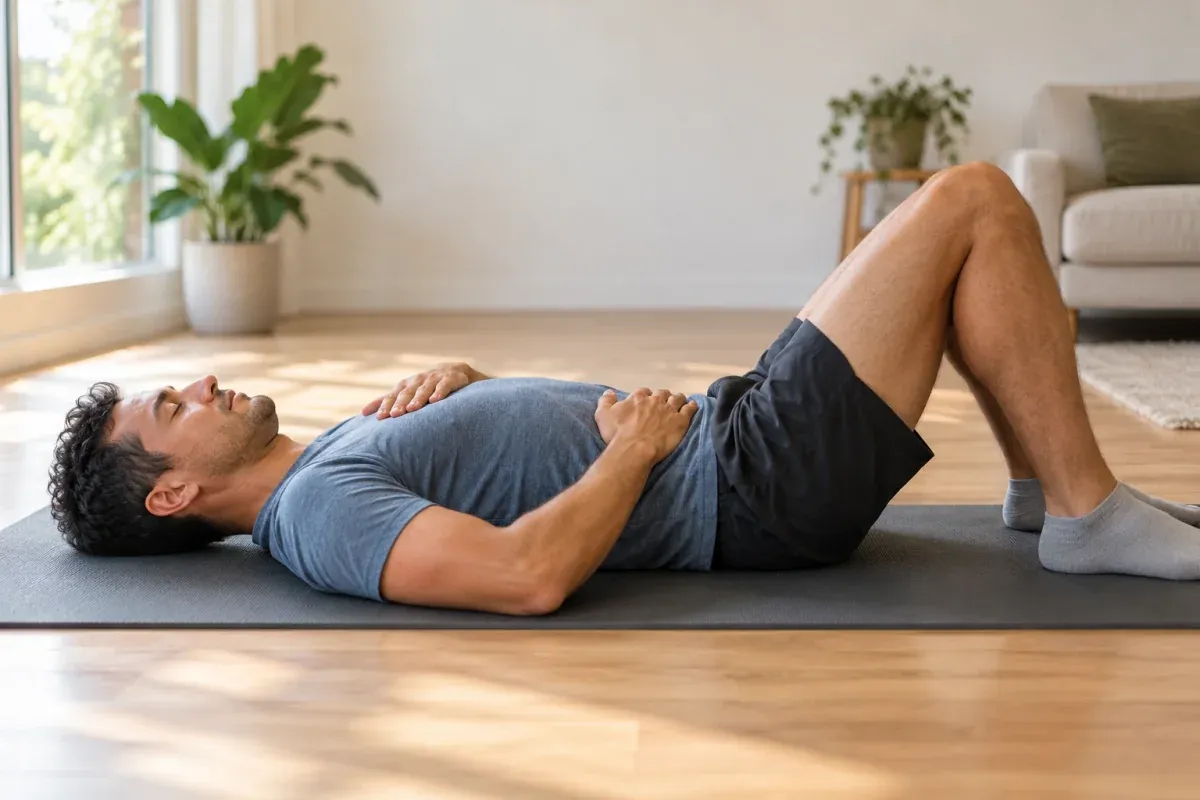
Once that feels natural, try it sitting, then while walking. One caution: the 2022 review found that direct evidence for belly breathing during running is limited. Treat it as a reasonable way to relax and breathe deeper, not a proven way to run faster. On the run, don't push your belly out. Just let it move.
Should you use your nose or mouth to breathe when running?
Both, once the effort rises. In a 1980 study of 30 healthy adults on a stationary bike, 20 switched from nose-only to nose-and-mouth breathing as the workload went up. Five stayed on nose-only breathing, four breathed through the nose and mouth from the start and one had no consistent pattern.
The studies below are small, but together they suggest that switching between nose and mouth is normal. In the table, VO2max is the most oxygen your body can use at peak effort, and running economy is how much oxygen you use at a steady pace.
| Study | Who | Setting | What it found |
|---|---|---|---|
| Niinimaa, 1980 | 30 healthy adults | Cycling, rising workload | Most people moved from nose-only to nose and mouth as effort rose |
| Dallam, 2018 | 10 recreational runners who already chose nose-only breathing in training and races | Running tests, including a hard steady effort | No loss in VO2max, and better running economy at the hard steady effort |
| Mapelli, 2025 | 12 healthy adults | Cycling to exhaustion | Nose-only breathing lowered peak effort and felt harder; mouth-only matched normal breathing |
| Bergqvist, 2025 | 12 trained cyclists and triathletes | Cycling to exhaustion | Mouth-only vs nose-and-mouth made no significant difference in VO2max, ventilation or perceived effort |
Put together, the studies suggest that nose-only breathing held back peak effort in healthy adults on a bike (Mapelli). Runners who already chose nose-only breathing lost no VO2max (Dallam), but that study had only 10 runners, so it can't tell you what happens if you switch to nose-only breathing overnight. Nose breathing may work if you are already used to it, but you don't need to force it. Mouth-only breathing did not significantly change peak results in either cycling study that tested it.
Try it on a run this way:
- Try nose breathing on an easy mile. Breathe in and out through your nose for as long as it feels comfortable. If it feels like you're sucking air through a straw, you're probably running faster than easy, or your nose just isn't up to the job today. Slow down or open your mouth. Nose breathing can also work as a quick pace check.
- Let effort guide the choice. As the effort rises, breathe through your nose and mouth together, or use just your mouth. You're not doing anything wrong by breathing that way.
Can matching your breathing rhythm to your steps help?
Rhythmic breathing means matching your breaths to your footsteps. A 3:2 pattern means you breathe in for three steps and out for two. Coaches use patterns like these to settle into a rhythm. Greg McMillan, for example, describes using his breathing rhythm to control pace in workouts and races.
Many runners also fall into a pattern on their own. An early study of running mammals, including people, found that human runners used several ratios of strides to breaths, with 2:1 the most favored. That study counted strides rather than steps, so its ratios do not line up directly with the in:out patterns below. In a study of 34 untrained adults on a treadmill, the average coordination between breathing and steps reached up to 40%, and oxygen use for a given workload was slightly lower when the coordination was strong.
That doesn't mean you have to force a pattern. The 2022 review concluded that breathing strategies likely don't improve performance right away, may add 1% to 5% over a longer learning period, and help most on the mental side. A treadmill study also found that trained runners used more oxygen at the same speed when they focused on their breathing instead of their surroundings. Think of a pattern as a tool that settles some runners into a rhythm and is optional for the rest.
If you want to try one, the math is simple. Divide your steps per minute by the steps in one full breath (breathing in plus breathing out) to get breaths per minute. The table below assumes a runner taking 160 to 180 steps per minute. If you take fewer steps per minute, your breaths per minute will be lower too.
| Pattern (in:out) | Steps per breath | Breaths per minute | Where runners tend to use it |
|---|---|---|---|
| 4:4 | 8 | 20 to 23 | Slow, relaxed jogging |
| 3:3 | 6 | 27 to 30 | Easy runs |
| 3:2 | 5 | 32 to 36 | Easy to steady runs |
| 2:2 | 4 | 40 to 45 | Faster running |
| 2:1 | 3 | 53 to 60 | Hard efforts |
The last column is a rough guide from coaching practice, not a rule, and sources differ. McMillan, for example, pairs 4:2 or 3:2 with easy runs, 3:2 or 2:2 with faster runs and 2:1 or 1:1 with the hardest efforts. The American Lung Association suggests a 3:2 pattern for casual jogging and 2:1 at a quicker pace.
Some guides also list 1:1 for an all-out sprint. At 160 to 180 steps per minute, that works out to 80 to 90 breaths a minute, well above the 35 to 70 peak range in the research, so treat it as shorthand for "breathing as hard as you can" rather than a pattern to count.
These tips can help when you try it:
- On an easy run, choose a pattern that gives each breath room. If the pattern feels rushed, try 3:3 instead of 3:2.
- Count for about five minutes. Then stop counting and see whether the rhythm carries on by itself as you run.
- Counting may feel clumsy at first. That's normal, and you can drop it if it never clicks.
- Stop counting if it makes your jaw or shoulders tense, or if it leaves you dizzy. If you feel faint, stop running and check the warning signs below.
How to handle a side stitch
A side stitch, which researchers call exercise-related transient abdominal pain, is a sharp or cramping pain along the side of your abdomen, near the lower ribs. In a survey of 965 sports participants, 69% of the runners said they'd had one in the past year. The cause is still unsettled, and a 2015 review called strategies for managing a stitch largely anecdotal and said techniques for relieving one during an episode are uncertain. So any single "fix" is an idea to try, not a sure thing.
The review lists these commonly suggested ways to lower the odds:
- Avoid large amounts of food and drink (especially concentrated sugary drinks) for at least two hours before a run. This is about portion size and timing, not skipping food.
- Work on your posture, especially your upper back.
- Build core strength or try wearing a supportive belt.
Coaches also suggest warming up and starting easy, both of which are simple to try. If a stitch hits mid-run, breathe slowly, slow down or walk, and wait for it to fade before running again. Some runners try breathing out as the foot on the opposite side from the stitch lands. The American Lung Association suggests a pattern such as 3:2, which changes the foot you breathe in on from one breath to the next. Strong evidence doesn't back either approach, so keep using one only if it seems to help.
A typical stitch fades when you stop running or slow your pace. Pain that doesn't fade, or that comes with chest pain, trouble breathing or faintness, is a different problem. See the warning signs below.
Breathing in cold air
Cold, dry air can irritate your airways even when your lungs are healthy. The American Lung Association suggests breathing through your nose when you can, since your nasal passages warm and humidify air better than your mouth does. It also suggests covering your nose and mouth with a scarf or light layer, and moving your workout indoors on extremely cold days. If cold air regularly leaves you coughing, wheezing or with a tight chest, see the warning signs below. If your ears also ache in the cold, see our guide to why your ears hurt when you run.
When trouble breathing is not normal
Hard breathing that eases when you slow down or stop is normal. The signs below are not.
Emergency signs. Stop running and call 911 for sudden or severe trouble breathing, or if you may be having a heart attack. The CDC lists these heart attack symptoms:
- Chest pain or discomfort that lasts more than a few minutes or keeps coming back
- Feeling weak, light-headed or faint, sometimes with a cold sweat
- Pain or discomfort in your jaw, neck or back
- Pain or discomfort in one or both arms or shoulders
- Shortness of breath
Signs to raise with a doctor. Make an appointment if you notice any of the following. This list is based on MedlinePlus guidance on breathing difficulty:
- Shortness of breath after only slight activity, while resting or when you are simply talking
- Shortness of breath that wakes you at night
- Wheezing
Cough, wheeze or chest tightness that starts during a run, or peaks a few minutes after you stop, can be exercise-induced bronchoconstriction. This is a narrowing of the airways that happens with or without asthma. It usually peaks about 5 to 10 minutes after exercise and is more likely in cold, dry air. A doctor can test for it and treat it, so raise it with one instead of guessing. If you have asthma, COPD (a long-term lung disease) or another lung condition, talk with your doctor before changing your running.
A 10-minute routine to practice breathing for running
This is an example routine rather than a protocol from a study. Do it as a warm-up before an easy run.
- Minutes 1 to 2: Lie down and follow the belly breathing steps above.
- Minutes 3 to 5: Walk at a slow pace. Breathe in over three steps and out over three steps (3:3).
- Minutes 6 to 10: Jog at a pace that still lets you talk. Use the 3:3 pattern if you like, then stop counting at minute 10 and run the rest of your easy run by feel.
Repeat it three times a week for two weeks. Once you know how it feels, you can drop the routine. Thinking about your breathing for a whole run may cost you some efficiency, as the treadmill study above suggests. On your next easy run, start at a pace that lets you talk, breathe in whatever way feels comfortable and let your breathing follow your effort.
Frequently asked questions
When running, is it better to breathe through your nose or mouth?
There's no best choice for everyone. Most people breathe through both their nose and mouth as effort goes up. Mouth-only breathing didn't significantly change peak results in two small cycling studies. Nose breathing can work at an easy pace if you're used to it, and it can also help you check your pace. In cold air, breathe through your nose when you can and cover your nose and mouth with a scarf.
Why do I run out of breath so quickly when running?
Running faster than your current fitness supports is a common reason. Try the talk test. If you can't say a full sentence, slow down or walk for a minute, then start again. After weeks of regular easy running, that same pace usually starts to feel easier. If you're short of breath after slight activity, at rest or just from talking, or you wheeze, see a doctor.
How do you breathe in a 3:2 pattern?
Breathe in for three steps and out for two. That's one full breath every five steps. If you take 160 to 180 steps per minute, that works out to 32 to 36 breaths a minute. Coaches often choose it for runs at an easy to steady pace. It starts each breath on alternating feet. The evidence for any pattern is limited, so treat it as optional, and switch to 3:3 if 3:2 feels rushed.
How do I stop a side stitch while running?
Slow down or walk, breathe slowly and start again when it fades. A 2015 review found no technique with strong evidence, so expect some trial and error. To lower the odds, avoid large meals and concentrated sugary drinks for at least two hours before a run. Pain that doesn't fade, or that comes with chest pain, trouble breathing or faintness, needs medical attention.
Why do my lungs burn when I run?
Cold, dry air can irritate your airways, which may cause coughing or chest tightness, and running faster than your fitness supports can make breathing feel harsh too. Slow to a talking pace first. In the cold, breathe through your nose when you can and cover your nose and mouth with a scarf. If you cough, wheeze or feel your chest tighten during or after runs, tell a doctor, because exercise-induced bronchoconstriction, a narrowing of the airways, happens with or without asthma. Stop and get emergency help for chest pain, faintness or sudden, severe trouble breathing.
Can changing your breathing technique make you run faster?
You probably won't see an immediate benefit. A 2022 review concluded that breathing strategies likely don't improve performance right away, may add 1% to 5% over a longer learning period, and help most on the mental side. For most beginners, slowing to a talking pace is the first thing to try.
I completed my first 10K on a dare. In a year, I ran a half-marathon. Another year later, I finished a marathon race. Today I run 4 marathons a year and a half-marathon every week. I learned everything about running the hard way. So, I help runners achieve better results easier.