Summarize this article with AI
There's a better fit between running and strength training than most runners expect. Plan two short strength sessions weekly. Use a few leg and trunk exercises and keep those sessions away from your key runs. They can help you use a little less energy at the same pace and race a little faster in many studies. You won't bulk up. There's no need to cut your running mileage to fit strength work into the week.
This guide explains what strength work does and doesn't do for runners and gives gym and home exercise options. You'll also find a 12-week progression and sample weeks for three, four and five running days. It draws on published studies and current US and sports medicine guidelines. It points out where the evidence is weaker than you might expect, as it is for injury prevention.
Strength training for runners at a glance
Two short weekly strength sessions are enough for most runners. Allow 30 to 45 minutes per session. You'll do five or six exercises that load your legs as well as your hips and trunk. Use light weights to learn the movements first. Add weight over the following weeks. Continue until the last few reps in each set feel hard to do. Think about the timing too. The exercises you do and their place in your week deserve equal attention.
Two sessions a week matches the Physical Activity Guidelines for Americans, which call for muscle-strengthening activity on 2 or more days a week. It also fits a review of strength training in distance runners, where most studies with positive results used two to three sessions a week.
Use these starter rules:
- Two sessions a week. Space them at least a day apart.
- A short menu. Include a squat or split squat and a hip hinge alongside a step-up and a calf raise. A trunk exercise belongs here too. If time allows you can add a row to work your upper back.
- Stop short of failure. Keep a rep or two in reserve at the end of each set once you know the moves. There's no need to squeeze out every last rep.
- Do heavy leg work on hard days. Your heavier leg session belongs on the day of a quality run (a hard workout such as intervals or a tempo run). Ideally lift a few hours afterward so your easy days stay easy.
- Protect your key runs. Heavy leg work can wait. Leave it out today if your long run or hardest workout is tomorrow.
- Change one thing at a time. Let the strength habit settle in. Keep your running steady throughout the first month as you get used to those sessions.
A gym can wait while you get started. You don't need much at first. For the first few weeks bodyweight plus a step and a backpack will do. Most runners need more weight eventually if they want to carry on improving.
What runners can and can't expect from strength training
It makes each stride a little more efficient
Running economy measures oxygen use at a given pace. That also tells you how much energy you're using to keep that pace. Better economy makes that pace less costly. You have more left in reserve toward the end of a run or race.
Strength training improves it modestly. In an analysis of 16 studies, runners who added strength work improved their economy by about 4% on average. A review of 24 studies found time-trial gains of 2% to 4% at distances up to 10K. On a 60-minute 10K, that's roughly 1 to 2½ minutes. Your VO2 max, the ceiling on how much oxygen you can use, doesn't change. What changes is how much of that ceiling each stride costs.
Heavier loads matter. In a 2024 analysis, heavy lifting (at least 80% of the most you can lift once) improved economy, both on its own and combined with jumps. Moderate loads and static holds did not.
There's a catch for newer runners. Most of this research used trained or well-trained runners, and in that same 2024 analysis, heavy lifting did little for the economy of moderately trained runners. Results in recreational runners are mixed. Two small trials found faster times. In a trial of 16 recreational runners, the eight who added six weeks of heavy lifting ran 5K 3.6% faster, about 54 seconds off a 25-minute 5K. In a trial of 18 local 10K runners, the strength group's 10K time improved by 2.5%, while the group that only ran got slightly slower. But a trial in recreational marathoners found stronger legs and no change in economy.
Two more limits are worth knowing. Don't expect strength work to change your running form. The strength gains are real, but research hasn't shown that they carry over to how you move. And the benefit fades if you stop. In the 5K trial, times drifted back close to where they started after six weeks of running only.
It may lower injury risk, but the running evidence is mixed
You'll often read that strength training cuts injuries by two thirds. That figure comes from a 2014 analysis of 25 trials with more than 26,000 participants, where strength training programs lowered injury risk to about a third of the control groups' risk. But those trials covered a mix of sports, not running.
Studies in runners are less clear:
- The best summary is neutral. A 2024 analysis of nine trials with 1,904 runners found that exercise programs didn't clearly reduce running injuries. The authors also noted that traditional strength training has seldom been tested in runners.
- One trial in new runners was positive. In a Finnish trial of 325 novice runners, a physical therapist-guided hip and core routine lowered injury risk by about a third over 24 weeks, compared with stretching.
- A large marathon trial was not. Among 720 first-time marathoners, a self-guided 10-minute routine for the thighs, hips and core, done three times a week, made no difference: 7.1% of the routine group had an overuse injury that kept them from completing the race, against 7.3% of those who didn't do it. Only half of the runners given the routine did at least two sessions a week.
Consistency may matter. In the 2024 analysis, the few supervised programs, which had high attendance, looked more promising than the ones runners did on their own, though that comparison was small. So lift for the performance benefits and general strength, and treat fewer injuries as a possible bonus. If something already hurts, start with our guides to knee pain after running and lower back pain when you run.
It won't make you bulky
The 24-study review above found that virtually all the studies showed no change in runners' body weight, lean mass or leg girth. Most of those programs lasted under 14 weeks. In a trial of 19 well-trained female endurance athletes, 11 weeks of heavy lifting raised their leg strength by about 40%, yet their average weight barely moved, from 137.6 lb (62.4 kg) to 139.1 lb (63.1 kg). Individual muscle fibers did grow, so some leg muscle gain is possible, just not bulk.
If you lift twice a week and keep running, expect stronger legs with little change on the scale. Our guide to whether running builds muscle covers the other side of the question: what running does to muscle you build in the gym.
It helps you stay strong as you age
Muscle shrinks with age, and strength drops faster than size. In a review of aging studies, strength fell two to five times faster than muscle mass. Muscle-strengthening work also builds bone strength, and the National Institutes of Health recommends combining weight-bearing exercise, such as running, with resistance exercise for bone health. Those are good reasons to keep lifting even in years when you aren't chasing a time.
What to do in a runner's strength session
A runner's session needs only a few movements. Work down the table and pick one exercise from each line. If you're pressed for time, you don't need both the squat and the split squat. Either one will let you fit the session in. Adding load is easier at the gym. At home you can cover the first weeks and those busy weeks that come later.
| Movement | Gym option | Home option | Why runners use it |
|---|---|---|---|
| Squat | Goblet squat or barbell back squat | Bodyweight squat, then a loaded backpack | Thighs and glutes absorb each landing and push you off the ground |
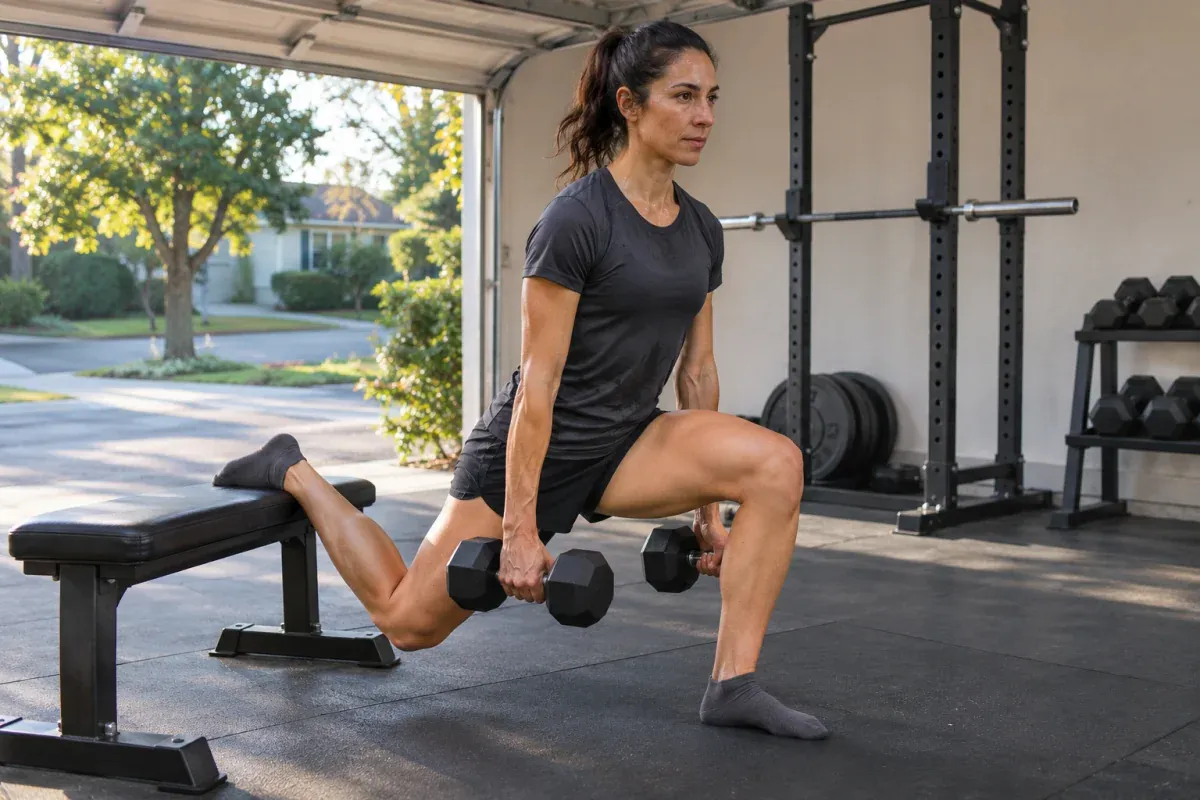
| Split squat | Rear-foot-elevated split squat with dumbbells | Split squat with the back foot on the floor | You land and push off on one leg at a time |
| Hip hinge | Romanian deadlift or trap-bar deadlift | Single-leg Romanian deadlift or hip bridge | Hamstrings and glutes drive the leg back |
| Step-up | Dumbbell step-up onto a knee-height box | Step-up onto a sturdy stair or bench | Single-leg strength in a running-like position |
| Calf raise | Weighted calf raise with straight knees, then bent knees | Single-leg calf raise on a step | Your calves do the most to hold you up on each stride |
| Core (trunk) | Pallof press or cable chop | Side plank or dead bug | Keeps your pelvis and ribcage steady as your legs move |
The calf raise earns its place. In a modeling study of nine runners, the two main calf muscles, the soleus and gastrocnemius, did more than any other muscles to hold the body up at speeds up to 7 meters per second. That's about a 3:50 per mile pace, far faster than any recreational runner goes, so the finding covers every pace you'll run. Do calf raises with straight knees and with bent knees. Bending the knee shifts a little more of the work to the soleus, although the difference is small.

For a complete leg workout with sets, reps and both bodyweight and loaded versions, see our runner's legs guide.
How heavy and how many reps
Start where the guidelines start. The Physical Activity Guidelines for Americans say one set of 8 to 12 reps of each exercise is effective, and two or three sets may be more effective. Each set should go to the point where another rep would be hard to do with good form. That's where you're headed by week three. In the first two weeks, stop a few reps earlier while you learn the moves.
Then build toward heavier work. The American College of Sports Medicine's 2026 position stand recommends at least two sets per exercise, at least twice a week. It found strength improved most with heavier loads (at least 80% of your one-rep max, the most you can lift once), a full range of motion and two to three sets, and when the exercise came early in the session. Training to failure didn't consistently improve results, so you can stop each set with a rep or two left.
You don't need to test your one-rep max. Use reps as your guide. Many of the heavy-lifting runner studies used sets of about 4 to 6 reps with weights the runners could lift only that many times, such as three sets of four to six at 85% to 90% of their max. That's a target for later, once your technique is solid, not for week one.
Where jumps fit
Jumps (plyometrics) train your legs to absorb and return force quickly, as they do with each stride. The evidence is less consistent than for heavy lifting. Jump training improved 2K to 5K time trials in one analysis, but two others found only a trivial effect or no clear effect on running performance. Its economy gains showed up at slower speeds, around 8 minutes per mile or slower.
Give lifting at least a month. The jumps can wait until then. The 12-week plan below puts them in the sessions from week 7 onward. Do short jumps while your legs are still fresh for the work. A small amount is enough at first. Put them first in the session. Try two or three sets with 10 to 20 small hops in place. A few skipping rounds work too. If your calves or Achilles tendons are already sore, leave them out.
No gym?
You can cover your first month or two with bodyweight and a resistance band plus a backpack. Load the backpack with books or water bottles. Single-leg versions make a light load harder. In a split squat or single-leg Romanian deadlift, one leg does the work of two. A set gets harder still when you take three seconds to lower the weight.
Eventually, light loads stop being enough. Moderate loads didn't improve running economy in the research above, so after a couple of months, a gym or a set of adjustable dumbbells is worth it if you want the performance benefits.
Your first 12 weeks of strength training
This is a practical template, not a study protocol. Its ranges come from the guidelines and runner studies above. In the research, the economy gains from heavy lifting came after 6 to 14 weeks, so give it about three months before you judge it.
| Weeks | Sets and reps | How it should feel | Goal |
|---|---|---|---|
| 1–2 | 1–2 sets of 8–12 | Moderate; 3 or more reps left in the tank | Learn the moves and get through the soreness |
| 3–6 | 2–3 sets of 8–12 | Hard; 1–2 reps left | Add weight once you reach 12 good reps on every set |
| 7–12 | Main lifts: 3 sets of 4–6. Other exercises: 2 sets of 8–12 | Main lifts heavy; 1–2 reps left | Build strength; add a few jumps |
| After 12 | 1–2 sessions a week, 2–3 sets | Keep the weights heavy | Hold your gains through race season |
Make the hip hinge and either the squat or split squat your main lifts. For calf raises and trunk work, stick with sets in the 8 to 12 rep range. Raise the weight in small steps. For the week, pick either weight or reps. Stick with that one change. Leave the other alone so weight and reps don't go up together.
Don't cut your running to make room. Nearly all the runner studies added strength sessions on top of normal running, so that's what the evidence supports.
How to schedule running and strength training
Strength training and running don't cancel each other out. A 2022 analysis of 43 studies found that adding endurance training didn't reduce gains in maximal strength or muscle size. A 2024 analysis of 59 studies found that adding strength training didn't hold back aerobic fitness in trained people. The catch is short-term fatigue. A hard leg session can take the edge off your running for a day or two while your legs recover, so where you put it in the week matters.
Four scheduling rules
1. Put heavy leg work on hard days. Lifting on the same day as a quality run keeps your easy days genuinely easy and leaves your legs fresher for the next key run. Expect some next-day fatigue either way. In a small study of trained male runners, a heavy lower-body session left them with much less staying power the next day. When they lifted first and ran six hours later, they could hold a fast pace (above their threshold) for 29% less time the next day than at baseline. When they ran first and lifted later, the drop was 18%.
2. Keep heavy leg work away from your key runs. In a related study, runners' economy was unaffected six hours after a heavy session, but their ability to run hard was reduced. A light session had no effect. Easy running tolerates lifting fatigue, but hard running doesn't. Leave at least a day, and preferably two, between a hard leg session and your next interval or tempo run. That study didn't test long runs, but the same buffer is a sensible precaution so they don't turn into a grind.
3. Separate the two by a few hours when you can. Explosive strength gains were smaller when both sessions happened within about 20 minutes, but not when they were at least three hours apart. In a trial of amateur rugby players, strength gains were lower when the two sessions were back to back than when they were six hours apart. A morning run and an evening lift is the simplest way to do this.
4. Give your legs time to adapt. The first few sessions hit hardest. In studies of men new to lifting, easy-pace running was impaired for up to a day after heavy leg sessions, and the effect eased after the third session. Expect your runs to feel a little heavier for the first two weeks.
Example schedules for 3, 4 and 5 running days
These weeks give you examples you can adjust rather than prescriptions you must follow. The days can move to fit your life. Keep the heavier leg session (A) after a harder run and the lighter session (B) at least two days before your long run.
| Day | 3 runs a week | 4 runs a week | 5 runs a week |
|---|---|---|---|
| Monday | Rest | Rest | Rest |
| Tuesday | Harder run, then strength A later | Quality run, then strength A later | Quality run, then strength A later |
| Wednesday | Rest | Easy run | Easy run |
| Thursday | Easy run and strength B, either order | Strength B | Easy run and strength B, either order |
| Friday | Rest | Rest | Rest |
| Saturday | Long run | Long run | Long run |
| Sunday | Rest | Easy run | Easy run |
- Strength A (heavier): Do your squat, split squat, hinge and calf exercise at the heavier end of your range. Include one trunk exercise as well.
- Strength B (lighter): Use lighter leg work with step-ups, a single-leg hinge and calf raises plus a trunk exercise and a row. Once you're ready for jumps, add a few at the start.
Run or lift first?
It depends on which session matters more that day:
- Hard run day: run first. Lift later, ideally after a few hours. The study in rule 1 found less next-day fatigue with this order.
- Easy run day: either order works. In studies of mostly untrained people, lifting first produced slightly bigger gains in leg strength without affecting aerobic fitness.
- Don't always tack lifting onto the end of a run. In a 24-week trial, recreational male runners who always lifted straight after running kept their strength but didn't gain any.
Back-to-back sessions may be your only option. If so, use them to fit both in. Runners who lifted after running still kept their leg strength and muscle in the same trial. Those who only ran lost some of both. Switch the order on easy days when you can or put a few hours between the two.
How to adjust strength work through a training block
Your strength plan should change with your running. A simple pattern:
- Base building and off-season: Two sessions a week. Work toward heavier lifts during this phase. Your running is easier now so the fatigue costs less than it would otherwise.
- Peak mileage: One or two sessions a week. Keep the weights heavy but cut the number of sets. In a 40-week trial of competitive runners, dropping from two sessions a week to one during the racing season at least maintained their strength and economy gains. That trial was small, but studies in cyclists and general exercisers point the same way: one session a week can hold strength for months if the load stays heavy.
- Race taper: Taper research supports cutting training volume while keeping intensity, but it looked at training in general, not strength sessions. Without strength-specific evidence, a cautious approach is to do your last hard leg session at least a week before race day, keep to one shorter, moderate session in the last week or two, and avoid new exercises.
- After the race: Once normal walking and easy running feel fine, return to strength work starting light as in weeks 1 and 2.
Try not to drop strength training entirely. The recreational runners in the 5K study lost most of their improvement after six weeks without lifting.
Soreness, pain and when to back off
New exercises cause the most soreness, especially the lowering part of each rep. Delayed-onset muscle soreness usually peaks 24 to 72 hours after the session and fades within five to seven days. The good news is that repeating the same exercise causes much less soreness the next time. That's why the first two weeks are the hardest and why starting light pays off.
When your legs are sore:
- Keep the next day or two of running easy. A review of muscle soreness advises lowering intensity for a day or two after a session that leaves you very sore.
- Move a hard workout back a day rather than forcing it.
- Don't add sets or weight until the soreness from your last increase has settled.
Ordinary soreness is an ache in the muscles you worked that follows the timeline above. Some pain is different. Stop and get checked by a doctor or physical therapist if you feel sharp or joint pain during a lift, pain that gets worse from set to set, swelling, or pain that changes how you run. Stop right away and get medical help for chest pain or pressure, dizziness, unusual shortness of breath or a racing heartbeat. The American Heart Association lists these as signs that need immediate medical evaluation.
Most healthy adults don't need a checkup before they start. The Physical Activity Guidelines for Americans say people without chronic conditions or symptoms such as chest pain, dizziness or joint pain most likely don't need to consult a provider first. If you have a chronic condition such as heart disease or diabetes, or any of those symptoms, talk to your doctor before you start and ask how to adapt the plan.
Keep an eye on the bigger picture too. Legs that stay heavy for days can be signs that your total training load is too high. Workouts that keep feeling harder than they should can be signs too. Trim your mileage or drop a strength session for a week. Our guide to why your legs feel heavy when you run covers the other common causes.
Your first week
- Pick your two days from the sample weeks above. Put session A after the week's hardest run. Session B goes at least two days before your long run.
- Take one exercise from every line of the menu. Begin with your bodyweight or a light pair of dumbbells.
- For each exercise, use one or two sets with 8 to 12 reps. Leave three or more reps in reserve when you finish each set. Keep your running just as it is.
- Track how your legs feel during the two days following each session. Let any increase wait. Add a set or a little weight only once you reach week three.
Frequently asked questions
Should I run before or after strength training?
If the run is your hard workout, do it first. Save lifting for later and ideally give yourself a few hours after the run. Trained runners had less next-day fatigue with that order in a small study. Either order works on easy days. In studies of mostly untrained people, lifting before running gave slightly bigger leg-strength gains.
Can I run and lift weights on the same day?
Yes. Running in the morning and lifting in the evening is the easiest way to arrange both. One analysis found smaller explosive strength gains with sessions about 20 minutes apart or less. That wasn't the case when the gap was at least three hours. A few hours after a heavy session, easy running holds up well but hard running doesn't.
Is it okay to lift weights the day before a long run?
Light upper-body and trunk work is fine. Keep heavy leg work out of that day. A heavy lower-body session cut trained runners' time at a fast pace the next day. In one study they held it for 18% to 29% less time. Your leg session needs a buffer. Leave at least two days between it and your long run or hardest workout.
Should runners lift heavy or light?
Learn the moves with light weights, then work toward heavy lifting. Most runners work up to sets of about 4 to 6 reps on squats and hinges after a couple of months. In a 2024 analysis, loads of at least 80% of the most you can lift once improved running economy while moderate loads did not, although heavy lifting did little for the economy of moderately trained runners.
Will strength training make me bulky or slow me down?
Very unlikely. A review of 24 runner studies found virtually no change in body weight, and strength work doesn't lower VO2 max. In that review, time trials improved by 2% to 4% at distances up to 10K, mostly in trained runners. During the first couple of weeks you may find that runs feel heavier than usual. That heavier feeling passes.
How often should runners strength train?
Lifting twice a week is the goal. US guidelines set the minimum at muscle-strengthening activity on 2 or more days a week. In most studies with positive results the runners did two to three strength sessions. When mileage peaks or race season arrives, one heavy session a week can maintain the gains you've made.
Does strength training prevent running injuries?
It might help, but it isn't proven for runners. A 2024 analysis of nine trials with 1,904 runners found that exercise programs didn't clearly reduce running injuries. A supervised hip and core routine did lower injury risk in one trial of novice runners. Lift for performance and general strength and treat fewer injuries as a possible bonus.
Do I need a gym to strength train for running?
Not at first. For the first month or two you can use bodyweight alongside a step and a resistance band. A loaded backpack completes that setup. Heavier loads matter for running economy later. A gym or adjustable dumbbells become worth it if you want those performance benefits.
I completed my first 10K on a dare. In a year, I ran a half-marathon. Another year later, I finished a marathon race. Today I run 4 marathons a year and a half-marathon every week. I learned everything about running the hard way. So, I help runners achieve better results easier.