
Does running build muscle? A little, mostly in your thighs, and mostly if you're new to exercise or coming back after a break. For regular runners, more miles mainly build endurance and help you keep the muscle you already have. Lifting weights is the most reliable way to add size.
If you lift, a few runs a week won't undo your work in the gym, as long as you schedule them sensibly and eat enough to cover both. This guide draws on published studies and current exercise and nutrition guidelines to show who gains muscle from running, which muscles it works, when it can cost you muscle and how to plan a week of running and lifting.
Does running build muscle? It depends on where you start
The clearest gains show up in people who are new to training. In a small 2017 study, 12 college students who hadn't done any formal endurance or strength training in the previous six months ran intervals about three times a week: four 4-minute efforts at 90–95% of maximum heart rate. After 10 weeks, one of their front-thigh muscles, the vastus lateralis, was 10.6% larger in cross-sectional area. A control group of five who didn't do the training showed no change.
The wider research points the same way, with a catch. A review by Konopka and Harber found that aerobic training studies reporting growth averaged gains of more than 7% in thigh muscle size. Most of those studies used cycling, though, and most of the participants were untrained or older adults. If you've been running for years, adding more of the same easy miles is unlikely to make your muscles bigger.
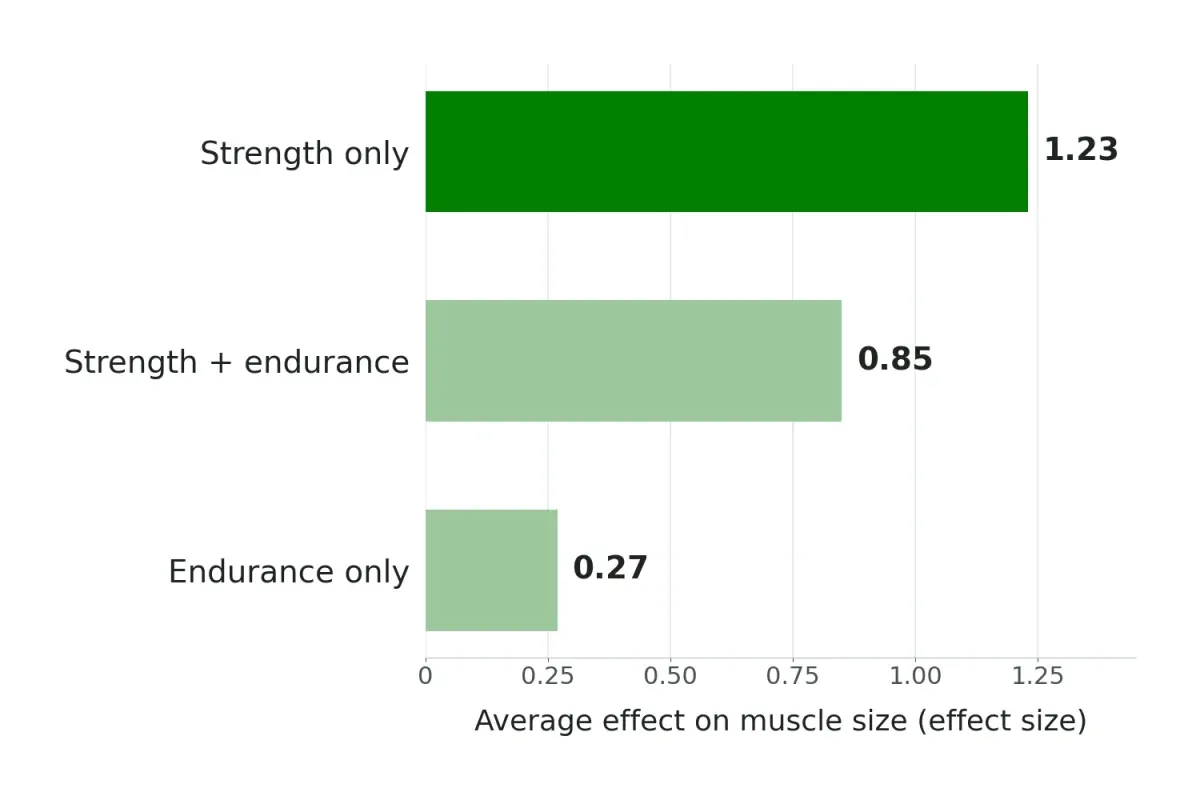
Lifting weights does that job far better. In a 2012 meta-analysis of 21 studies, the average effect on muscle size was 1.23 for strength training and 0.27 for endurance training alone. Those numbers are standardized effect sizes, a statistical measure rather than percentages, but the gap is wide.
| Your situation | What running alone is likely to do | Why |
|---|---|---|
| New to exercise or returning after a long break | Some measurable growth, mostly in the thighs, over the first few months | It's a new stimulus; studies of untrained people found growth within 10 to 12 weeks |
| Regular runner doing mostly easy miles | Keeps the muscle you have, with little or no growth | Your legs have already adapted to that load |
| Regular runner adding hills, strides or intervals | Possibly a small gain, mostly in the legs | Faster, harder efforts demand more force, but average gains are small |
| Lifter adding a few runs a week | Little effect on your lifting gains at moderate volume | The largest recent review found no loss of muscle growth from adding aerobic training |
Why running builds endurance more than size
Every run asks your legs for thousands of fairly light contractions. Your body responds by improving what that job needs, starting with mitochondria, the parts of muscle cells that use oxygen to make energy. A study comparing lifting with endurance exercise found that endurance sessions boosted production of mitochondrial proteins but not myofibrillar proteins, the contractile proteins that make a muscle bigger. Lifting did boost myofibrillar protein production. The endurance exercise in that study was cycling, a similar kind of steady aerobic work to an easy run.
Running mostly trains your slow-twitch (type I) muscle fibers, which resist fatigue. These fibers can grow too: in the cycling studies in Konopka and Harber's review, slow-twitch fibers got about 16% to 20% larger in previously untrained adults over 12 weeks. Fast-twitch (type II) fibers produce more force and are called on when an effort is heavy or fast, like a sprint, a steep climb or a heavy lift. Easy running rarely asks for them.
If you look more muscular after a few months of running, some of that may be less body fat over the same muscle. Distance runners tend to be lean for related reasons, which we cover in why runners are so skinny.
Which muscles does running work?
Running works your whole lower body, but not evenly, and the mix changes with speed. A biomechanics study that modeled leg muscle forces from slow running to all-out sprinting found:
- At slow and moderate speeds, your calf muscles (soleus and gastrocnemius) provide most of the force that holds you up on each step.
- At sprint speeds, your hip muscles do more of the work. The hip flexors, glutes and hamstrings swing your legs through faster.
The switch in that study happened above 7 meters per second (about 15.7 mph, or faster than a 4-minute mile), far quicker than most recreational runners ever go. The trend still matters for your training: the faster and more forceful your stride, the more your hips and hamstrings have to contribute.
Your quadriceps help absorb each landing, and one of them, the vastus lateralis, is the muscle that grew in the interval study above. Your core and arms keep you upright and balanced, but the load on them is light, so running won't add much muscle there. For more detail, see what running does to your legs and whether running can give you abs.
Does running burn muscle?
Not at normal training volumes when you eat enough. Konopka and Harber even point to aerobic exercise as a possible way to slow muscle loss in groups prone to it, such as older adults.
Running can cost you muscle, or some of your gains from lifting, in three situations:
- You eat too little for your training for weeks or months. Sports medicine experts call this low energy availability. Over time it can lead to Relative Energy Deficiency in Sport (REDs), a syndrome that can harm health and performance in both women and men.
- You're cutting calories to lose weight. The International Society of Sports Nutrition (ISSN) protein position stand notes that people who lift may need more protein, 2.3 to 3.1 grams per kilogram of body weight a day, to hold on to lean mass during a calorie deficit.
- You stack long, frequent endurance sessions on top of a lifting program. In the 2012 meta-analysis, longer and more frequent endurance sessions were linked to smaller gains in muscle size, strength and power.
Watch for signs that you aren't eating enough for your training: weight that keeps dropping when you aren't trying to lose it, lifts that keep going backward, feeling worn out most days or, for women, periods that become irregular or stop. If you notice them, eat more, run a little less or both. If the signs continue, if your periods change or if you have a history of disordered eating, talk with a doctor or a registered dietitian who works with athletes.
Will running hurt your gains from lifting?
This worry has a name: the interference effect. It comes from older studies in which people who combined endurance and strength training gained less than people who only lifted. The research has become more reassuring since then:
- 2012, 21 studies: Strength training alone had the largest effect on muscle size (1.23), with combined training lower (0.85). When the endurance work was running rather than cycling, gains in muscle size and strength were significantly smaller. Longer and more frequent endurance sessions were linked to smaller gains.
- 2022, 43 studies: In the largest update so far, adding aerobic training to lifting didn't reduce gains in muscle size or maximal strength, whether the aerobic work was running or cycling. Explosive strength, the kind you use to jump or sprint, improved less, mainly when both workouts were done in the same session rather than at least 3 hours apart.
- 2022, 15 studies of muscle fibers: A fiber-level review found a small negative effect of combined training on fiber growth overall, with early evidence that running, but not cycling, held back growth of slow-twitch fibers.
The bottom line: a few runs a week won't erase your progress in the gym. Whether running costs you anything depends on how much you do, how you schedule it and whether you eat enough to cover both.
How to build muscle while you keep running
Lift at least twice a week
The Physical Activity Guidelines for Americans recommend muscle-strengthening activity at least two days a week. The American College of Sports Medicine's 2026 resistance training position stand says to work all major muscle groups at least twice a week and, if size is your goal, to aim for about 10 sets per muscle group per week.
You don't need a complicated program. ACSM's review found that training to failure, elaborate periodized plans and the choice between machines and free weights didn't consistently change results for healthy adults. Bands, bodyweight and home workouts count too. A simple full-body session could include:
- A squat or split squat
- A hip hinge, such as a Romanian deadlift
- Step-ups or lunges
- A push, such as push-ups or a dumbbell press
- A pull, such as a dumbbell or cable row
Do two to four hard sets of each, stopping when you could still do one or two more reps, and add weight or reps as the sets get easier. If you want a full lower-body session built for runners, use the workout in our runner's legs guide.

Make some runs faster, not just longer
Hills and short fast efforts are the running workouts most likely to add muscle, because they demand more force than easy running. Keep your expectations realistic. A 2025 meta-analysis of high-intensity interval training found that front-thigh size grew by an average of about 4.7% across the 71 participants measured, but most of those studies used cycling rather than running, and the authors rated the certainty of the evidence as low. As in the other research above, the clearest gains came from people who were new to training.
Pick one of these for a single harder session each week, once you've built a base of easy running:
- Hill sprints: Warm up with 10 to 15 minutes of easy running. On a moderately steep hill, run hard uphill for 10 to 15 seconds, then walk back down and rest until you feel ready. Start with four to six repeats and build toward eight to ten over several weeks.
- Intervals: After an easy warm-up, run three or four 3- to 4-minute efforts at a hard but controlled pace, with 2 to 3 minutes of easy jogging between them. You should be able to hold the same pace on the last rep as on the first. The 2017 study above used four 4-minute efforts at 90–95% of maximum heart rate; build up to that rather than starting there.
If your calves or Achilles tendons are already sore, let them settle before you add hill sprints. Mild muscle soreness for a day or two after a new workout is common. Pain that is sharp, keeps getting worse or makes you change your stride is a reason to stop and get it checked by a doctor or physical therapist.
Plan your week so the hard days don't collide
Here's an example week for someone who runs five days and lifts twice. Shift the days to fit your schedule.
| Day | Run | Strength |
|---|---|---|
| Monday | Rest | None |
| Tuesday | Easy run | Session A: full body, heavier legs |
| Wednesday | Easy run | None |
| Thursday | Hill sprints or intervals | None |
| Friday | Rest from running | Session B: full body, upper-body focus, light legs |
| Saturday | Long run | None |
| Sunday | Easy run | None |
A few rules make this work:
- Keep heavy leg work at least a day away from your hardest run and your long run when you can.
- If you run and lift on the same day, separate them by a few hours. In the 2022 review of 43 studies, explosive strength suffered most when both workouts happened in one session.
- Do the session that matters most to you first.
- Hold your running mileage steady while you build the strength habit, then change one thing at a time.
Eat enough protein and enough food
The ISSN recommends 1.4 to 2.0 grams of protein per kilogram of body weight per day for most people who exercise. A meta-analysis of 49 trials found that extra protein stopped boosting muscle gains from lifting at around 1.6 grams per kilogram per day. For a 150-pound (68 kg) runner, the ISSN range works out to about 95 to 136 grams a day.
Spread it out. The ISSN suggests 20 to 40 grams per meal, every three to four hours. Meat, fish, eggs, dairy, soy and beans all count. Don't cut carbs to make room for protein: the same position stand advises endurance athletes to focus on getting enough carbohydrate to perform well.
To add muscle, you generally need to eat a little more than you burn. Guidance for lifters in a muscle-building phase suggests a small surplus, about 10% to 20% above the calories you need to maintain your weight, aiming to gain roughly 0.25% to 0.5% of body weight a week. For a 150-pound person, that's about 0.4 to 0.75 pound a week. That guidance was written for bodybuilders, so treat it as a ceiling rather than a target if running performance matters to you. If the scale is climbing faster than you expected, our guide to gaining weight while running covers the usual reasons. If you have a history of disordered eating, skip the numbers and work with a registered dietitian.
Where to start this week
Pick your two strength days, plan one hill or interval session once your easy running feels comfortable and check that each meal has a solid serving of protein. Give it 10 to 12 weeks before you judge the results.
Frequently asked questions
Does jogging build muscle?
Slow jogging mainly builds endurance. If you're new to exercise, you may gain a little thigh muscle in the first few months, but regular joggers mostly maintain what they have. To add size, lift weights at least twice a week and make some runs faster or hillier.
Does running build belly or upper-body muscle?
Not much. Your core works to keep you upright and your arms swing in rhythm, but the load is light compared with lifting. Core and upper-body strength exercises do far more, and our guide to whether running gives you abs explains what makes abs visible.
Can you build muscle while training for a marathon?
You can keep muscle and may gain some, but it's harder during high-mileage weeks. In a 2012 meta-analysis, longer and more frequent endurance sessions were linked to smaller strength-training gains. Keep two strength sessions a week, eat enough to cover your mileage and aim to maintain muscle during peak weeks rather than build it.
Should you lift or run first?
Put the session that matters most to you first. If you do both on the same day, separate them by a few hours when you can. A 2022 review found that explosive strength gains suffered most when running and lifting happened in the same session.
How long does it take to see a difference?
Research on people new to training has found measurable muscle growth after 10 to 12 weeks of running or other aerobic training. Visible changes vary from person to person. Give a consistent plan about three months before you judge it.
Does running make you skinny or muscular?
Neither on its own. Running burns energy, so it can lower body fat and make the muscle you have easier to see, while adding little size for most regular runners. Lifting and eating enough are what add muscle. Our article on why runners are so skinny explains why distance runners tend to be lean.
How much protein do runners need to build muscle?
The International Society of Sports Nutrition recommends 1.4 to 2.0 grams per kilogram of body weight per day for most people who exercise. In a large meta-analysis, extra protein stopped boosting muscle gains from lifting at around 1.6 grams per kilogram. For a 150-pound runner, the ISSN range is about 95 to 136 grams a day, spread over meals.
I completed my first 10K on a dare. In a year, I ran a half-marathon. Another year later, I finished a marathon race. Today I run 4 marathons a year and a half-marathon every week. I learned everything about running the hard way. So, I help runners achieve better results easier.