
Summarize this article with AI
Running in the rain is usually safe. Rain often feels surprisingly pleasant. You might not guess that from a look out the window. The real risks are what can come with the rain. They include lightning and floodwater along with cold wind-driven rain and dark roads where drivers see less. If none of those are in play, you can dress for the temperature, put on a cap and go.
This guide starts before you leave. It helps you make that call and choose what to wear by temperature, adjust your footing and visibility during the run and warm back up and dry your shoes afterward. The safety advice comes from published studies and the National Weather Service, the CDC and NHTSA. It doesn't come from gear marketing.
Is it safe to run in the rain?
Usually, yes. In comfortable temperatures rain is just weather. That applies to a light shower or steady rain. You'll be wet with shoes that squelch. A few adjustments are all it takes. With those in place the run carries no more risk than a dry-day run.
Thunder and lightning change the plan. So do flooding and strong wind along with cold and darkness. Give the conditions a quick check before heading out.
| Conditions | What to do |
|---|---|
| Light or steady rain, mild temperature, daylight | Run as planned. Dress for the temperature, wear a cap and expect wet feet. |
| Heavy rain, puddles everywhere, or rain after dark | Run, but adjust. Pick a familiar loop with sidewalks or paved paths, add lights and reflective gear, and slow down on slick surfaces. |
| Cold rain, roughly 33 to 49°F (1 to 9°C), or rain with strong wind | Shorten the run and stay close to home. Wear a shell, a hat and gloves, and have dry clothes ready. |
| Thunder, lightning or thunderstorms nearby | Move the run indoors or reschedule it. Wait until 30 minutes after the last thunder before heading out. |
| A flood warning for your area, or water flowing across roads or trails | Stay off flooded routes. Run indoors or on another day. |
| Freezing rain, sleet or icy surfaces | Stay inside or reschedule. The footing is the danger. |
You can still get the workout done on a no-go day. A treadmill is an option, and our treadmill pace chart matches each speed setting to a pace. You could take a rest day instead. Cross-training at home is another option for replacing that workout.
What to do if thunder starts mid-run
The National Weather Service rule is short: when thunder roars, go indoors. If you can hear thunder, you're likely within striking distance, and the NWS says there is no safe place outside when thunderstorms are around. Its sports safety page says a significant lightning threat extends about 6 to 10 miles out from the base of a storm. It also notes that traffic, wind and rain can make thunder harder to hear, so take out an earbud or turn your music down when the sky darkens.
Don't wait for an alert. The NWS doesn't issue severe thunderstorm warnings for lightning, because every thunderstorm produces it.
Head for real shelter: a substantial building with wiring and plumbing, such as a store, gym or home, or a hard-topped car with the windows closed. The NWS lists picnic shelters, covered patios, sheds, tents and dugouts as unsafe, and an open bus shelter is no better. Don't shelter under a tree, either. The NWS myths page says being under a tree is the second leading cause of lightning casualties.
If no shelter is close, keep moving toward one. Stay away from tall, isolated trees, open fields and hilltops, water, and metal fences or railings. The old "lightning crouch" is now on the NWS myths list: crouching doesn't make you any safer, so spend that time getting to a building or car. Once you're inside, wait 30 minutes after the last thunder before you go back out.
Runners do get caught. In an NWS analysis of lightning deaths from 2006 to 2019, running accounted for 23% of the deaths that happened during sports. If someone near you is struck, call 911. Lightning victims don't carry an electrical charge, so it's safe to touch them and start CPR if needed.
Flooded roads and paths
Never run through water flowing across a road or path. According to the NWS, just 6 inches of fast-moving floodwater can knock over an adult, and walking into or near floodwater is one of the most common causes of flood deaths. Floodwater can also hide sharp debris and spots where the path has washed out.
Flash floods can build within hours, and urban areas and creeks are especially prone. After heavy rain, skip low underpasses, creekside greenways and riverside paths until the water drops. A Flood Watch means flooding is possible. A Flash Flood Warning means it is happening or about to, and you should get to high ground.
What to wear running in the rain
Start with the temperature. Choose your clothes for that before you decide on rain protection. Steady rain will soak whatever clothes you're wearing. You aren't trying to stay dry. The aim is to feel warm and comfortable for the run you're doing.
Two things matter most. First, wear thin layers and leave heavy cotton at home. Wet layers chill you, and thick fabric holds the most water. In Canadian defense lab tests, the amount of water a fabric held depended on its thickness more than its fiber, and drying time followed the water it held. A heavy cotton sweatshirt turns into a cold, soggy weight, while a thin running shirt holds much less. Second, don't overdress. You warm up within the first mile, and a heavy jacket on a mild day leaves you soaked in sweat from the inside.
Treat this as a starting point, and adjust it if you tend to run hot or cold:
| Temperature | Top | Legs | Extras |
|---|---|---|---|
| 60°F (16°C) and up | Short-sleeve technical shirt or singlet; usually no jacket | Shorts | Cap with a brim, anti-chafe balm |
| 50 to 60°F (10 to 16°C) | Short- or long-sleeve technical shirt; a light water-resistant shell if it's windy | Shorts | Cap |
| 40 to 50°F (4 to 10°C) | Long-sleeve base layer under a water-resistant or waterproof shell | Shorts or tights | Cap, light gloves |
| Below 40°F (4°C) | Base layer, plus a mid-layer if needed, under a waterproof-breathable shell | Tights | Cap or beanie under the hood, gloves; consider moving the run indoors near freezing |
Should you wear a waterproof or water-resistant jacket?
A water-resistant wind shell breathes well without weighing much. Light drizzle and brief showers roll off it. Heavy rain gets through it if it lasts long enough. A waterproof-breathable jacket is better suited to cold rain. It keeps rain out for longer and gives you more protection from the wind. More heat and sweat stay trapped inside, so on a warm day you can end up nearly as wet as you would with no jacket at all.
Whichever rain jacket you choose, look for vents, a hood that stays put and cuffs you can pull over your hands. Most runners don't need rain pants; shorts or tights work. The American College of Sports Medicine's guidance on exercising in the cold suggests wearing an outer shell during exercise only when it's raining or very windy, and carrying dry clothes to change into. Save the plastic poncho or trash bag for standing around at a start line, since running in one traps heat.
Hat and glasses
Of all your rain accessories, a brimmed cap may be the most useful. A cap helps your glasses stay clearer. Water stays out of your eyes. That makes being in the rain much less annoying than it would be. Clear-lens sport glasses are another way some runners keep wind-driven rain out. A downpour can leave those lenses fogged. It can also leave the lenses covered in beads of water instead.
Shoes and socks
Wet feet blister more easily. Damp skin grips fabric harder than dry skin: a review of skin friction research found friction on wet skin typically 2 to 4 times higher than on dry skin, and in a lab study, skin rubbing on completely wet fabric had more than twice the friction of dry fabric. Soaked socks rub more, not less.
Choose snug synthetic or wool-blend running socks rather than everyday cotton ones. In a study of distance runners, padded acrylic socks led to fewer and smaller blisters than the same socks in cotton. A follow-up with a generic cushion-sole sock found no difference between the two fibers, so padding and construction seem to matter as much as the fiber itself. On a long, wet run, a dry pair waiting in your bag or car is worth having.
You can use your usual running shoes. An older pair works if the tread is still good. Your newer pair can wait for a dry day or race day. Keep the laces snug. That keeps the wet shoe from shifting around as your foot moves inside it.
Splashes and wet grass stay outside waterproof shoes. They're helpful on a cold and damp trail run. They're less helpful in a downpour. The ankle opening still lets water in. Deep puddles and rain that runs down your legs can both get water inside. The waterproof lining keeps it from draining out of the shoe as quickly. Drainage helps in warm rain. You'll usually be more comfortable in a shoe that drains and lets air through.
Be easy to see
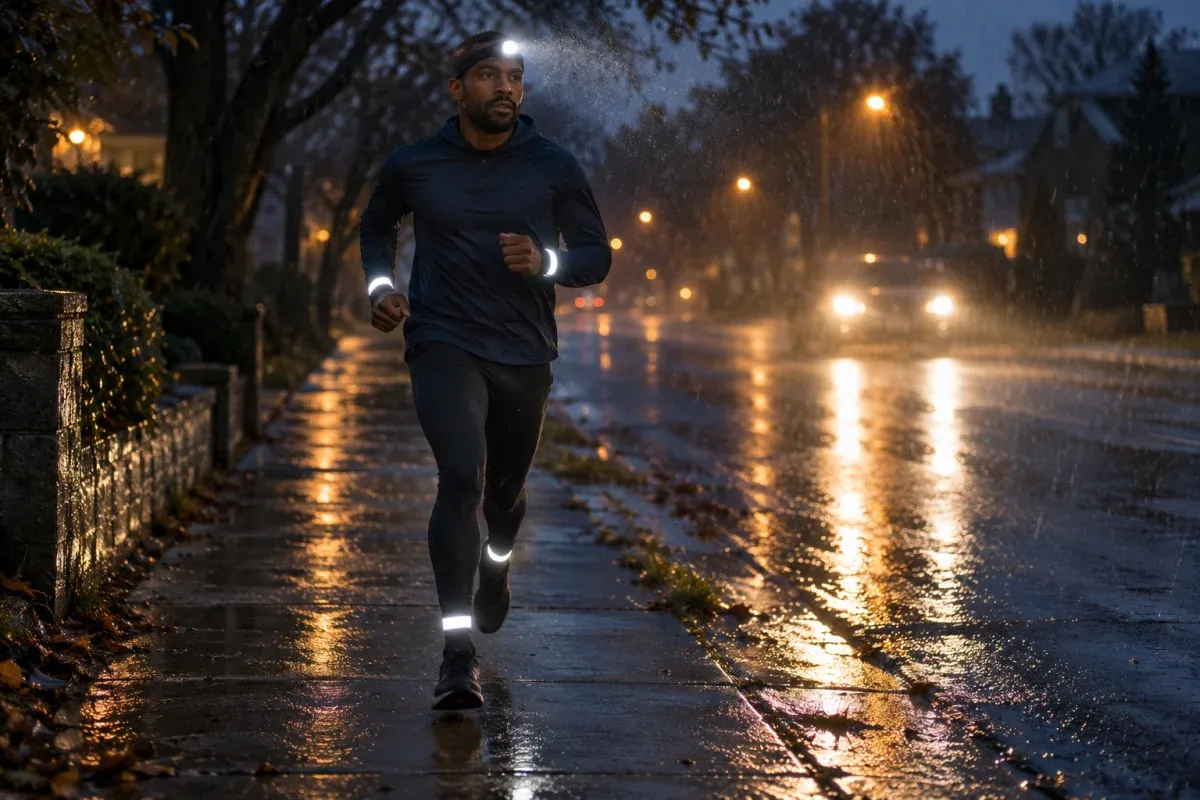
Rain and darkness both make it harder for drivers to see you. NHTSA counts runners as pedestrians, and 76% of pedestrian deaths in 2024 happened in the dark. Its safety tips warn drivers that pedestrians are harder to see at night and in poor weather.
Bright and neon colors help in daylight. At night, retroreflective material does far more, and people tend to get this backward. In a 2024 study, observers overestimated how bright fluorescent materials would look in headlights and underestimated retroreflective ones.
Where you put the reflective material matters too. In a study of drivers on a closed road at night, pedestrians wearing a reflective vest plus reflective markers on their joints, placed to show the body's movement, were recognized at about 319 meters (roughly 1,050 feet), compared with about 185 meters (roughly 600 feet) for the vest alone. In another study, a reflective vest on its own did no better than no reflective markings at all, while bands on just the ankles and wrists were picked out from surprisingly far away. Moving reflectors show a driver the shape of a person in motion. These tests were run at night in dry weather; none of them tested rain.
Most people also overestimate how visible they are. In one study, pedestrians overestimated their own visibility at night and badly underestimated how much reflective gear helped. So wear reflective bands on your ankles and wrists, add a headlamp or chest light to see the path, and clip a small blinking light on your back.
Prevent chafing
Wet fabric clings and rubs. That means chafing shows up faster on rainy runs than it otherwise would. Before you go put anti-chafe balm or petroleum jelly on your inner thighs and underarms. Put it on your sports-bra line and nipples too. Clothes that fit snugly move less against your skin than ones that are loose. See our guides on preventing chafing and jogger's nipple for the details.
Keep your phone dry
Water-resistance ratings come from lab tests in still water, and Apple says that resistance isn't permanent and can decrease with normal wear. A wet screen can also stop responding to your finger, as Samsung notes. Seal your phone in a zip-top bag or a waterproof pouch and carry it in a zippered pocket or running belt. Our guide to carrying your phone while running covers options that don't bounce. If it does get soaked, dry it with a cloth and let it air-dry. Apple advises against heat, compressed air or a bag of rice, and against charging an iPhone while it's wet.
How to run in the rain
Choose your route before heading out. Use a familiar loop. Pick sidewalks or paved paths on a route that drains well when it rains. After dark the route needs lights. Keep those loops near home. That way you can shorten the run if the weather takes a turn.
Watch your footing. Painted road lines and crosswalk stripes have less grip than bare pavement when wet. In a small Korean sidewalk study, wet steel manhole covers tested far slipperier than the paving around them, so treat metal grates with the same caution. Wet leaves and wooden boardwalks call for care too. On those surfaces, on turns and on downhills, shorten your stride and keep your feet under your body. In a lab study of walking, people who expected a slippery floor took shorter steps and landed flatter, which cut the grip they needed by 16% to 33%.
Deep puddles can hide potholes. Go around them when you can. Once your feet are soaked, there's little point in tiptoeing around shallow puddles.
Expect drivers to see less and need longer to stop on wet roads. If there's no sidewalk, run on the shoulder facing traffic, as NHTSA advises, and never assume a driver has seen you.
Run by effort, not pace. Wet footing, a soaked shirt and a headwind can all slow you down, and that's fine. In a lab study, men who ran for an hour at 50°F (10°C) in rain and wind used more oxygen and rated the effort harder than on the same run in dry, still air. If the footing is bad, save fast intervals for a dry day, a track or a treadmill.
You still sweat in cool rain, and the National Athletic Trainers' Association notes that cold weather blunts thirst. On longer runs, drink when you're thirsty, even if you feel cool. The same statement calls drinking to thirst a safe way to avoid overdrinking when you don't know your sweat rate, so don't force down more than you lose in sweat.
Running in cold rain
Cold rain is where a rainy run can turn dangerous. Water pulls heat from your skin faster than air does, and wet skin also cools as the water evaporates. The American College of Sports Medicine says wet or damp conditions greatly increase the risk of cold injury, and wind adds to the heat loss by reducing how well your clothes insulate.
You don't need freezing weather for trouble. The CDC says hypothermia can occur even above 40°F when a person gets chilled from rain, sweat or cold water. Frostbite is different: the NWS says the air itself must be below freezing for it to develop.
Moving keeps you warm, and slowing down is when cold rain catches up with you. In a lab study, men walked in 41°F (5°C) air with heavy simulated rain and wind and no rain gear. Eleven of the 18 couldn't finish, and one who couldn't keep up the walking pace cooled rapidly. A walk break, a long stop at a light or an injury far from home can all chill you quickly.
In adults the CDC lists hypothermia warning signs. These include confusion and fumbling hands along with shivering and exhaustion (or feeling very tired). Drowsiness, memory loss and slurred speech are on the list too. Stop the run and get indoors or into a car if you start shivering hard or feel clumsy or can't think clearly. Remove wet clothes, warm the center of your body first (chest, neck, head and groin) and have a warm, non-alcoholic drink. The CDC calls hypothermia a medical emergency. Get medical care as soon as possible if you suspect it. Keep warming up in the meantime. Get medical attention immediately if body temperature is below 95°F (35°C). If someone is unconscious, call 911 and don't try to give them anything to drink.
You can lower the risk:
- Run loops past your house or car or keep cold-rain runs short and close to home.
- Wear a wind-blocking shell with a hat and gloves.
- Run into the wind on the way out if it's windy. On the way home, when you're wetter and more tired, the wind will be at your back.
- Bring a buddy if you'll be running at an easy pace in cold rain.
- Have a towel and dry clothes waiting for you along with a warm layer.
Race day in the rain
Race day may be wet. A few rainy training runs are good practice because you can't count on dry weather. Use these tips if race day turns out rainy:
- Keep a throwaway layer on while waiting. A large trash bag with arm and head holes also works at the start. Then drop it where the race allows.
- You can warm up in an old pair of shoes and socks if possible. Your race pair can wait until just before the start.
- Use more anti-chafe balm than usual. Cover your nipples too if your shirt tends to rub against them when you race.
- Take care on tight turns, painted lines and metal covers.
- Race by effort. Cold and windy conditions are a reason to expect a slower time on race day.
- Pack for after the race too. Your gear-check bag should hold a towel, dry clothes and a warm layer for when you're done.
Plan the finish as carefully as the start, because you cool quickly once you stop running. At the 2018 Boston Marathon, run in cold wind and heavy rain, 2,785 runners received medical attention, according to B.A.A. figures reported by Boston Magazine.
After your run: warm up and dry out
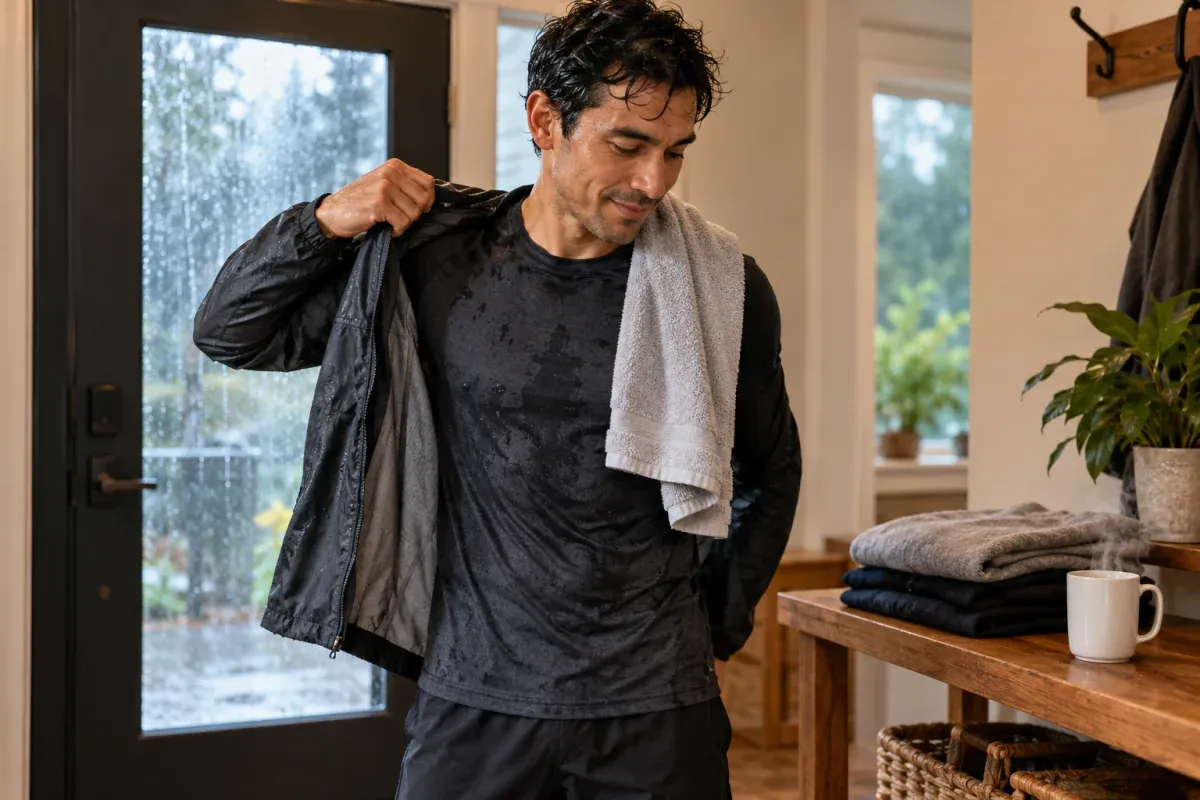
Change out of wet clothes as soon as you finish. Once you stop moving, your body keeps cooling. Wet fabric speeds that up. After you dry off, put on warm layers and have something warm to drink.
Then dry your shoes:
- Take the insoles out and loosen up the laces.
- Stuff newspaper or paper towels inside. Replace the stuffing when it's soaked rather than leaving wet paper in the shoes.
- Leave them to dry at room temperature. Choose a place where air can move freely all around the shoes. Drying can go faster with an unheated fan.
Skip the clothes dryer, radiator and other direct heat. Brooks, ASICS and Nike all warn that heat can warp the foam or fabric, shrink the shoe or damage the glue, and Nike advises against drying shoes in direct sun. Plan on about a day: New Balance suggests letting shoes air-dry for 24 hours before you wear them. That's one good reason to rotate two pairs. Hang your jacket and clothes to dry rather than leaving them in a bag.
Is running in the rain bad for you?
No. Running in the rain is no worse than running in dry weather. This applies to most healthy runners. That holds as long as you steer clear of lightning, floodwater and ice. You also need to get warm and dry afterward.
The old warning that rain gives you a cold isn't quite right. Colds are viral infections, and you catch them from viruses, not from weather. There is a wrinkle. In a study of 180 adults, 13 of the 90 who had their feet chilled in cold water reported a cold within 4 to 5 days, compared with 5 of the 90 who didn't. The colds were self-reported, not confirmed by virus tests, and one proposed explanation is that chilling can bring out symptoms of an infection someone already had. Getting dry and warm soon after a cold, wet run is sensible either way.
Regular exercise may even help. In a 12-week study of 1,002 adults through fall and winter, those who did aerobic exercise at least five days a week had 43% fewer days with colds and other upper respiratory infections than those who exercised one day a week or less. That's an association, not proof.
Rain has its good points. It keeps you cool on warm days. The usual paths are less crowded and you get practice for a wet race day.
Frequently asked questions
Is it bad to run in the rain?
No. For most healthy runners, light or steady rain carries about the same risk as a dry day. Skip or move the run when there's thunder or lightning or flooding. The same goes for icy surfaces or cold wind-driven rain. Change into dry clothes soon after finishing.
Can you get sick from running in the rain?
The rain doesn't give you a cold. Viruses do. One study found that people whose feet were chilled in cold water reported more colds over the next few days. That was possibly because chilling brought out an infection they already had. Soon after a cold and wet run, getting dry and warm is a sensible habit.
What should I wear to run in the rain?
Start with the temperature. Use that to choose your clothes before you add any rain protection. Wear thin layers and skip the heavy cotton. Your running socks should fit snugly. Wear shoes with good tread and a cap with a brim as well. A light shell helps when it's cool or windy. Cold rain calls for a warm hat and gloves along with that shell.
Do I need a waterproof jacket for running in the rain?
Not always. In mild temperatures a light water-resistant shell is all you need for drizzle. You may feel more comfortable without a jacket when you're running in warm rain. Staying warm comes before staying cool. That's the priority in cold rain or rain that's long and steady. A waterproof-breathable jacket is a sensible choice then.
What should I do if I hear thunder while running?
Get indoors to a substantial building. You can also get into a hard-topped car with the windows closed. Keep moving toward one if neither is close. Crouching doesn't make you safer. Picnic shelters, sheds and trees don't protect you. Before you head back out, wait 30 minutes after the last thunder.
Can I run in the rain in regular running shoes?
Yes. Your usual running shoes are fine to wear. An older pair is ideal, as long as its tread is still good. After the run remove the insoles. Use newspaper or paper towels to stuff the shoes. Let the shoes air-dry. Don't try to speed things up by using a dryer or heater.
How do I keep my phone dry while running in the rain?
Before carrying it, seal it. Use a zip-top bag or waterproof pouch. Then put it in a zippered pocket or belt for the run. Water resistance can decrease over time. A wet screen may no longer respond to your touch. If it's soaked, leave the phone to air-dry. Plug it in to charge only once it's dry.
I completed my first 10K on a dare. In a year, I ran a half-marathon. Another year later, I finished a marathon race. Today I run 4 marathons a year and a half-marathon every week. I learned everything about running the hard way. So, I help runners achieve better results easier.