Summarize this article with AI
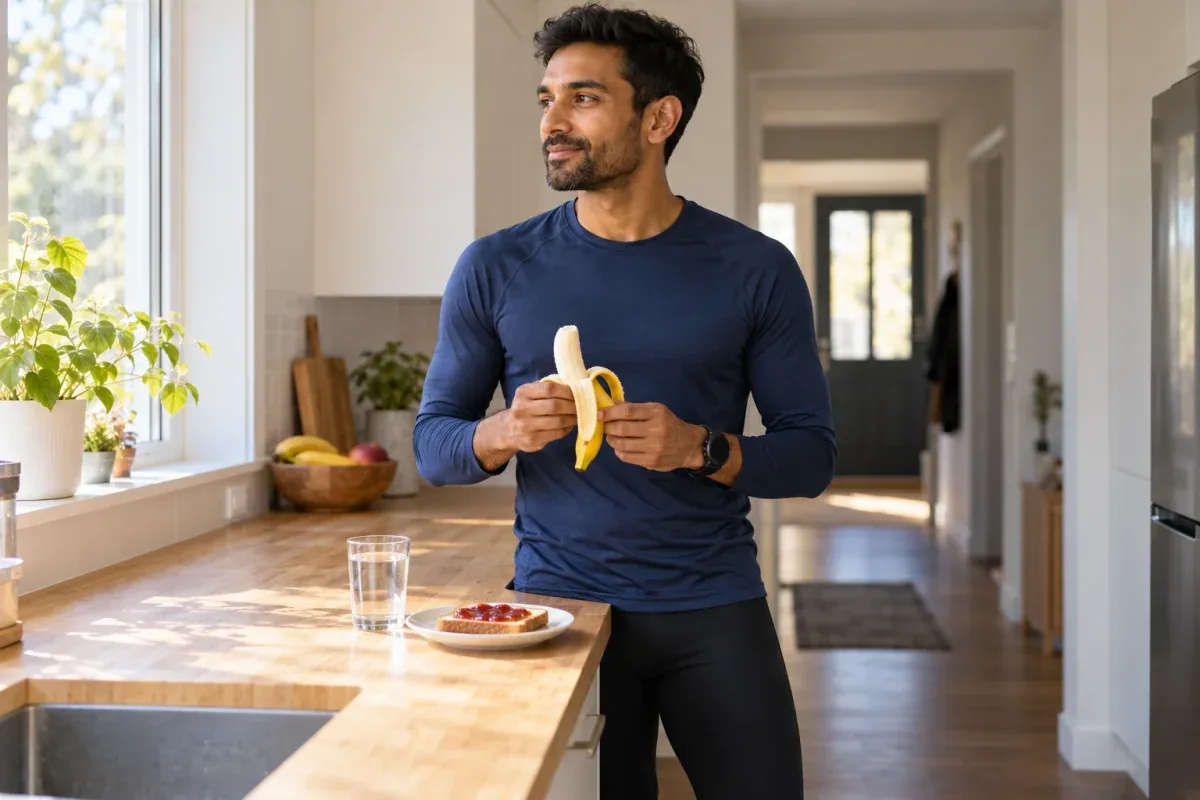
Your timing and effort shape what to eat before a run. Look at the run you've planned. Consider its length and effort along with how much time you have before starting. Keep it simple when you do need fuel (easy-to-digest carbs with little fat or fiber). Eat your normal meal with 3 to 4 hours to go before starting. You need less time after a small snack. Try a banana or toast with jam 30 to 60 minutes before heading out. For an easy run lasting less than an hour, your usual meals often cover what you need.
The advice below comes from sports nutrition position statements and published studies. The carb counts for common foods here come from USDA data. Treat it as a starting point, and use easy runs to check what agrees with your stomach before you rely on a food for a long run or race.
How long before a run should you eat?
Eat smaller and simpler as the start gets closer. Give a full meal a few hours to settle before running. A banana or a slice of toast with jam works within the hour.
Mayo Clinic's exercise nutrition guidance says to eat large meals at least 3 to 4 hours before exercise and small meals or snacks about 1 to 3 hours before. Liquids leave the stomach faster than solid food, and bigger, higher-calorie or fattier meals empty more slowly, as this review of gastric emptying explains. That's why juice or a sports drink is the easy choice when you're short on time.
Choose food based on how much time you have left:
| Time before your run | What to eat | Examples |
|---|---|---|
| 3 to 4 hours | A normal meal built around carbs, with some protein and only a little fat | Oatmeal with banana and honey; a bagel with eggs; rice or potatoes with chicken |
| 1 to 2 hours | A small meal or bigger snack, mostly carbs | Toast with jam and a banana; low-fat fruit yogurt; cereal with milk |
| 30 to 60 minutes | A light carb snack that's easy to digest | A banana; toast with honey; a handful of pretzels; applesauce |
| Less than 30 minutes | Something small or liquid, or nothing at all | A few gulps of juice or sports drink; a date; a couple of crackers |
In the last hour, simple low-fiber carbs such as white toast, honey, jam and bananas are the usual choice. Complex carbs like oatmeal and whole-grain bread carry more fiber, so save them for meals at least an hour or two before you head out.
How much should you eat?
For runs longer than about an hour, sports nutrition guidance suggests 1 to 4 grams of carbohydrate per kilogram of body weight, eaten 1 to 4 hours before. That range comes from the joint position of the American College of Sports Medicine and dietitian groups, and the international consensus for distance runners uses the same numbers. Eat toward the low end when the run is close and the high end only when you have several hours.
Take a runner who weighs 150 pounds (68 kilograms) as an example. At the low end, that runner would eat about 68 grams of carbs one hour out. A medium bagel topped with a tablespoon of jam provides about 69. Four hours out, the top of the range is 272 grams, which is a very large carb-heavy breakfast. These numbers were written for athletes before longer sessions. There's no need to count grams before an easy 3-mile run.
Can eating a snack an hour before running cause a sugar crash?
Probably not. A long-running worry says carbs in the hour before exercise spike insulin and leave you shaky. A review of pre-exercise carbohydrate research called the advice to avoid carbs in that hour "unfounded." It found the shaky feeling is rarely tied to truly low blood sugar and doesn't seem to hurt performance.
Some people do still feel shaky. If that happens to you, try a different time for your snack. You could snack right before heading out. Other options are eating during your warm-up or skipping carbs in the 90 minutes before the run. Most of this research comes from small lab studies of trained cyclists, so let your own runs decide.
Do you need to eat before every run?
No. Start with the time of your last meal. The run's length and intensity also affect whether you need to eat something before starting.
Short, easy runs
If you ate a meal in the last few hours, you probably don't need anything extra before an easy run of less than an hour. Mayo Clinic notes that a snack right before a workout shorter than 60 minutes probably won't give you added energy, though it may keep you from feeling hungry. A review of 46 studies found that eating beforehand improved longer aerobic exercise but not shorter efforts.
Have something small anyway if you're hungry, if many hours have passed since your last meal, or if you tend to feel shaky or lightheaded without food. If you're new and building up with short run-walk sessions like the ones in our beginner running plan, your normal meals usually cover it.
Speed work and tempo runs
Aim for some carbs before hard sessions, with nothing heavy in your stomach when the workout starts. A light snack 30 to 60 minutes before gives you energy without a full stomach bouncing through your intervals. A small meal works too if you eat it 1 to 2 hours before. Keep it simple: a banana, toast with honey or a few crackers.
Long runs
For a run longer than an hour, plan a carb-focused meal 2 to 4 hours beforehand. If you're heading out early, have a bigger snack 1 to 2 hours before instead. The pre-run meal matters more as the run gets longer. Once a run goes past an hour, Mayo Clinic says carbs during the run may help too. Our hitting the wall guide covers fueling on the move.
What to eat before a morning run
Morning runs are the tricky ones because you start after an overnight fast. In a study of fit young men, liver glycogen dropped 21% to 23% overnight, while glycogen in the muscles didn't drop. Your liver uses its store to keep blood sugar steady, and your leg muscles draw on their own. That helps explain why many runners can handle a short easy run before breakfast, and why a long or hard morning session goes better with some carbs first.
For a morning workout, Mayo Clinic suggests finishing breakfast at least an hour before you exercise. For an earlier start, it suggests a light meal or a sports drink. Let the time before you leave guide your choice:
- Out the door in 10 to 15 minutes: half a banana, a Medjool date (about 18 grams of carbs) or a small glass of juice. A full 8-ounce glass of orange juice has about 25 grams.
- 30 to 60 minutes: a whole banana (about 27 grams) or a slice of white toast with a tablespoon of jam or honey (about 28 to 31 grams).
- Long run or race: get up early enough for a carb-focused breakfast 2 to 4 hours before the start. When that isn't realistic, have a bigger snack 1 to 2 hours before instead. Bring carbs for the run if it's long.
If you can't face food early, try liquids. Juice or a sports drink often goes down when toast won't.
What to eat before an afternoon or evening run
Lunch counts. A normal lunch 3 to 4 hours before an afternoon run may be all you need. That's especially true for an easy run.
Lunch may be five or six hours back by the time you run after work. An afternoon snack fills that gap. Eat that snack 30 to 90 minutes before heading out:
- a banana or another piece of fruit
- a 6-ounce cup of low-fat fruit yogurt (about 32 grams of carbs)
- an ounce of pretzels (about 23 grams) or a few graham crackers
- a slice of toast or half a bagel with jam
Skip a big, rich lunch in the hours before a hard session. If you're running soon after lunch, keep that meal lighter. A snack later in the day can make up the difference.
What to eat before a long run or race
Your long runs are the place to settle on a pre-race breakfast. Eat it 2 to 4 hours before you start, built around carbs that sit well with you, with only a little fat, fiber and protein. That matches the runner consensus, which advises reducing fat, fiber and protein depending on your risk of gut trouble. A few simple combinations:
- a medium bagel with jam and a banana (about 96 grams of carbs)
- a cup of oatmeal with a banana and a tablespoon of honey (about 72 grams)
- a cup of white rice with a scrambled egg (about 45 grams)
Then stick with it. A review on training the gut recommends practicing your race nutrition in training, and Mayo Clinic warns against adding new products before a long event. Race morning is not the day to try a new bar, gel or breakfast.

The distance determines how much food you'll need. At a 10-minute-mile pace, a 5K takes 31 minutes to finish, so a light breakfast or a snack an hour before the run is usually plenty. Half and full marathons call for a bigger breakfast plus carbs during the race. The runner consensus also suggests a small carb snack during the warm-up, especially for morning races. If nerves kill your appetite, the joint position notes that liquid meals can be easier to get down.
Is it OK to run on an empty stomach?
It can be OK to skip food before a short, easy run, as long as you feel good doing it. Heading out first thing without food suits some runners, so let your own preference guide that choice. Just don't treat it as a shortcut to fitness or fat loss.
Exercising on an empty stomach does burn more fat during the workout itself. A meta-analysis of 27 studies found higher fat burning in the fasted state. That didn't translate into more fat loss in a 4-week trial in 20 women eating in a calorie deficit: body composition changed about the same whether they trained fasted or fed. Our article on whether running burns fat covers the bigger picture.
Eating first is the better choice when:
- the run is long, since eating first helps longer efforts more than short ones
- it's a hard workout you want to run well
- you feel sluggish or lightheaded when you run before breakfast, which Mayo Clinic lists as a possible result of skipping food
- you use insulin or another medicine that lowers blood sugar (see the personal advice section below)
- you've been eating less than your training needs, or have a history of disordered eating
Repeated under-fueling is more than a bad run. The International Olympic Committee describes low energy availability, or taking in too little energy for the training you do, as harmful to both health and performance. Low fuel is also one of the common reasons your legs feel heavy on runs.
What not to eat right before a run
Stomach trouble is common in endurance sports. A review of gut complaints during exercise estimates that 30% to 50% of athletes experience them. The same review links fiber, fat, protein and fructose to a greater risk of symptoms, while noting that the research behind its advice is limited. In a survey of 55 triathletes, everyone with intestinal cramps had eaten fiber-rich foods in their pre-race meal, compared with 10% of those without cramps.
Go easy on the following in the hour or two before a run:
- High-fat foods: fried food, bacon, sausage, pastries and big spoonfuls of nut butter. Fat slows how fast your stomach empties.
- High-fiber foods: beans, lentils, bran cereal and big salads.
- Large protein portions: a big steak or a large protein shake. The joint position advises keeping protein low to moderate in the meal before your event.
- Big portions of anything: a huge meal needs hours to settle, not minutes.
- Spicy food, sugar-free sweets and, for some people, caffeine or dairy: the American Medical Society for Sports Medicine lists caffeine, fiber, sorbitol, dairy and spicy food among possible triggers for gut trouble on runs. If coffee or yogurt sits fine before your runs, you don't need to cut it.
- Anything new before a key run: try it on an easy day first.
It's a question of when you eat these foods. Whole grains, beans and vegetables still belong in your diet; eat them at meals well before or after your runs. If the stomach trouble keeps coming back, see our runner's trots guide for triggers and advice on when to get checked.
Water and coffee before you run
How much water to drink
If you drink normally through the day, you probably don't need to load up. The National Athletic Trainers' Association says recreational athletes shouldn't need extra fluids before activity but should start out hydrated. Thirst and urine color are easy checks.
If you do need to catch up, the American College of Sports Medicine suggests slowly drinking about 5 to 7 milliliters per kilogram of body weight at least 4 hours before. For a 150-pound runner, that's about 11.5 to 16 ounces. If you still aren't peeing or your urine is dark, add about 7 to 11.5 ounces around 2 hours before.
More isn't better. Drinking more than you sweat out is the main cause of exercise-associated hyponatremia, a dangerous drop in blood sodium. When you don't know your sweat rate, the athletic trainers' group says drinking when you're thirsty is a safe approach.
Coffee before running
Coffee can help. The International Society of Sports Nutrition says caffeine consistently improves exercise performance at 3 to 6 milligrams per kilogram of body weight, and the minimum effective dose may be as low as 2 milligrams per kilogram. It's usually taken about 60 minutes before. Side effects like anxiety, a racing heart, headaches and poor sleep become more likely at higher doses.
For a 150-pound runner, 3 milligrams per kilogram is about 204 milligrams. An 8-ounce cup of brewed coffee averages about 95 milligrams in USDA data, so that's roughly two cups. Real cups vary a lot: the society notes up to an eight- to ninefold difference in caffeine between similar coffees.
Coffee can also get your bowels moving. In a study of 99 volunteers, 29% said coffee gave them the urge to go. When researchers measured colon activity, it rose within four minutes in the people who reported that effect. Caffeinated coffee stimulated the colon about as much as a meal in another small study. Have it early enough to use the bathroom before you leave. The athletic trainers' position statement adds that coffee doesn't make you pee more during exercise. Test your coffee routine in training before you rely on it on race day.
What to eat before a run with carb counts for simple foods
These numbers help you match pre-run snacks and meals to your timing. Values come from USDA FoodData Central and include fiber.
| Food | Serving | Carbs | Good for |
|---|---|---|---|
| Banana | 1 medium | 27 g | 15 to 60 minutes before |
| Medjool date | 1 date | 18 g | 10 to 30 minutes before |
| Orange juice | 8 fl oz | 25 g | 15 to 30 minutes before |
| Sports drink | 8 fl oz | 16 g | Right before or during a warm-up |
| Unsweetened applesauce | 4 oz | 14 g | 15 to 60 minutes before |
| Saltine crackers | 5 crackers | 11 g | 15 to 60 minutes before |
| Hard pretzels | 1 oz | 23 g | 30 to 60 minutes before |
| Rice cake, plain | 1 cake | 7 g | 30 to 60 minutes before, add honey or jam |
| White bread | 1 slice | 14 g | 30 to 60 minutes before, add honey or jam |
| Honey or jam | 1 tbsp | 14 to 17 g | Topping for toast, rice cakes or oatmeal |
| English muffin | 1 muffin | 26 g | 30 to 90 minutes before |
| Low-fat fruit yogurt | 6 oz | 32 g | 30 minutes to 2 hours before |
| Plain bagel | 1 medium | 55 g | 1 to 3 hours before |
| Oatmeal, cooked | 1 cup | 28 g | 1 to 3 hours before |
| White rice, cooked | 1 cup | 45 g | 2 to 4 hours before |
| Pasta (spaghetti), cooked | 1 cup | 38 g | 3 to 4 hours before or the night before |
| Peanut butter | 1 tbsp | 4 g (8 g fat) | A small add-on 1+ hours before |
Peanut butter is mostly fat, so keep it to a topping rather than the main part of your snack when a run is close.
When to get personal advice
General advice won't fit every situation. Talk with a registered dietitian, your doctor or diabetes care team if:
- You have diabetes. The American Diabetes Association says low blood sugar from exercise is common in type 1 diabetes and, to a lesser extent, in type 2 diabetes treated with insulin or insulin secretagogues (medicines that make the pancreas release insulin). Food and medication changes around exercise need to be individualized.
- Your stomach keeps acting up despite simpler, smaller and earlier food, or you have symptoms when you aren't running.
- You've had an eating disorder, or you're regularly under-eating for the training you do.
- You're pregnant or managing a medical condition that affects what or when you eat.
Stop and get checked if you feel faint, confused or unusually dizzy during a run. That's not a fueling experiment.
Test one change on your next run
Check the timing table and find the row that fits the run you've planned next. Note the food and when you ate it, then record how the run felt: your energy, your stomach and any urgent bathroom stops. Make only one change at a time, whether that's the food, how much you eat or when you eat it.
Allow a few weeks to experiment and find two or three options you can rely on: one for easy days, one for hard workouts and one for your long runs. Take the long-run option into race day, and your race breakfast will already be something you trust.
Frequently asked questions
What should I eat 30 minutes before a run?
Choose a light carb snack that's easy to digest, such as a banana, a slice of toast with honey or jam, a handful of pretzels or some applesauce. Go light on fat, fiber and protein. With less time than that, a few gulps of juice or a sports drink is usually easier on your stomach.
Is it better to run on an empty stomach or with food?
For a short, easy run, either can work if you feel good. Eating first helps on longer runs: a review of 46 studies found that eating beforehand improved longer aerobic exercise but not shorter efforts. Eat first if you get dizzy or lightheaded, if the run is long or hard, or if you take insulin or another medicine that lowers blood sugar.
Is a banana good to eat before running?
Yes. A medium banana has about 27 grams of carbs and is easy to carry. Most people find it sits comfortably 15 to 60 minutes before a run. If you have an hour or more, add a slice of toast or a little peanut butter.
How long after eating can I run?
Mayo Clinic suggests waiting at least 3 to 4 hours after a large meal and about 1 to 3 hours after a small meal or snack. A light carb snack can fit within the hour before you run. If your stomach feels full or heavy when you start, allow more time before the next run.
Can I drink coffee before a run?
Yes, if it agrees with you. Caffeine can help you perform better in endurance exercise and is usually taken about 60 minutes before. For some people, coffee gets the bowels moving within minutes, so drink it early enough to use the bathroom before you head out, and test it on easy runs first.
Should I eat before a 5K?
Something light is usually enough. A 5K counts as a short run for most runners, so a light carb breakfast a couple of hours before, or a small snack about an hour beforehand, covers it. Keep the food familiar, and try it before an easy run or workout so race day isn't the first test.
What foods should I avoid before running?
In the hour or two before a run, go easy on meals high in fat or fiber, very large or protein-heavy meals, spicy food and anything you haven't tried before. Fiber, fat and protein are linked to more stomach trouble during exercise. Save those foods for other times of day.
I completed my first 10K on a dare. In a year, I ran a half-marathon. Another year later, I finished a marathon race. Today I run 4 marathons a year and a half-marathon every week. I learned everything about running the hard way. So, I help runners achieve better results easier.