
Summarize this article with AI
There isn't one perfect style of good running form. Keep yourself tall and relaxed. Lean slightly from your ankles. Let your arms swing loosely as you take quick and light steps that land close under your hips. It's fine to land heel first, as most runners do. Slightly shorter and quicker steps are the best change for many runners to try. That keeps your foot from reaching out in front.
This guide sorts proper running form cues by how well research supports them, drawing on lab studies of runners' joint loads and a review of 53 foot-strike studies. You'll learn which habits to change or leave alone. The guide also covers checking your form with a phone video and changing one thing safely.
Good running form from head to toe
Bodies differ and so do running histories. That's why proper running form won't look quite the same on every runner. Still, most of the standard coaching cues below are easy to check. Exact numbers from coaches are rough guides. A 90-degree elbow is an example of a cue you don't have to follow exactly.
| Body part | What to aim for | Common fault |
|---|---|---|
| Head and eyes | Look ahead down the road with your chin level | Staring at your feet or pushing your chin forward |
| Shoulders | Low and loose; shrug and drop them when you notice tension | Creeping up toward your ears as you tire |
| Arms and hands | A relaxed bend at the elbow, swinging forward and back from the shoulder, hands loose | Clenched fists, stiff arms or a big swing across your body |
| Torso | Tall, with a slight forward lean from the ankles | Bending at the waist or leaning back |
| Hips | Level and stacked under your torso | One hip dropping sharply on each step |
| Legs | Foot lands close under your hips, knee softly bent | Reaching forward and landing on a straight leg |
| Feet | A light, quiet landing, whichever part touches first | Loud slapping, or forcing yourself onto your toes |
Some differences are simply personal style and you don't have to match every row. Use the video check below before changing anything if one of these common faults sounds familiar.
The form changes that actually matter
Most form research comes from small lab studies that measure joint loads, not injuries. One randomized trial that tracked injuries is a notable exception (see the bounce section below), but it used lab feedback, so it doesn't show whether changes you make on your own prevent injuries. A few patterns still have stronger evidence behind them despite those limits.
Stop reaching: land closer under your hips
Overstriding means your foot lands well out in front of your body, usually on a straight knee. Each landing then acts a little like a brake. In a lab comparison of 72 injured and 36 healthy runners, the injured group landed with a straighter knee and a more upturned ankle on average. That shows an association, not proof that the landing caused the injuries.
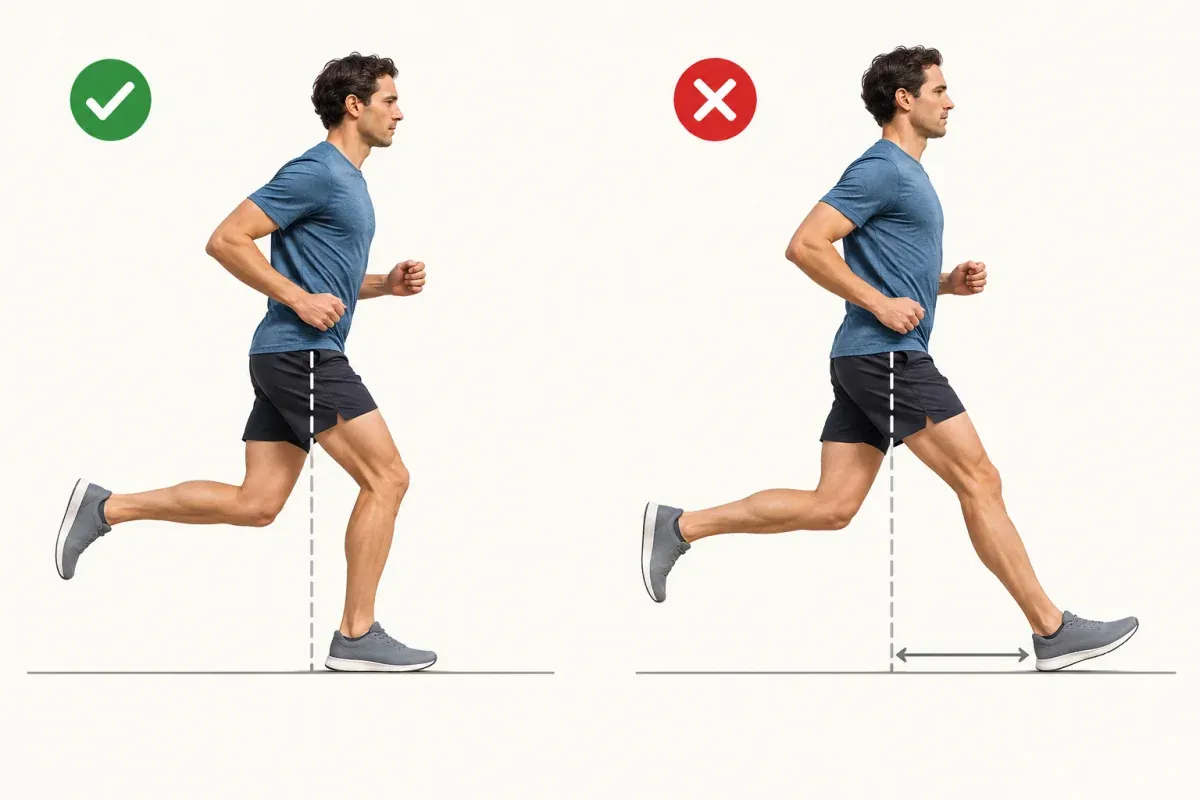
Pulling your foot back under you isn't the fix. With slightly shorter steps your foot naturally lands closer to your body.
Use slightly lighter and quicker steps
Raising your cadence, the number of steps you take per minute (spm), is the simplest way to shorten your stride. In 45 healthy recreational runners, raising step rate 5% at the same speed reduced the energy absorbed at the knee with each landing, and a 10% increase reduced it at the hip as well. In a modeling study of 30 adults, a 10% increase cut peak force behind the kneecap by 14%. These are lab measures of joint load, not injury rates.
Want your cadence? Your watch shows cadence. Otherwise, count one foot's landings for 30 seconds. Multiply that count by 4, and you'll have it. A 5% increase is small and takes you from 160 spm to a target of 168. Our guide on how to increase running cadence walks through the full method.
You don't need to reach 180. That number is widely traced to elite runners in races, and even elites vary: among 20 elite 100 km runners, cadence ranged from about 155 to 203 spm, with taller runners taking fewer steps.
Run tall with a slight forward lean
Stand tall, then tip forward a little from your ankles rather than folding at the waist. In 24 recreational runners, a slight forward lean lowered stress on the joint behind the kneecap compared with running very upright. Keep the lean slight, though: in the injured-versus-healthy comparison above, the injured runners leaned forward more. If your back aches on runs, our guide to lower back pain when running covers other possible causes.
Keep your arm swing loose
Your arms balance the twist your legs create. When runners in a treadmill study held their arms behind their back, across their chest or on top of their head, running took 3%, 9% and 13% more energy. So let your arms move rather than holding them still.
You can keep everything else simple. Keep your shoulders down. Let your arms swing mostly forward and back while keeping your hands loose. Research hasn't found an ideal elbow angle. You can bend your elbows as much as feels relaxed for you.
Bounce less and keep your hips level
Some up-and-down movement is part of running, but a big bounce sends energy upward instead of forward. In 97 endurance runners, three technique measures, including how much the pelvis rose and fell during ground contact and how much the runner slowed on each landing, explained 39% of the differences in energy cost. That's a correlation, not proof that changing those measures saves energy. If you can hear yourself slapping the ground, try running more quietly. Quicker steps may help too: in the 45-runner study above, up-and-down movement fell as step rate rose.
Softer landings may also matter for injuries. In a randomized trial of 320 novice runners, those who got two weeks of treadmill retraining with real-time feedback on their landing impact were less likely to be injured over the next year: 16% were, compared with 38% of a group that ran the same treadmill sessions without feedback. That's one trial with lab equipment, so it doesn't prove that a cue you practice on your own works the same way.
Hip drop is the other pattern worth knowing. In the injured-versus-healthy comparison, a bigger drop of the hip on the swinging-leg side was the strongest predictor of being in the injured group: each extra degree came with 80% higher odds. Again, that's an association. Hip and glute strength work is a sensible response, but it hasn't been shown to fix the drop on its own. In a small trial of 20 female runners whose thighs angled inward more than usual as they ran, those who did six weeks of hip strengthening and single-leg squat practice got stronger. Their hip and knee mechanics while running didn't change.
What you can leave alone
Plenty of popular form advice doesn't hold up for recreational runners. Here's what the evidence says about five common beliefs.
| Belief | What the evidence says |
|---|---|
| Heel striking is bad form | Most runners land heel first. At 10 km into one road race, about 89% of 936 mostly recreational runners heel struck, as did about 75% of runners filmed in an elite-level half marathon. |
| You should switch to a forefoot or midfoot strike | A review of 53 studies found no prospective evidence that switching prevents injury, and no energy saving. Forcing a forefoot landing made heel strikers less economical in the short term and shifted load to the calf and Achilles. |
| Everyone should hit 180 spm | Cadence varies with height and speed. A small, gradual increase can help an overstrider, but 180 isn't a universal target. |
| There's one perfect form to copy | A 2016 review found that strides up to about 3% shorter than a runner's preferred length cost little extra energy, and it cautioned against prescribing one "economical" technique. Ten women new to running became about 8% more economical over 10 weeks of training, and their gait changed without coaching. |
| Barefoot or minimalist shoes will fix your form | Switching carries its own risk. After a gradual 10-week switch to minimalist shoes, 10 of 19 experienced runners showed increased bone marrow edema, a sign of bone stress, on foot MRI. Any big footwear change needs a slow build. |
So if you heel strike, there's no need to change it. Your foot strike is whichever part of your foot touches down first. Where your foot lands matters more than which part makes contact. For the shoe side of things, see our guide to heel-to-toe drop in running shoes. It explains what the numbers mean.
Check your running form with a phone video
You can't feel most form habits while you run. A short video shows you what they look like. Here's a simple setup for filming yourself:

- A friend can film you. You can also prop the phone at about hip height beside a flat path or treadmill.
- Use your normal easy pace while you run. The camera should stay on for 10 to 15 seconds of running. Film from the side once. Then film once more from behind you.
- Film again near the end of a longer run. Form can change late in a run: in one race, more marathoners heel struck at 32 km than at 10 km.
- Play each clip in slow motion. Pause it at the moment a foot first makes contact with the ground.
Then look for the big patterns:
| What you see | What to try |
|---|---|
| Foot lands well ahead of your hips on a straight knee | Slightly quicker, shorter steps |
| A lot of up-and-down movement | Quicker steps and quieter landings |
| Bending forward at the waist | Run tall and lean from the ankles |
| Arms held still, stiff or swinging far across your body | Drop your shoulders and let your arms swing forward and back |
| One hip dropping sharply on each step (rear view) | Hip and glute strength work; get assessed if it comes with pain |
Keep your expectations realistic. Phone video is good for spotting obvious patterns, but studies have found phone footage inaccurate for measuring some joint angles, especially at the hip (Neal and colleagues; Mousavi and colleagues). If nothing stands out, leave your form alone and keep training.
How to improve your running form safely
If you're new to running, you can skip most of this for now. The 10 new runners in the study above became more economical with regular training alone, so build the habit first with our guide on how to start running.
Everyone else should change one thing at a time in small doses. A new pattern moves load to different tissues, so your body needs time to adapt.
- Pick one change. Choose the pattern from your video that stands out most. For many runners, that's overstriding.
- Practice in short blocks on easy runs. For example, focus on your cue for the first minute of each mile, then run normally. Keep the check-ins short rather than thinking about form the whole way. When runners focused on their movement on a treadmill, they used more energy and bounced more than when they watched a video.
- Use a beat for cadence changes. Set a metronome app or your watch's cadence alert to about 5% above your usual cadence. In a two-week trial of 33 runners, metronome runs raised cadence without raising heart rate or perceived effort.
- Give it a few weeks. Usually a new pattern feels awkward at first. There's no tested schedule for this. One run isn't enough to judge. Wait several weeks before deciding how the change feels on your runs.
- Use drills or strides as a warm-up if you like them. A-skips, high knees and strides (short, relaxed accelerations) are common ways to practice coordination before a run. There's no good evidence that drills change your form by themselves.
- Make room for strength work. One or two sessions a week for your hips, glutes and core is common advice alongside form work, though strength training hasn't been shown to fix form on its own.
- Back off if something new hurts. Calf or Achilles soreness can follow a foot-strike change, because the load shifts there. A quicker cadence gives the muscles that swing your legs more work to do. Go back to your usual pattern. Stop and get checked if the pain is sharp, keeps getting worse or changes how you run.
Start this week with a video. Film yourself for 15 seconds during an easy run. Pick the one pattern that stands out. Then practice its fix for a minute during each mile of your run.
When to get help with your form
Form changes are for healthy runners. If you're hurting, don't try to treat an injury on your own by changing how you run.
Leeds Community Healthcare NHS Trust advises seeking professional advice for sharp or worsening pain, swelling, or pain that limits your movement or strength. The NHS also advises against running through pain. A physical therapist or sports medicine clinician who offers running gait analysis can tell you whether your form plays a part, and is worth seeing if the same problem keeps coming back.
Targeted changes can help in the right case. In a small study of 12 runners with kneecap pain and unusual hip or pelvis movement, one retraining session used a metronome to raise their step rate 10%. Afterward, they checked it on their usual runs with a watch and metronome. Their pain and pelvic drop decreased, and the gains held at 3 months. Those runners were selected after a lab gait analysis, and the study had no comparison group, so it isn't a plan to try on your own. If your knees hurt, our guide to knee pain after running is a good place to start.
Frequently asked questions
Is heel striking a bad way to run?
No. Most runners land heel first, including about 89% of 936 mostly recreational runners at 10 km into one road race. A review of 53 studies found no prospective evidence that switching to a forefoot strike prevents injury, and the switch shifted load to the calf and Achilles. Focus on landing close under your hips instead.
What running form is correct for beginners?
Keep an easy pace. Run tall and relaxed with your gaze ahead and let your arms swing. Beginners don't need to overhaul their form. In one small study women new to running became about 8% more economical over 10 weeks of training without any coaching. Get into a running habit before revisiting form.
How can I stop overstriding when I run?
Don't pull your foot back under you on purpose. Make each step slightly quicker and shorter instead. Start at about 5% above your usual cadence. A usual cadence of 160 steps per minute puts your target at 168. Keep that practice to short blocks on easy runs. You can try a metronome app for those blocks if the beat helps.
If I'm not injured, should I change my running form?
Not necessarily. Most form research measures joint loads rather than injuries. The one large trial that cut injuries used lab feedback to teach softer landings. A small and gradual change is reasonable if a video shows an obvious pattern such as a big overstride. Keep training and leave your form alone otherwise.
How long does changing your running form take?
There isn't a tested timeline. Give one change several weeks. Use short practice blocks during that time before you judge how it's going. A pattern usually feels awkward when it's new. One two-week trial used metronome runs. They raised runners' cadence without raising their heart rate or perceived effort.
Does running form change when you get tired?
Yes, it can. In one race, more marathoners heel struck at 32 km than at 10 km. Film yourself near the end of a longer run as well as at the start, and check your shoulders and posture late in runs, when they tend to slip.
I completed my first 10K on a dare. In a year, I ran a half-marathon. Another year later, I finished a marathon race. Today I run 4 marathons a year and a half-marathon every week. I learned everything about running the hard way. So, I help runners achieve better results easier.