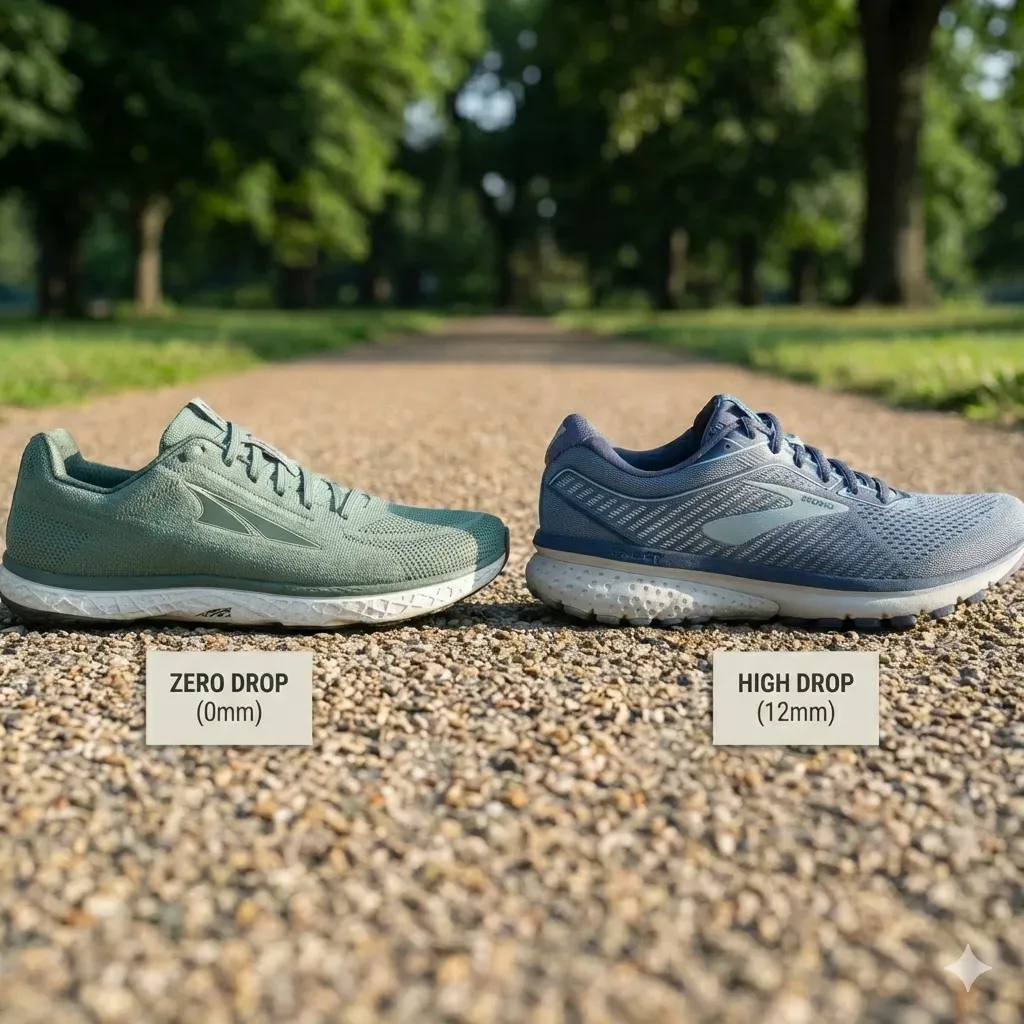
Heel-to-toe drop is the difference between a running shoe's heel and forefoot heights, measured in millimeters. A shoe with a heel height of 32 mm and a forefoot height of 24 mm has an 8 mm drop. Drop describes the slope under your foot, but it doesn't tell you how soft or cushioned the shoe feels.
If your current shoes are comfortable and you're running without pain, a similar drop is a sensible starting point for your next pair. There isn't a best number for everyone, and choosing a drop based on where you hurt is no substitute for finding out why you hurt.
Choose a running shoe drop in 60 seconds
Begin with the shoes you know.
- If you feel good now, look up your current shoe's drop and try something similar.
- If you have ongoing pain, get advice from a qualified clinician before using a shoe change to address it.
- If you want to change the drop, keep your familiar shoes available and make your first outing in the new pair short and easy.
Two examples:
- Example 1: Your current shoes feel comfortable on ordinary runs. You don't need to switch to a lower drop just because a shoe is marketed as more natural.
- Example 2: Your knees ache after longer runs. Review your training load and get ongoing pain assessed before buying a low-drop shoe to fix it.
A one-minute running shoe shopping checklist
- What drop do you run in now? Confirm the exact model and version.
- Are you comfortable, or managing a recurring problem? Pain changes the decision from shopping to getting appropriate advice.
- What else is different about the new shoe? Fit, stack height, firmness and rocker shape can all change how it feels.
- Can you test it during a quieter training period? Experimenting is harder during a demanding race block.
What heel-to-toe drop tells you
Heel-to-toe drop, also called offset or differential, is heel stack height minus forefoot stack height. The definition used in the cushioned-shoe injury trial refers to the height difference inside the shoe.
- In the example above, subtract the forefoot height of 24 mm from the heel height of 32 mm to get 8 mm.
- With zero drop, the heel and forefoot sit at the same height. There can still be plenty of material under your foot.
- Sidewalls and curved soles can make a shoe's outside profile misleading.
Drop, stack height and cushioning
Drop and stack height describe different measurements:
- Stack height: The height of material beneath your foot at a given point.
- Drop: The difference between heel and forefoot stack heights.
These made-up shoes show why the drop number alone doesn't tell you how much material is underfoot:
| Example shoe | Heel stack | Forefoot stack | Drop | What it tells you |
|---|---|---|---|---|
| Shoe A | 40 mm | 36 mm | 4 mm | High stack, low drop |
| Shoe B | 28 mm | 20 mm | 8 mm | Lower stack, higher drop |
| Shoe C | 24 mm | 24 mm | 0 mm | Equal heights, zero drop |
A low-drop shoe can be cushioned, and a higher-drop shoe can feel firm. Sole thickness alone doesn't tell you how soft a shoe feels or how well its cushioning performs.
How drop can change the way running feels
Drop can change running mechanics. But a different joint load in a laboratory does not automatically mean fewer injuries or less pain.
In a study of 18 healthy runners, shoes with 10 and 15 mm drops produced greater modeled kneecap-joint stress than zero-drop shoes. This was a short-term biomechanics comparison, not a treatment trial in runners with knee pain. It does not establish a drop that will fix your knees or hips.
A six-month randomized trial of 553 leisure-time runners found no statistically significant overall difference in injury risk between cushioned shoes with 0, 6 and 10 mm drops. Results differed between occasional and regular runners in subgroup analyses. The findings do not prove that every drop is equally suitable for every runner.
For Achilles symptoms, AAOS guidance includes footwear changes and heel lifts among possible management options. That is a reason to discuss footwear with a clinician, not evidence that everyone with calf or tendon pain needs a particular shoe-drop number.
What should you watch for during the first two weeks with a different drop?
Treat the first two weeks as an initial check-in, not a deadline for adapting. During the run, afterward and the next morning, watch for:
- Calf soreness that builds across outings
- Achilles pain or morning stiffness
- New pain in the forefoot, knee or hip
- Swelling, limping or another change in how you walk
Mild muscle soreness that settles is different from persistent or worsening pain in a tendon or joint. Do not use a fixed number of hours as permission to progress. If symptoms build, reduce or stop the running that aggravates them and pause the shoe experiment. AAOS advises decreasing or stopping activities that worsen Achilles pain.
Stop running and seek medical advice for sharp pain, swelling, limping or worsening tendon pain. A sudden pop at the back of the calf or heel can signal a tendon tear and warrants prompt medical assessment.
How to choose a running shoe drop
A drop you've tolerated before is a good place to start. Consider your injury history, how the whole shoe fits and feels, and whether you have time for a gradual trial. There is no reliable way to calculate your ideal drop from your symptoms.
How injury history affects the decision
Use this table to guide your next step, not to prescribe treatment:
| Your situation | Useful starting point | What to avoid |
|---|---|---|
| Comfortable and pain-free | Try a familiar drop in a well-fitting shoe | Changing a successful setup to chase a trend |
| Recurring calf or Achilles pain | Discuss training and footwear with a clinician | Assuming a higher drop will solve the cause |
| Recurring knee or hip pain | Get the problem assessed before a major shoe change | Assuming zero or low drop will cure it |
| Returning from an injury | Follow your clinician's return-to-running guidance | Treating a new shoe as clearance to increase training |
Choosing drop with ankle mobility and calf stiffness in mind
A home mobility check cannot identify your ideal drop. If a new shoe feels uncomfortable, ankle mobility is one factor you can discuss with a clinician.
For a simple observation, face a wall with one foot flat on the floor. Move that knee toward the wall while keeping your heel down, then compare how the movement feels on each side. Don't use the distance you reach to decide which shoes to buy.
If the movement is painful or noticeably restricted, get advice rather than forcing it. Calf exercises and stretches should suit your situation, especially if you already have tendon pain.
Does your foot strike determine your drop?
You can observe your foot strike, but it doesn't set a rule for choosing shoes. If you're curious, record 10 seconds of running at an easy pace to see how your foot lands. You can also film 10 seconds at a moderate pace if that feels comfortable. You don't need to change how you land just because you've changed drop.
In a longer-term trial of cushioned shoes, different drops did not produce distinct adaptations in most measured running-pattern variables. A low-drop shoe does not guarantee a forefoot strike, and heel striking alone does not identify your best drop.
Fit and stability are separate decisions. See our guides to how running shoes should fit and what a neutral running shoe is if those terms are also on your shopping list.
Are brand drop specs accurate?
The published number is a reference for that exact shoe model, but it can't fully describe how the shoe feels. Two shoes with the same listed drop can feel different.
Why measurements can differ
Before comparing numbers, check what each source measured: the measurement points, shoe size and whether the sockliner was included. A static height difference also doesn't describe how the shoe compresses during running. These details help you judge whether a small discrepancy matters.
Photos aren't a reliable way to estimate drop because sidewalls and curved soles can hide the underfoot heights.
Can you check drop at home without cutting the shoe?
You can't reliably verify underfoot drop from the outside of an intact shoe or by standing on a forefoot wedge. Inside measurements are easy to misread too, particularly when reference points or sole shapes differ.
For shopping, a comfort check is more useful. Confirm the model's published specification, try on both shoes and take a short, easy jog if the retailer allows it. The jog helps you assess comfort, but it can't verify the drop measurement.

Why sidewalls and rocker can mislead you
Two common visual traps:
- Tall sidewalls: Foam can extend up around the foot without all that height sitting beneath it.
- Rocker: A curved sole changes the rolling feel, but it doesn't reveal the difference between heel and forefoot heights.
Feeling as though a shoe tips you forward doesn't establish its drop. Base your choice on how the whole shoe fits and feels, rather than its side profile alone.
How to try a different drop gradually
Changing shoes is an experiment, and your training load matters too. Zero drop doesn't have to be your goal. No universal timetable makes a shoe change safe for every runner.
Introducing the target shoe vs using an intermediate pair
Introduce the target shoe gradually and use your familiar pair for your other runs. If a large change feels uncomfortable, a shoe with an intermediate drop is another option. That extra pair isn't a proven injury-prevention step or a required purchase.
Choose a useful transition shoe
If you want an intermediate pair, choose one that's comfortable and useful for your ordinary running. A mathematical midpoint alone isn't a reason to buy it.
| Approach | How to use it | Limit |
|---|---|---|
| Introduce the target shoe | Start with a short portion of an easy outing | A comfortable first run does not prove full adaptation |
| Try an intermediate shoe | Use a comfortable pair with a less dramatic change | No exact intermediate drop is required |
| Keep the current drop | Replace a worn pair with something familiar | A similar number does not guarantee an identical fit or feel |
Keep the first outings easy
- Keep the running easy and on flat ground when you first wear the new shoes.
- Keep your familiar shoes available for the remainder of your training.
- Avoid increasing mileage or speed work while you're increasing time in the new shoes.
- Reduce or pause the new exposure if symptoms appear. Don't push through just to stay on schedule.
A sample trial with the target shoe
These examples show how you might organize a trial. They aren't a validated transition protocol:
- Beginner, 3 runs per week: Use the new shoes for part of one short, easy run. Wear your familiar shoes for the other outings.
- Intermediate, 5 runs per week: Start with part of one easy run too. Running more often doesn't give you a reason to rush the transition.
Repeat that amount of running in the new shoes before considering an increase. Progress only if it remains comfortable during the run and afterward. Hold or step back if symptoms build, and don't automatically add another new-shoe run each week.
If you use an intermediate shoe
An intermediate pair needs the same gradual trial. When you later try the target shoe, start with a short exposure again. The earlier trial doesn't mean you're prepared for every difference.
You aren't on a deadline to replace every run in your familiar shoes. If the new pair keeps causing discomfort, reconsider the change.
Can shoe wear change the drop?
Uneven sole wear can change a shoe's shape and feel. Outsole marks alone can't tell you its current underfoot drop or prove that it caused an ache.
| Check | Look or feel for | How to use the check |
|---|---|---|
| Outsole pattern | Heel wear, forefoot hotspots or uneven wear between shoes. | Compare both soles alongside any new change in comfort. |
| Flat-table check | New or increased rocking or leaning on a flat surface. | Notice whether stability also feels worse on turns or downhills. |
| Changes on a run | A harsher or lower feel, new calf tightness, or a clear left-right difference. | Consider rotating or replacing the pair when uneven wear tracks a new ache. |
| Pain that persists | Pain that stays after you change shoes. | Consider a clinician check; shoe wear is only one possible factor. |
Outsole wear checklist: what to look for in 30 seconds
Compare the pair:
- Look over the outsole. Check whether one part is much more worn than another.
- Look for an obvious difference between the left shoe and the right.
- Does either shoe lean or rock more on a flat surface than it used to?
- Has comfort or stability changed on your usual runs?
These checks help you inspect the pair; they can't diagnose your gait or give you a new drop number from visible wear.
When to replace or rotate worn shoes
If worn shoes feel uncomfortable or unstable, consider trying another pair. Pay extra attention if one shoe feels different from the other. Get pain assessed if it persists after a change, since shoe wear is only one possible factor.
Cheat sheet: drop ranges and terms
Drop ranges in plain buckets
For this guide, these are convenient labels rather than universal boundaries:
- Zero drop: 0 mm
- Low drop: 1 to 4 mm
- Medium drop: 5 to 8 mm
- Higher drop: 9 to 12 mm
Shoes outside those ranges exist. None of these categories is a ranking or a treatment recommendation.
Key terms glossary
| Term | What it means | Why it matters |
|---|---|---|
| Drop (offset) | Heel height minus forefoot height | Can shift where stress shows up |
| Stack height | Total height underfoot | Relates to cushioning and protection |
| Rocker | Curved sole shape | Changes how the shoe rolls forward |
| Sidewalls | Foam that rises up the sides | Can change stability and visual slope |
| Outsole wear | Rubber worn down over miles | Can change effective drop and feel |
Shopping reminder
Start with a drop you've tolerated, then assess fit, comfort, firmness, stack height and rocker feel. A short trial tells you more about the whole shoe than the drop number alone.
Frequently asked questions
What does heel-to-toe drop mean in a running shoe?
Heel-to-toe drop is heel stack height minus forefoot stack height, measured in millimeters. A shoe with a heel height of 32 mm and a forefoot height of 24 mm has an 8 mm drop.
Are heel-to-toe drop and cushioning or stack height the same thing?
No. Stack height describes the height of material underfoot, while drop is the difference between heel and forefoot heights. A zero-drop shoe can have a thick sole. Neither measurement tells you how soft a shoe feels.
If I feel good right now, what shoe drop should I buy next?
Try a drop close to your current shoe's, and check fit and comfort too. If your setup is working, there's no need to change it just to try a different drop category.
Why do my calves or Achilles feel tight after I switch to a lower drop?
A shoe change can alter the demands of running, but tightness alone can't tell you what's causing it. Pause the experiment if symptoms build. Seek advice from a qualified clinician for persistent Achilles pain or morning stiffness rather than running through it to adapt.
If my knees ache after long runs, should I try a lower drop?
A lower drop isn't a treatment to prescribe for yourself. Laboratory findings about knee loading don't prove a particular shoe will relieve your pain. Review ongoing pain and your training with a qualified clinician before making a major change.
How quickly can I change shoe drop safely?
No single timeline makes every change safe. Keep familiar shoes available and wear the new pair for a short portion of an easy run. Check how you feel during the run, afterward and the next morning. Increase exposure only if it remains comfortable, and stop or step back if symptoms build.
How accurate are shoe brands' drop numbers?
The specs are useful references, but comparisons depend on measurement methods and the exact shoe measured. The listed number doesn't describe compression during running, and the outside profile can't verify it. A short jog checks comfort, not the drop measurement.
When should I stop using a new drop and get help?
Stop running and seek medical advice for sharp pain, limping, swelling or worsening tendon pain. Get persistent pain assessed rather than trying more shoe changes to fix it. A sudden pop at the back of the heel or calf warrants prompt medical assessment.
I completed my first 10K on a dare. In a year, I ran a half-marathon. Another year later, I finished a marathon race. Today I run 4 marathons a year and a half-marathon every week. I learned everything about running the hard way. So, I help runners achieve better results easier.