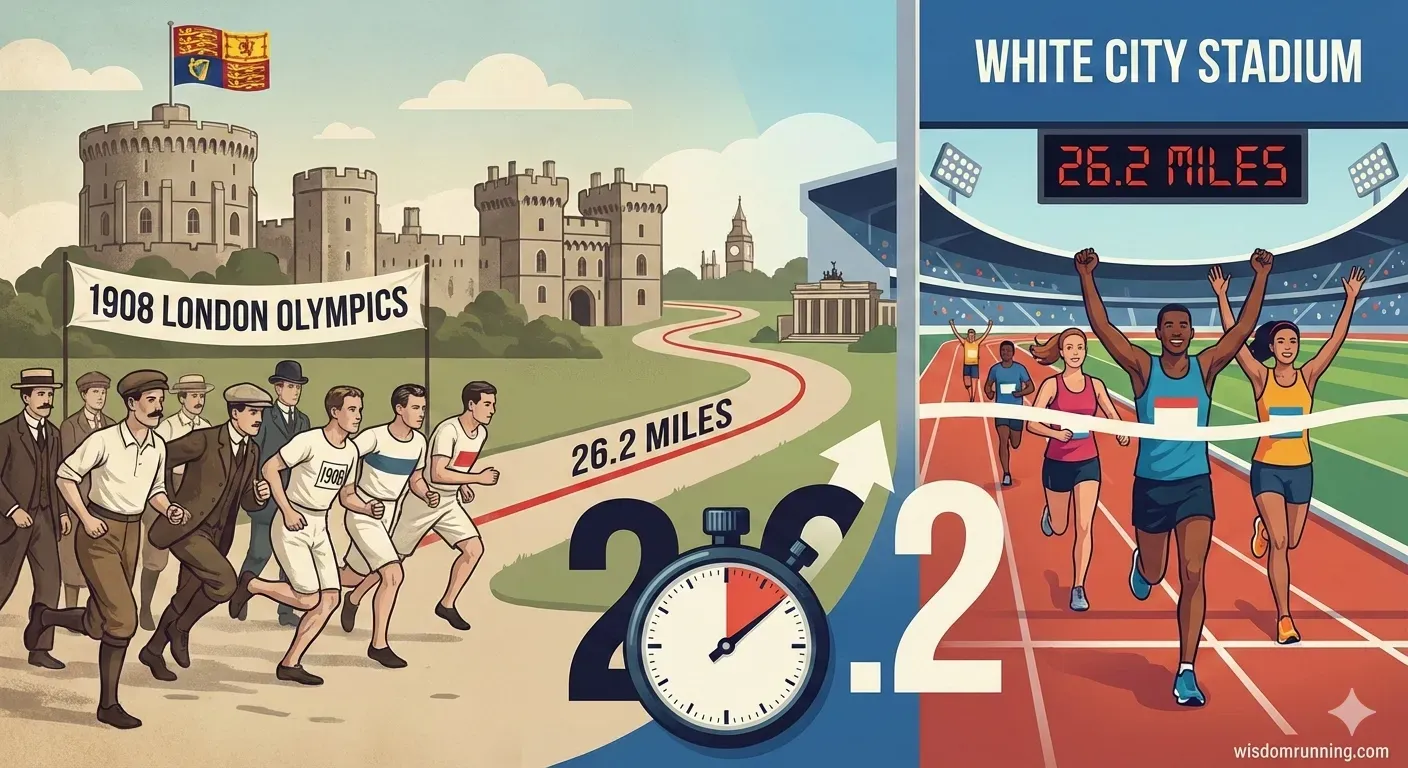
So how long is a marathon, exactly? Officially it is 42.195 kilometers, or 26 miles 385 yards. Most people simply call it 26.2 miles. It is also 42,195 meters, about 105.5 laps of a 400-meter track and exactly twice a half marathon.
Below you will find the distance in every common unit, the story of where the odd 385 yards came from (the 1908 London Olympics), how race courses are measured today and why your GPS watch usually reads longer than 26.2. If you came for finish times instead, start with our average marathon time guide or the pace table further down.
Quick answer: marathon distance in every unit
The official marathon distance is 42.195 km, or 26 miles 385 yards. World Athletics uses that figure for the event, and its Technical Rules list the marathon among the standard road distances. Runners say "26.2 miles" because it is the rounded version of the same distance.
| Unit | Marathon distance |
|---|---|
| Kilometers | 42.195 km |
| Meters | 42,195 m |
| Miles and yards | 26 miles 385 yards |
| Miles, decimal | 26.21875 miles (usually rounded to 26.2) |
| Half of a marathon | 21.0975 km, or about 13.1 miles |
| Laps of a 400-meter track | About 105.5 |
Why does everyone say 26.2 miles instead of 26.21875?
Saying 26.21875 out loud is awkward, so people round to one decimal. U.S. races talk in miles, but the rule books define the distance in meters. That is why 42.195 km is the number that counts.
The ".2" hides a little more than it looks. The distance past 26 miles is 385 yards, about 352 meters. A flat 0.2 mile is only 352 yards (about 322 meters), so "26.2" rounds the true remainder down by 33 yards, roughly 30 meters. The two 352s are a coincidence of units: one is meters, the other is yards.
The metric figure is rounded too. Exactly 26 miles 385 yards works out to 42,194.988 meters, which the rules write as 42.195 km.
Where the marathon distance came from
The word "marathon" comes from a legend of a Greek messenger who ran from the battlefield at Marathon to Athens. Olympedia notes that historians now regard the legend as apocryphal (doubtful as history), but it inspired the race at the first modern Olympics in Athens in 1896, which covered about 40 km.
Nothing fixed the distance after that. Each Games laid out its own course, so the length changed from one Olympics to the next:
| Games | Host | Distance | Miles, approx. |
|---|---|---|---|
| 1896 | Athens | About 40 km | 24.9 |
| 1900 | Paris | 40.26 km | 25.0 |
| 1904 | St. Louis | 40 km | 24.9 |
| 1906 (Intercalated Games) | Athens | 41.86 km | 26.0 |
| 1908 | London | 42.195 km | 26.2 |
| 1912 | Stockholm | 40.2 km | 25.0 |
| 1920 | Antwerp | 42.75 km | 26.6 |
| 1924 | Paris | 42.195 km | 26.2 |
Distances come from Olympedia's results page for each Games (linked under Sources). Each miles figure is the kilometers divided by 1.609344.
How the 1908 London Games set the length
The Olympic marathon run on July 24, 1908, produced the length used today. It started by the East Terrace of Windsor Castle and finished inside White City Stadium, in front of the Royal Box. Olympedia gives the distance as 42,195 meters, or 26 miles 385 yards.
The 1908 Official Report describes a course from Windsor Castle to the stadium, with 385 yards run on the cinder track to the finish below the Royal Box. Accounts of the planning, summarized in Wikipedia's article on the race, say the Royal Entrance could not serve as the marathon entrance, so runners came in through another gate. The direction around the track was also changed so more spectators could see the final yards. That left 385 yards on the track after about 26 miles on the road.
When the distance became official
Two dates often get mixed up. The 1921 decision set the standard, and the 1924 Olympics were the first Games to use it again.
| Year | What happened |
|---|---|
| 1908 | The London Olympic marathon is run over 26 miles 385 yards. |
| 1921 | The IAAF, now World Athletics, adopts 42.195 km as the standard marathon distance. |
| 1924 | The Paris Olympics hold the marathon over 42.195 km, the first Olympic marathon at that length since 1908. |
The IAAF adopted the distance at its Fifth Congress in Geneva in May 1921. The Olympic marathons in between, in 1912 and 1920, ran 40.2 km and 42.75 km, so 1924 was the first return to the 1908 length (Olympedia).
What the record shows and what is still disputed
Popular retellings say the race was set up so the royal children could watch the start from the nursery windows at Windsor. World Athletics' own marathon page still tells it that way. Olympic historians disagree. Olympedia calls the nursery explanation "certainly false," citing historian Bob Wilcock and David Davis's book Showdown at Shepherd's Bush. It adds that The Sporting Life reported as early as November 1907 that organizers were seeking permission to start at Windsor, with no request from the royal family. Wilcock found nothing in the royal archives to support the story.
The 1921 decision does not explain itself either. In The Olympic Marathon, David Martin and Roger Gynn write that the length was stated, but "no discussion is provided regarding the rationale for its selection".
| Claim | Status | Source |
|---|---|---|
| The 1908 London course produced 26 miles 385 yards | Well documented | Olympedia |
| The start was at Windsor Castle's East Terrace and the finish in front of the Royal Box | Well documented | Olympedia |
| The start was placed so royal children could watch | Disputed; no support found in the royal archives | Olympedia, Boston.com |
| The IAAF chose the 1908 length in 1921 for a recorded reason | No rationale on record | Boston.com |
| The 1908 course was measured 174 yards short | Challenged by a 2024 re-measurement of the opening 700 yards | The Guardian, via Yahoo |
Was the 1908 course measured accurately?
A re-measurement reported in John Bryant's book The Marathon Makers claimed the first mile of the 1908 course was 174 yards (159 meters) short. On July 23, 2024, The Guardian reported on a new check. Course measurer Hugh Jones and retired civil servant Joe Neanor re-measured the opening 700 yards inside Windsor Castle's grounds, with the King's permission. They concluded that stretch had been measured accurately in 1908, and a period photograph put the start near the East Terrace rather than on the Long Walk (The Guardian, via Yahoo). Only that opening stretch was re-measured, but it was the part in dispute.
How marathon courses are measured today
Certified courses are not measured with GPS. World Athletics' Technical Rules require a road course to be measured along the shortest possible route an athlete could follow within the part of the road open to the race, and the course may never be shorter than the official distance. The IAAF/AIMS measurement manual compares that route to a stretched string pulled tight through the course boundaries.
The rules call for the calibrated bicycle method. A bicycle with a counter on its front wheel is calibrated over a stretch measured with a steel tape, then ridden along the route.
To keep a course from being found short when it is measured again, the rules recommend building in a small cushion called a short course prevention factor, set at 0.1%. Each kilometer is laid out as 1,001 meters, which adds about 42 meters over a marathon. At World Rankings Competitions the measurement uncertainty may not exceed 0.1% (about 42 meters), a measurer certifies the course in advance and the certificate is valid for five years.
Why your GPS watch may read past 26.2 miles
Your watch logs the path you actually ran, not the measured line. Nobody holds the shortest possible route for 26 miles. You weave around other runners, swing wide on turns and drift away from the inside line, and those small detours add extra distance on the watch.

GPS error adds more. Signals bounce off buildings and small errors add up over 42 km, and GPS devices typically overestimate how far you ran. The writer of one Run Washington guide logged about 0.3 extra miles at the 2015 Marine Corps Marathon, and readers who sent in their own GPS data reported at least 26.5 miles.
The 42 meters of built-in length from the course measurement is only about 0.03 mile, so it explains very little of that extra distance. A watch reading a few tenths of a mile long is normal, even on a certified course.
Because the watch logs extra distance, its average pace will look slightly faster than your pace by the markers, and its mile alerts will tend to come before the mile markers. So lean on the mile or kilometer markers when you check your pace, since they sit along the measured course. Running the tangents, which means taking each turn along its shortest path, also brings your watch reading closer to the official distance.
What 26.2 miles looks like
A few comparisons help show how far that is:
- About 105.5 laps of a 400-meter track.
- Two half marathons back to back, with nothing left over.
- The last 385 yards past the 26-mile marker, which is a bit under four football fields (100 yards each, not counting the end zones).

How long does a marathon take to run?
Distance and time answer different questions. Your finish time depends on your pace. Multiply your pace per mile by 26.21875, or your pace per kilometer by 42.195, and you get an estimate of your finish time if you hold that pace the whole way. Real races rarely go at a perfectly even pace, so treat the result as an estimate. The table shows common paces, with per-kilometer paces and finish times rounded to the second.
| Pace per mile | Pace per km | Finish time |
|---|---|---|
| 7:00 | 4:21 | 3:03:32 |
| 8:00 | 4:58 | 3:29:45 |
| 9:00 | 5:36 | 3:55:58 |
| 10:00 | 6:13 | 4:22:11 |
| 11:00 | 6:50 | 4:48:24 |
| 12:00 | 7:27 | 5:14:38 |
For typical finish times at different fitness levels, see our guide to average marathon times. To work out your own pace, use the pace calculator or the finish time calculator.
Bottom line
A marathon is 42.195 km, or 26 miles 385 yards. The length goes back to the 1908 London Olympic course, which ran from Windsor Castle to the Royal Box at White City Stadium. The IAAF made that length the standard in 1921, and the reason it chose it is not on record. On race day, trust the course markers over your watch. Certified courses are measured on the shortest possible line, but your watch rarely follows it, so a few tenths of a mile extra on the watch is normal.

Sources
- World Athletics: Technical Rules 2026, Part VII Road Races (standard distances and course measurement)
- World Athletics: Marathon
- IAAF/AIMS: The Measurement of Road Race Courses
- Olympedia: Marathon, Men, 1896, 1900, 1904, 1906, 1908, 1912, 1920 and 1924
- AIMS: David Martin, Worlds Apart (1921 IAAF Congress)
- Boston.com: Why is a marathon 26.2 miles? (Official Report, Wilcock, Martin and Gynn)
- The Guardian via Yahoo: Mystery solved after 116 years (2024 re-measurement)
- Wikipedia: 1908 Olympic men's marathon (summary of the stadium arrangements)
- Run Washington: Cut your MCM time: run the tangents
- Pop Up Races: GPS watch v the Jones counter
- CDC NIOSH: heat-related illnesses
- CDC: heart attack symptoms and when to call 911
Frequently asked questions
How long is a marathon in yards, miles and kilometers?
A marathon is 26 miles 385 yards, or 42.195 kilometers from start to finish. In decimal miles that is 26.21875, which most people shorten to 26.2. A half marathon is exactly half of that, or 21.0975 km.
How far is the "point two" at the end of 26.2?
The "point two" is the last 385 yards, about 352 meters, between the 26-mile marker and the finish line. In decimal miles that is 0.21875 mile. A flat 0.2 mile would be only 352 yards, so 26.2 rounds the true remainder down by about 33 yards.
Why is a marathon 26 miles 385 yards and not a round number?
The length comes from the 1908 London Olympic course, which started at Windsor Castle and finished in front of the Royal Box at White City Stadium. The IAAF adopted that length in 1921, and no rationale for choosing it is on record. Many tellings say the start was placed at Windsor for the royal children, but Olympic historians question that story.
Why do some sources say 1921 while others say 1924?
They are two separate events. The IAAF adopted 42.195 km at its Geneva Congress in May 1921. The Olympic marathons in 1912 and 1920 had other lengths, so the 1924 Paris Olympics were the first to use that distance since 1908.
Why does my GPS watch show more than 26.2 miles on a certified course?
The measured line is the shortest possible route along the course, and runners rarely hold it. They weave around people, run wide on corners and drift away from the inside line. GPS error adds distance too, and tall buildings make it worse. Watches commonly read a few tenths of a mile long, and a reading such as 26.5 miles is not unusual. A long reading does not mean the course is long.
How do measurers certify marathon courses if not by GPS?
Measurers use a calibrated bicycle with a wheel counter and ride the shortest possible route. The rules also recommend a short course prevention factor of 0.1%, so each kilometer is laid out as 1,001 meters. Over a marathon that adds about 42 meters and keeps the course from being found short if it is measured again.
How long does a marathon take to run?
It depends on your pace. If you hold 10 minutes per mile the whole way, a marathon takes about 4 hours 22 minutes. At 8 minutes per mile, it takes about 3 hours 30 minutes. Real races rarely go at a perfectly even pace, so treat these as estimates. The table above and our average marathon time guide show more paces and typical finish times.
When should I stop running in a marathon and get medical help?
Stop running and get medical help right away for chest pain, fainting, severe shortness of breath or confusion. Headache, nausea, dizziness or weakness can be early signs of heat illness. If you notice them, slow down or stop and tell a race volunteer or official. Confusion, passing out, seizures or a very high body temperature are heat stroke warning signs that need an emergency call (911 in the US). Tired, heavy legs are common late in a marathon, but none of these signs are something to push through. If something feels unsafe, or you are not sure, it is okay to step off the course.
I completed my first 10K on a dare. In a year, I ran a half-marathon. Another year later, I finished a marathon race. Today I run 4 marathons a year and a half-marathon every week. I learned everything about running the hard way. So, I help runners achieve better results easier.