That “point two” at the end of a marathon is not trivia. It’s about 352 yards, long enough to wreck pacing, trigger cramps, or turn a strong finish into a shuffle.
To write this, I verified the exact metric-to-miles conversion, then cross-checked the standard distance and modern course-measurement method in official guidance and Olympic history sources.
Next you’ll get the quick, exact answer, why people say “26.2,” and the practical story behind the extra 385 yards from the 1908 London Olympics. You’ll also see why certified courses are not measured by GPS watches, and why your watch often reads long. Let’s get into it.
Quick answer: the marathon distance
A marathon is 42.195 kilometers, which is 26 miles 385 yards.
Most people say “26.2 miles” because it’s the rounded miles version of 42.195 km.
Exact vs. rounded
Official distance: 42.195 km
In miles: 26.2187575 miles (based on 1 mile = 1.609344 km)
Rounded: 26.2 miles (what most people say)
Why do people say “26.2” instead of “26.2188”?
Because decimals get messy fast.
26.2 is easy to remember and easy to print on a bib.
In the U.S., races often talk in miles, but the official distance is also stated in meters/kilometers.
When you convert 42.195 km to miles, you land at 26.2187…, so “26.2” sticks.
Also, that “.2” is not tiny. It’s about 352 yards, or a little over 3 football fields.
Where the marathon distance came from?
The word “marathon” comes from the legend of a messenger running from Marathon to Athens. In the first modern Olympics (1896), the course was about 40 km.
But early marathons did not always use the same distance. Organizers picked routes that fit their city and their stadium.
The key moment: the 1908 London Olympics and the “extra 385 yards”
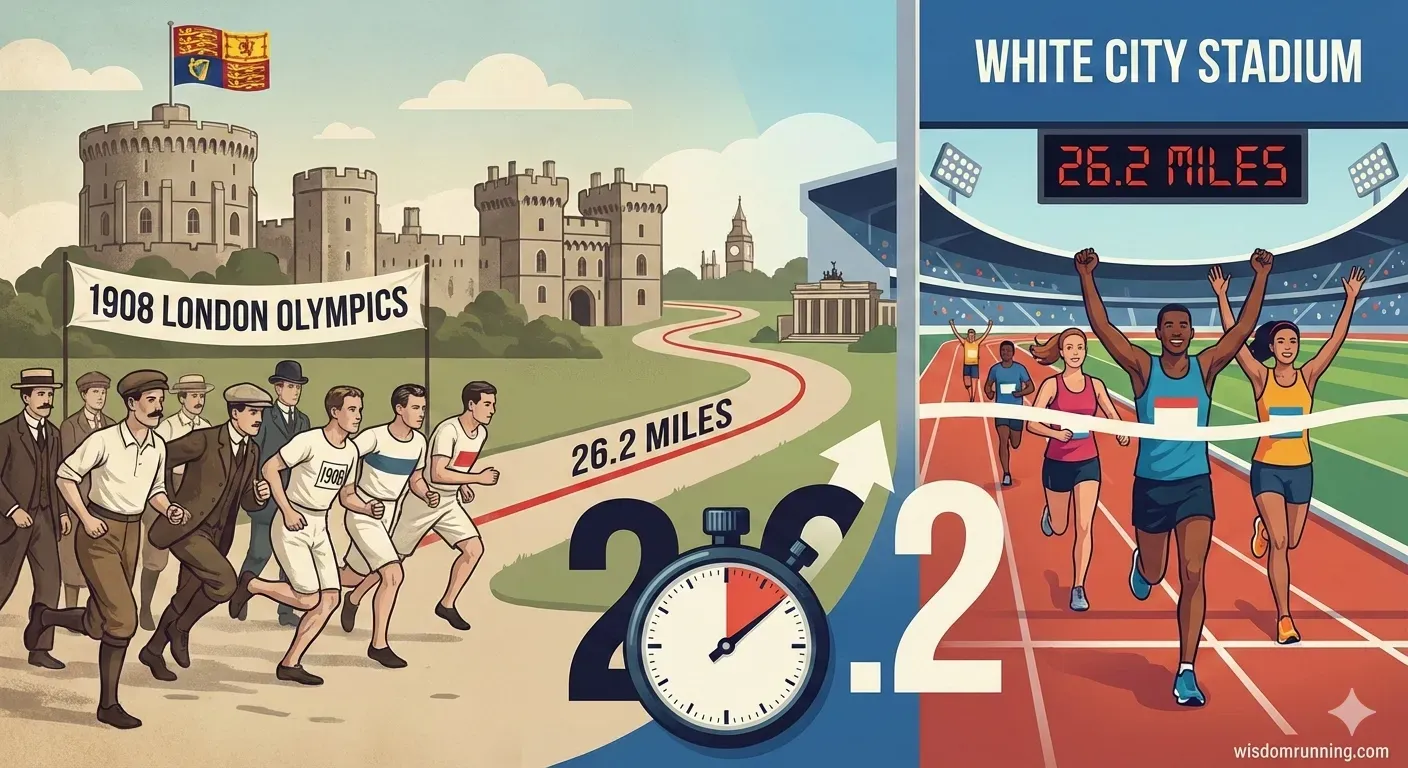
The 1908 Olympic marathon is the main reason we have 26 miles 385 yards today.
Here’s the helpful way to think about it: 385 yards happened because of logistics, not magic.
Step-by-step: how 385 yards got added
Historians and archived documents point to a chain of practical changes:
A longer start location was chosen (at Windsor Castle/terrace area), adding distance compared with earlier “about 40 km” marathons.
The route near the end had to change, based on how runners could enter the stadium grounds.
The planned stadium entrance (near the Royal Box) became unusable for the marathon tunnel/entry, so the entrance was moved.
Organizers kept the road portion at 26 miles to the track, then adjusted what happened inside the stadium.
They changed the direction on the track, which reduced the in-stadium distance to a partial lap of 385 yards to reach the same finish area.
That’s the clean origin story of 26 miles + 385 yards.
When it became “official,” and why the date can look confusing?
Two milestones matter:
1921: The sport’s governing body standardized the marathon at 26 miles 385 yards (42.195 km).
1924: The Olympics used that standardized distance (you’ll see this date cited in some references).
So if you’ve seen 1921 and 1924 in different articles, that’s usually why.
What we know vs. what’s debated?
A lot of popular retellings pin everything on “the royals wanted it.” Reality is messier.
What’s well-supported
The 1908 London Olympic marathon created the famous 26 miles 385 yards distance.
The finish setup and stadium-entry constraints played a real role in why the last part became 385 yards.
The distance was later standardized (commonly cited as 1921 by the sport’s governing body).
What’s disputed or often overstated
The tidy story that it was done purely so royal kids could watch (or purely for royal preference) is contested by Olympic historians and archival research.
Some modern reporting notes no supporting evidence found in royal archives for parts of the popular “royal request” version.
The exact reason the 1921 standard was selected is not always documented in a satisfying, single-sentence “because” explanation.
A newer wrinkle: was the 1908 course measured correctly?
There was a claim that the 1908 course was short, and later work revisited that measurement. A 2024 report describes research and re-measurement work tied to access at Windsor Castle.
How marathon courses are measured today?
For big races and record-eligible courses, the distance is measured with a formal method, not a GPS watch.
The basic idea: measure the shortest legal route, then add a small safety margin
Course measurers aim to measure the shortest possible route a runner could legally take, sometimes described like a string pulled tight along the course.
Then they apply a small factor (commonly 1.001) so the course is not accidentally short due to tiny measuring errors.
That factor adds about 1 meter per kilometer, which is about 42 meters over a marathon.
What tools and steps are involved?
You’ll often see these elements in certified course measurement:
A calibrated bicycle method (using a counting device on the wheel)
Pre- and post-calibration rides
A “short course prevention” factor of 1.001
Following the shortest possible route runners are allowed to take
If you like details, official manuals lay out the math and forms used to calculate the working constant and apply the 1.001 factor.
Why your GPS watch may show 26.3 to 26.6 miles?
Even if the course is correct, your watch can read long. Common reasons:
You don’t run perfect tangents. Small zigzags add up.
GPS drift can “round off” corners and add phantom distance.
Crowds, buildings, and trees can worsen GPS accuracy.
Certified courses are measured along the shortest legal route, not the path every runner actually takes.
Practical takeaway: if your watch reads long, it usually says more about your line and GPS than the race.
Make 26.2 miles feel real: quick equivalents
Here are a few ways to picture the distance:
42,195 meters
About 105.5 laps of a standard 400 m track
Two half marathons back-to-back (a marathon is exactly double a half-marathon)
If you want, you can add a small “equivalents” table with local landmarks for your audience.
Bottom line
A marathon is 42.195 km (26 miles 385 yards).
That distance traces back to how the 1908 London Olympic marathon was set up and finished, and it later became the standardized marathon distance used worldwide.
FAQs on marathon distance
How long is a marathon in miles, yards, and kilometers?
A marathon is 42.195 kilometers, which equals 26 miles 385 yards. In decimal miles, that is about 26.2188. Most people round it to “26.2 miles” because it’s easier to say and remember.
How far is the “point two” at the end of 26.2?
The “0.2” is about 0.2 miles, which is roughly 352 yards. That’s long enough to change your pacing if you go out too hard. Plan for it like a short, steady push, not a sprint from mile 26.
Why is a marathon 26 miles 385 yards instead of a clean number?
The modern distance traces back to how the 1908 London Olympic marathon start and finish were set up. The course ended up at 26 miles plus 385 yards for practical, on-the-ground reasons. Later, the sport standardized that distance and it stuck.
Why do some sources say 1921, and others say 1924?
Both dates show up because two things happened at different times. The marathon distance was standardized first, then the Olympics used that standardized distance later. If you see both, they are usually talking about those separate milestones.
Why does my GPS watch say 26.3 to 26.6 miles on a certified course?
Your watch often reads long because you rarely run the shortest legal line. Small zigzags around people, wide turns, and GPS drift add distance. Certified courses are measured along the shortest legal route, not the path most runners take.
How are certified marathon courses measured if not by GPS?
Certified courses are usually measured with a calibrated bicycle and a counting device on the wheel. Measurers follow the shortest legal route, then apply a small “short course prevention” factor (often 1.001). That builds in a tiny buffer so the course is not accidentally short.
Is a marathon exactly double a half marathon?
Yes, a marathon is exactly double a half marathon. A half marathon is 21.0975 km, and a full marathon is 42.195 km. If you can run one half, you still need specific training for the second half.
When should I stop running in a marathon and get medical help?
Stop and get help if you have chest pain, fainting, severe shortness of breath, or confusion. Also take heat symptoms seriously, like chills, stopped sweating, or trouble staying upright. If something feels unsafe, it is okay to step off the course.
I completed my first 10K on a dare. In a year, I ran a half-marathon. Another year later, I finished a marathon race. Today I run 4 marathons a year and a half-marathon every week. I learned everything about running the hard way. So, I help runners achieve better results easier.